Mundaka's name
The name 'Mundaka' might hint at a royal, exiled past, or perhaps something even older and more mysterious.
Full story unlocks in the tour
 Mikel Arrazola / CC BY 3.0 es, via Wikimedia Commons
Self-guided audio walking tour of Mundaka — GPS route, offline playback, story-driven narration in 32 languages.
“Where the ocean speaks in barrels and ancient legends linger.”
Not the postcards. The stories even locals don't know — whispered in your ear, right where they happened.
The name 'Mundaka' might hint at a royal, exiled past, or perhaps something even older and more mysterious.
This seemingly quiet island off the coast was once at the heart of a fierce rivalry between two towns, settled by a unique challenge.
Before Mundaka became a world-renowned surf spot, the arrival of surfers was met with skepticism by the local fishing community.
Discover every secret of Mundaka
Every address, every reveal in full — in your ear, right where it happened.
You pick your stops. You walk. The voice reveals what the others miss.

Your self-guided audio tour of Mundaka is ready — pick your landmarks, choose your language, and start the moment you arrive.
BuyLume has a built-in augmented-reality guide. Hold your phone up and its camera shows the street ahead of you, with a glowing arrow laid over the real view that always points to your next stop — no map to puzzle over, no wrong turns. Like everything in Lume, it works fully offline.
Mundaka, a small fishing village on the Basque coast, offers a blend of natural beauty, deep-rooted history, and world-class surfing. Situated within the Urdaibai Biosphere Reserve, a UNESCO World Heritage Site, the town is defined by its picturesque harbor, traditional Basque houses, and the dramatic cliffs that meet the Cantabrian Sea. While internationally recognized for its exceptional left-hand wave, Mundaka is more than just a surf destination; it's a place where ancient legends intertwine with daily life, and the rhythm of the ocean sets the pace.
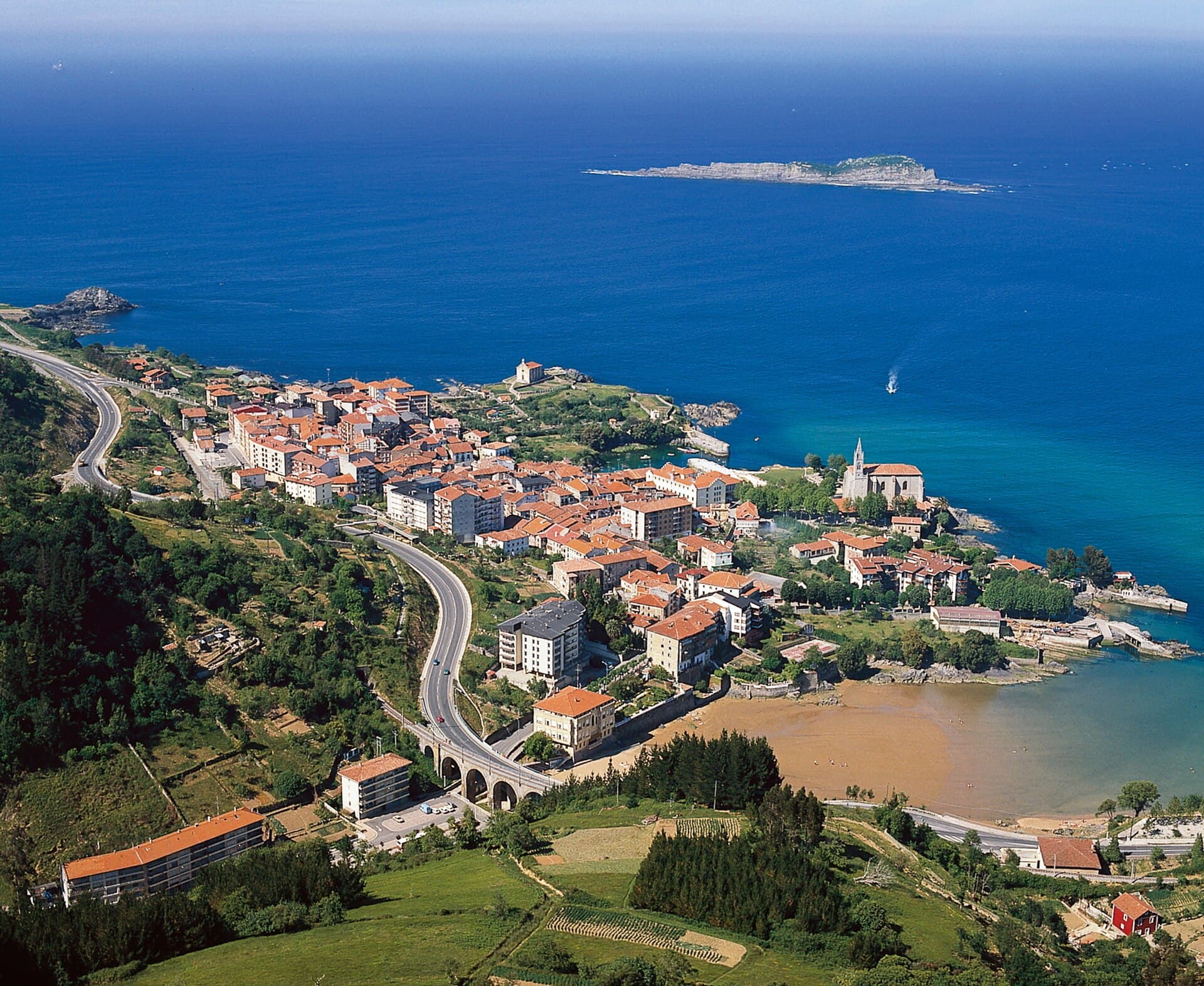
The town's compact center, with its colorful buildings and narrow streets, invites exploration on foot. Locals gather at the port, a hub of activity where fishing traditions endure alongside a relaxed, welcoming atmosphere. From its vantage point, visitors can take in views of Izaro Island and the Ogoño mount, all part of the expansive Urdaibai estuary.
Mundaka's origins are shrouded in legend, with tales suggesting its founding in the 10th century by a Scottish princess. This princess, exiled from her homeland, is said to have arrived on Mundaka's shores, naming the place 'Munda aqua' (clean water) after a pristine spring she discovered. Her son, Jaun Zuria, is then believed to have become the first Lord of Biscay. While historical verification remains elusive, this narrative underscores Mundaka's significant role in Basque history and mythology.
The town's documented history stretches back to at least 1051, with its earliest mention found in official writings from that year. Mundaka was an important location in the Lordship of Biscay, even serving as the initial meeting place for the region's main parliament, the General Parliament. Its development was historically centered around its port, with many medieval-style fishermen's houses still facing the sea. Over the centuries, Mundaka's economy was tied to fishing and maritime trade, producing notable sailors like Rodrigo de Portuondo. However, the town's small port and geographical limitations prevented industrial growth comparable to neighboring areas.
In the 19th century, Mundaka began to shift its economic focus towards tourism, a trend that continues today. The town also faced historical challenges, including occupation by French soldiers during the Peninsular War in 1811, with British ships aiding in the evacuation. The 16th-century Santa Maria Church, a blend of Gothic and Renaissance styles, stands as a testament to the town's enduring past, built on a site that has hosted a church since at least the 11th century.
Mundaka's international fame in the late 20th century largely stems from its exceptional surfing wave. Discovered by surfers in the 1960s and 70s, it quickly gained recognition as one of Europe's finest surf spots. The town's unique geography, where Atlantic swells meet a shifting sandbar at the mouth of the Oka River, creates one of the longest left-hand barrel waves in the world, capable of reaching heights of 4-5 meters and rides of up to 400 meters. This wave has attracted legendary surfers and hosted international competitions, including the Billabong Pro Mundaka, part of the ASP World Tour, from 1998 to 2009.
Mundaka's allure extends beyond its famous wave, offering a collection of sights that reflect its maritime heritage and natural setting. The Port of Mundaka is the heart of the village, a charming area surrounded by traditional, colorful Basque houses and small fishing boats. It’s a place where locals gather, and visitors can enjoy the atmosphere from one of the many bars and restaurants.
Atop a peninsula at the estuary's entrance, the Hermitage of Santa Catalina offers panoramic views of the sea. With medieval origins and rebuilt in the 19th century, its surrounding walls are remnants of an older fortress. Historically, it served as a meeting point for fishermen and a quarantine station.
The Santa Maria Church, located centrally next to the water, is a significant architectural landmark. The current 16th-century structure, featuring Gothic and Renaissance elements, stands on a site that has housed a church since the 11th century.
For those seeking natural beauty, the Urdaibai Biosphere Reserve envelops Mundaka, offering expansive views from the Ogoño Cliffs and opportunities for coastal walks. A short ferry ride in summer connects Mundaka to Laida Beach, known for its extensive sandy area. Just offshore, Izaro Island presents an emblematic silhouette, a protected ecological area and a site of historical disputes.
For general sightseeing and warm-weather activities, the best time to visit Mundaka is from late June to early September, when temperatures are comfortable, averaging highs of 70-74°F (21-23°C). July is particularly clear with less precipitation. If surfing is your primary goal, the ideal season is autumn and winter, specifically from September through December, with peak consistency in November and December. During these months, powerful Atlantic swells create the renowned left-hand wave. Be aware that while the surf can be epic, conditions are specific, and the classic wave doesn't break every day.
Mundaka is easily accessible, particularly from Bilbao. The most efficient way to reach the town is by train via the EuskoTren E4 Urdaibai line, which connects Bilbao to Bermeo with a stop in Mundaka. While bus services also run between Bilbao and Bermeo, they are less direct and travel times are longer. If driving, Mundaka is about a 40-45 minute scenic drive from downtown Bilbao. However, parking in the town center can be challenging, with many spots reserved for residents; more parking may be found near the Santa Catalina Hermitage, though it requires a walk to town.
Within Mundaka, the village is best explored on foot. For accommodation, options include surf-oriented apartments and small hotels in the village, with prices ranging from EUR 60-120 per night. Nearby Bermeo offers more restaurant choices and accommodation from EUR 40-80 per night, while Gernika, 10km inland, provides a wider range of hotels and dining. The local culinary scene is rich with Basque gastronomy, focusing on fresh seafood, regional recipes, and the local, slightly sparkling Txakoli wine. Pintxos, the Basque equivalent of tapas, are a staple in local taverns.
Mundaka in Korean, in Chinese or in Hebrew — and 29 more languages, every stop narrated by a native voice. The widest language range of any self-guided audio tour.
Available in: