Am Markt (Place du Marché)
La place principale de Pirna ressemble étonnamment à ce qu'elle était il y a des siècles, grâce à un célèbre peintre vénitien.
L'histoire complète se débloque dans le tour
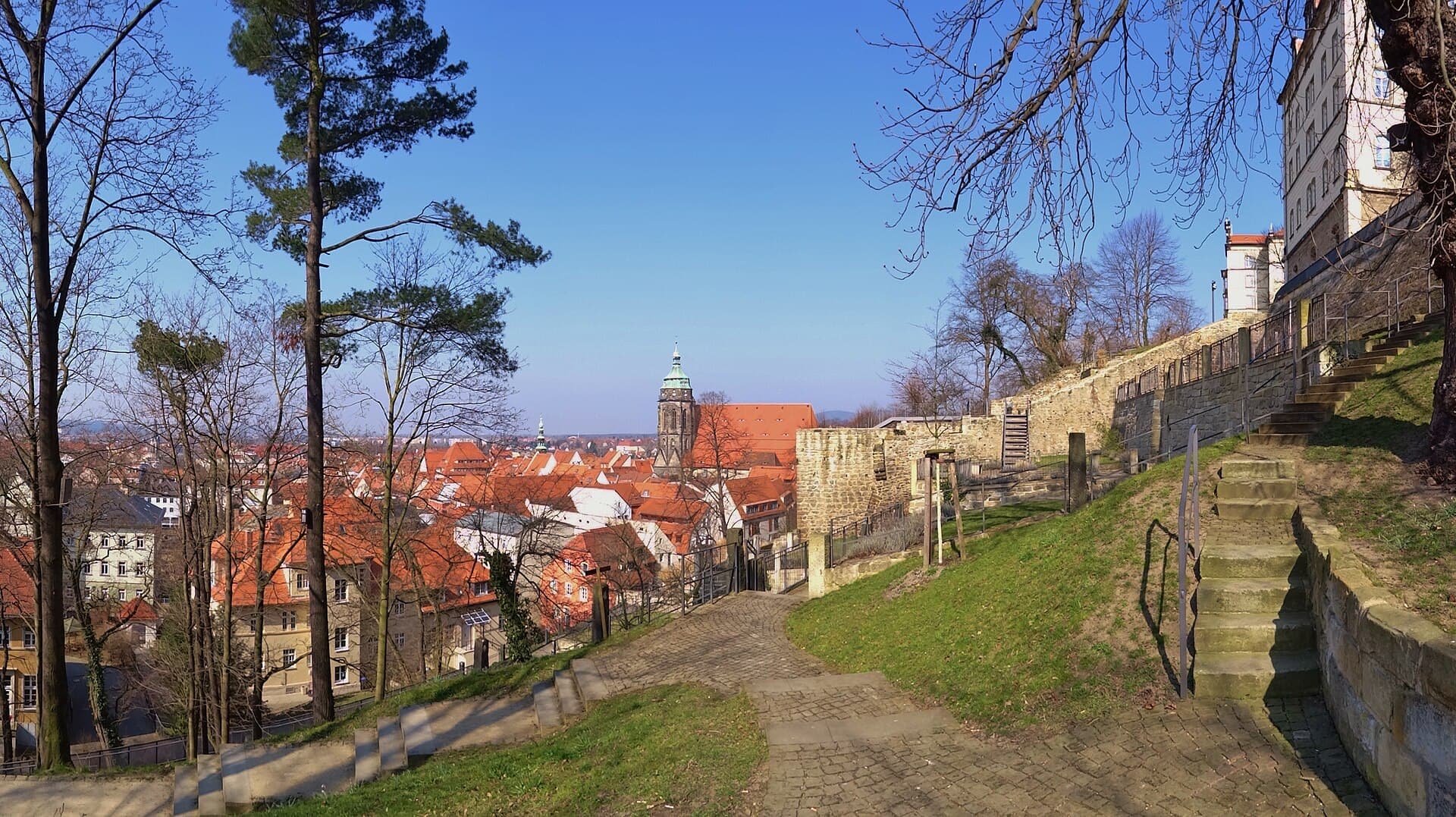 Kalispera Dell / CC BY 3.0, via Wikimedia Commons
Visite audio autoguidée de Pirna — parcours GPS à pied, lecture hors ligne, narration en 32 langues.
“Là où le grès rencontre l'Elbe, et l'histoire peint le décor.”
Pas les cartes postales. Les histoires que même les habitants ignorent — soufflées à l'oreille, là où elles se sont passées.
La place principale de Pirna ressemble étonnamment à ce qu'elle était il y a des siècles, grâce à un célèbre peintre vénitien.
Ce château, avec ses vues imprenables, recèle une histoire bien plus sombre qui a été dissimulée pendant des décennies.
Pirna se situe au début de la plus petite et la plus septentrionale région viticole d'Allemagne.
Découvrez tous les secrets de Pirna
Chaque adresse, chaque révélation en entier — dans ton oreille, là où elle s'est passée.
Tu choisis tes lieux. Tu marches. La voix te révèle ce que les autres ignorent.


Votre visite audioguidée de Pirna vous attend — choisissez vos lieux, votre langue, et lancez-vous dès votre arrivée.
AcheterLume intègre un guide en réalité augmentée. Levez votre téléphone : sa caméra montre la rue devant vous, avec une flèche lumineuse posée sur l'image réelle qui pointe toujours vers votre prochain arrêt — aucune carte à déchiffrer, aucun mauvais virage. Comme tout dans Lume, ça fonctionne entièrement hors-ligne.
Pirna, souvent surnommée la « Porte de la Suisse Saxonne », est une ville de l'État libre de Saxe, en Allemagne, située sur la rive droite de l'Elbe. À seulement 17 kilomètres au sud-est de Dresde, Pirna offre un mélange de caractère historique et de beauté naturelle. Son centre historique bien préservé, ou Altstadt, présente des maisons médiévales, des chemins pavés et des détails architecturaux tels que des oriels et des pignons.
L'emplacement de la ville dans la haute vallée de l'Elbe, où les rivières Wesenitz et Gottleuba se jettent dans l'Elbe, offre un arrière-plan pittoresque de collines verdoyantes et de formations de grès. Pirna sert de base idéale pour explorer les paysages spectaculaires du Parc National de la Suisse Saxonne, connu pour ses montagnes de grès uniques et ses sentiers de randonnée.
La réputation de beauté de Pirna remonte à des siècles, notamment capturée dans une série de peintures du XVIIIe siècle par Bernardo Bellotto, également connu sous le nom de Canaletto. Aujourd'hui, la ville conserve une grande partie de son apparence historique, invitant les visiteurs à explorer ses sites culturels, à profiter de l'hospitalité locale et à découvrir les merveilles naturelles environnantes.
L'histoire de Pirna remonte au Haut Moyen Âge, avec des preuves archéologiques suggérant l'existence d'un établissement avant même sa première mention officielle dans une charte de 1233 par le margrave Henri l'Illustre. Les linguistes pensent que le nom de la ville est d'origine slave, se traduisant par « sur la pierre dure », une description appropriée du paysage rocheux de la région.
Pirna fut fondée lors de la deuxième colonisation allemande de l'Est, avec des droits de ville accordés par Henri III au XIIIe siècle. Les rues de la ville furent tracées en damier, une approche d'urbanisme courante à l'époque. En 1293, le roi Venceslas II de Bohême acquit la ville et son château de l'évêque de Meissen, plaçant Pirna sous domination bohémienne jusqu'en 1405. Un monastère dominicain fut établi vers 1300, et en 1325, le roi Jean de Bohême renouvela les privilèges urbains de Pirna, y compris son droit d'étape, qui exigeait des marchands de proposer leurs marchandises à la vente dans la ville.
L'église Sainte-Marie de style gothique tardif, l'une des plus belles églises d'Allemagne, fut construite entre 1502 et 1546, remplaçant un bâtiment antérieur du XIIIe siècle. La Réforme atteignit Pirna en 1539. La ville connut des difficultés pendant la Guerre de Trente Ans, particulièrement en 1639 lorsque les soldats suédois la conquirent.
Une période significative pour l'héritage artistique de Pirna commença en 1753, lorsque Bernardo Bellotto, connu sous le nom de Canaletto, peignit onze grandes vedute (paysages urbains détaillés) de la ville. Ces tableaux, aujourd'hui conservés à la Galerie des Maîtres Anciens de Dresde, constituent un témoignage inestimable de l'apparence de Pirna au XVIIIe siècle.
Le XIXe siècle apporta le développement industriel, avec l'ouverture d'une manufacture d'impression de coton en 1774 et l'inauguration de la ligne de chemin de fer de Dresde à Pirna en 1848. Le château de Sonnenstein, à l'origine une forteresse, fut converti en un grand hôpital psychiatrique en 1811. Cependant, ce site allait plus tard être associé à l'une des périodes les plus sombres de l'histoire allemande. Entre 1940 et 1942, pendant la Seconde Guerre mondiale, le château de Sonnenstein fut utilisé comme centre d'extermination par les nazis dans le cadre du programme Aktion T4, où environ 13 720 personnes atteintes de maladies mentales et de handicaps furent systématiquement assassinées. Les crimes qui y furent commis ne furent largement connus qu'après la réunification de l'Allemagne en 1989, et aujourd'hui le site sert de mémorial.
Après la réunification de l'Allemagne en 1990, Pirna a connu un vaste réaménagement urbain. Un programme à grande échelle a été lancé pour restaurer la vieille ville, préservant les bâtiments historiques de la dégradation et permettant à Pirna de retrouver son statut de « Ville de Canaletto » et de destination touristique clé. La ville continue d'évoluer, conciliant son passé durable avec un présent animé et cosmopolite.
Commencez votre exploration sur la Place du Marché Historique (Am Markt) de Pirna, un lieu qui a conservé son caractère du XVIIIe siècle, rendu célèbre par Canaletto. Vous y trouverez l'Hôtel de Ville historique et la Canaletto Haus, qui abrite désormais l'office de tourisme local.
Une courte promenade depuis la place du marché mène à la Stadtkirche St. Marien (Église Sainte-Marie), une magnifique église-halle de style gothique tardif construite entre 1502 et 1546. Ses trésors architecturaux et ses hauts clochers sont une caractéristique proéminente de la ligne d'horizon de la vieille ville.
Surplombant la ville se trouve le Château de Sonnenstein (Schloss Sonnenstein), offrant des vues imprenables sur l'Elbe et le paysage environnant. Le complexe du château abrite également le Mémorial de Pirna-Sonnenstein, un site poignant documentant un chapitre sombre de l'histoire de la ville.
Pour une immersion plus profonde dans l'histoire locale, visitez le Musée de la Ville de Pirna, situé dans l'ancienne salle capitulaire du monastère dominicain. De plus, le Musée de la RDA de Pirna offre un aperçu de la vie quotidienne en Allemagne de l'Est, présentant des objets ménagers et des documents authentiques.
Pirna est également la « Porte du Parc National de la Suisse Saxonne ». Envisagez une excursion en bateau à vapeur sur l'Elbe ou un voyage en bus jusqu'au Pont de la Bastei pour des vues grandioses sur les Montagnes de Grès de l'Elbe.
La meilleure période pour visiter Pirna pour les activités par temps chaud s'étend de mi-juin à début septembre. Pendant ces mois, les températures diurnes sont agréables, allant de 19°C à 24°C (66°F à 75°F). Bien que juillet soit le mois le plus humide, avec une moyenne de 102 mm de précipitations, le temps reste généralement agréable. Le printemps et l'automne offrent des températures plus douces et la beauté de la nature en fleurs ou des feuillages changeants. Pour moins de foule et une meilleure vue sur l'architecture historique, envisagez de visiter en semaine, surtout à la fin du printemps ou au début de l'automne.
Pirna est facilement accessible, principalement via Dresde. Les principaux aéroports les plus proches sont Dresde (DRS), à environ 23 km, Prague (PRG) à environ 99 km, et Berlin Brandenburg (BER) à environ 159 km. Depuis la gare centrale de Dresde (Hauptbahnhof), le train S-Bahn S1, qui passe toutes les demi-heures, offre une connexion pratique vers Pirna. Des bus relient également Pirna à Dresde et aux villes environnantes, y compris le Parc National de la Suisse Saxonne.
Une fois à Pirna, la plupart des attractions de la vieille ville historique sont accessibles à pied. Des chaussures confortables sont recommandées, car le centre historique est pavé. Pour explorer au-delà de la ville, les transports en commun font partie de l'Association des Transports de la Haute Elbe (VVO), offrant un système unifié de billets et de tarifs pour les bus et les trains. Des options d'hébergement, y compris des maisons de ville historiques et des maisons d'hôtes, sont disponibles dans la vieille ville et de l'autre côté de l'Elbe.
Pirna en coréen, en chinois ou en hébreu — et dans 29 autres langues, chaque étape narrée par une voix native. La plus large gamme de langues de tous les audioguides autoguidés.
Disponible en :