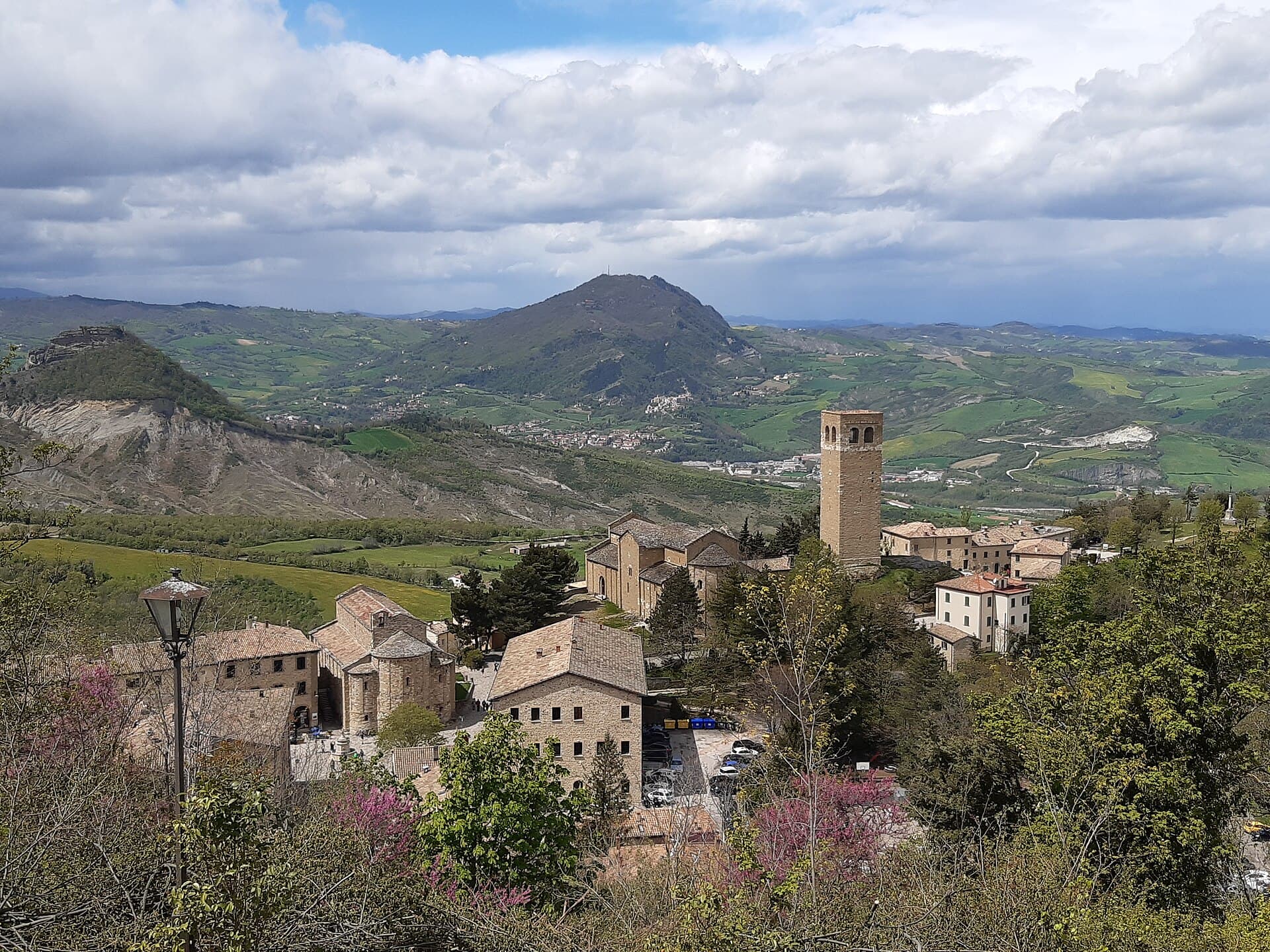
San Leo, ItalyDounamano / CC BY-SA 4.0, via Wikimedia Commons
IT

San Leo

Self-guided audio walking tour of San Leo — GPS route, offline playback, story-driven narration in 32 languages.

Where ancient stone holds fast to a cliff, and secrets echo through the ages.

The secrets of San Leo

San Leo, as no one tells it.

Not the postcards. The stories even locals don't know — whispered in your ear, right where they happened.

3 secrets below. Many more wait inside the tour.
Fortress of San Leo, Pozzetto cell

Imagine a cell so secure, it had no door. Provisions were lowered through an opening, and the prisoner observed the world through a grate. Who was deemed so dangerous, so adept at escape, that such a chamber was conceived for him?

Full story unlocks in the tour
San Leo Cathedral

Examine the columns within the Romanesque cathedral. You will discover 70 small, intricate carvings. What purpose did these detailed images serve in an era before widespread literacy?

Full story unlocks in the tour
Piazza Dante Alighieri

This central square bears the name of one of Italy's most celebrated poets. Yet, what specific, profound connection did Dante Alighieri have with San Leo, so much so that it found its way into his most renowned work?

Full story unlocks in the tour
The full tour

Discover every secret of San Leo

Every address, every reveal in full — in your ear, right where it happened.

Get the key to San Leo

You pick your stops. You walk. The voice reveals what the others miss.

Choose your time

How long do you have in San Leo?

Your self-guided audio tour of San Leo is ready — pick your landmarks, choose your language, and start the moment you arrive.

Buy
About San Leo

The story of San Leo

Rising dramatically atop a colossal rock formation, San Leo appears like a vision from a bygone era in Italy's Emilia-Romagna region. This captivating hilltop village, once called 'the most beautiful town in Italy' by Umberto Eco, stands as a testament to enduring history and striking natural beauty. Its formidable fortress, ancient churches, and labyrinthine streets invite visitors to step back in time and explore a landscape shaped by Romans, medieval lords, and even famous prisoners.

San Leo's strategic position, commanding expansive views of the Marecchia Valley and the Montefeltro region, has made it a coveted stronghold through the centuries. From its Roman origins as Mons Feretrius to its medieval prominence as the seat of the powerful Montefeltro family, the town's history is etched into its very stone. Today, San Leo offers a unique blend of cultural immersion and sweeping vistas, away from the bustling crowds of Italy's larger cities.

Whether you are drawn by the echoes of Dante, the legends of Saint Francis, or the somber secrets of Count Cagliostro, San Leo promises an unforgettable journey into Italy's profound and often mysterious past. It is a place where every paving stone and ancient wall seems to recount stories of power, faith, and intrigue, inviting you to uncover its many layers.

History

## From Roman Temple to Medieval Stronghold San Leo's history extends back to ancient Roman times, when the imposing rock it stands upon was known as Mons Feretrius. This name originated from a temple dedicated to Jupiter Feretrius, a deity honored after significant Roman victories. The region itself, Montefeltro, still carries the echo of this ancient nomenclature. In the 4th century, a Dalmatian stonemason named Leo settled here, playing a crucial role in the Christianization of the area alongside his companion Marino, who founded nearby San Marino. By the 10th century, the town officially adopted the name San Leo in his honor and became a bishopric.

## The Rise and Fall of Dynasties The true ascent of San Leo's power began in the Middle Ages when the influential Montefeltro family made it their seat. Over the centuries, the town became a prize contested by various powerful dynasties, including the Malatesta, the Medici, and the Della Rovere. In 962 AD, San Leo even briefly served as the capital of the Italian Empire under Berengar II, who sought refuge in its formidable fortress after his defeat by Emperor Otto I. The current fortress, a masterpiece of military architecture, was significantly modernized and expanded in the 15th century by Renaissance architect Francesco di Giorgio Martini, commissioned by Federico da Montefeltro, who considered it impregnable.

## Papal Prison and Famous Inmates In 1631, San Leo was absorbed into the Papal States, marking a long period of stability but also a transformation for its mighty fortress. It was converted into a maximum-security prison, a feared dungeon for the Vatican. Its most infamous inmate was the enigmatic Count Alessandro Cagliostro (born Giuseppe Balsamo), an alchemist, adventurer, and Freemason, who was imprisoned here in 1791 after being condemned for heresy. He died in his unique, doorless cell in 1795. Other notable prisoners included Felice Orsini. The fortress continued to function as a prison until 1914, after which it became a museum.

## A Modern Identity San Leo's journey continued into modern times. Until 2009, it was part of the Marche region before being reassigned to Emilia-Romagna following a referendum. Today, it proudly holds the titles of one of 'The Most Beautiful Villages in Italy' and an 'Orange Flag' by the Italian Touring Club, recognized for its preserved historical and artistic heritage. The town's profound past, intertwined with figures like Dante Alighieri and Saint Francis of Assisi, continues to captivate visitors, making San Leo a living museum of Italian history and culture.
What to see

Begin your exploration in Piazza Dante Alighieri, the heart of San Leo, where you will find a concentration of the town's most significant religious and civic buildings. Here stands the Pieve di Santa Maria Assunta, the oldest church in Montefeltro, dating back to the 9th century with roots in a 4th-century chapel. Its unique side entrance and elevated chancel are notable features. Directly opposite is the magnificent San Leo Cathedral, a 12th-century Romanesque masterpiece. Seek out the 70 small reliefs carved into its columns, designed to educate the illiterate faithful, and explore the crypt, which once held the sarcophagus of Saint Leo. Adjacent to the Cathedral is the Bell Tower, a 12th-century watchtower offering expansive views of the Marecchia Valley.

Dominating the skyline is the Fortress of San Leo, a formidable Renaissance stronghold designed by Francesco di Giorgio Martini. Explore its courtyards, armories, and the infamous prison cells, including the 'Pozzetto' where Count Cagliostro was held. The fortress also houses a museum dedicated to its military history and Cagliostro's story. Do not overlook the Palazzo Medici, a 16th-century Renaissance palace now home to the Museum of Sacred Art, showcasing artifacts from the 8th to the 18th centuries. For a moment of tranquility, visit the Convent of Sant'Igne, a Franciscan monastery situated below the fortress, linked to a legend of Saint Francis and a guiding fire.

When to visit

San Leo is a delightful destination year-round, but for the most agreeable weather and outdoor exploration, consider visiting in spring (April to June) or early autumn (September to October). During these months, the temperatures are mild, ideal for walking the town's steep streets and exploring the fortress. The 'AlchimiAlchimie Festival' in late August offers a unique blend of magic, esotericism, and science, with shows, concerts, and exhibitions. Summer (July and August) can be warm, but the evenings are often pleasant, and the longer daylight hours allow for extended sightseeing. Winter offers a quieter, more atmospheric experience, often with fewer crowds, though some services might have reduced hours.

Practical

San Leo is approximately 35 kilometers (22 miles) southwest of Rimini and about a 3-hour drive west of Florence. While public transport options from Rimini are limited, a car is highly recommended for ease of access and exploring the surrounding Montefeltro region. Parking is available at Piazza Buscarini Mario, a convenient starting point for exploring the town on foot. The town itself is best navigated on foot, with its intricate lanes and staircases. The official tourism website for San Leo provides further details on opening times and ticket information for attractions, though it may primarily be in Italian. Allow at least half a day to fully experience the fortress and the historic center, and consider staying longer to immerse yourself in the local atmosphere and cuisine. Traditional osterias and pizzerias offer homemade dishes, and you might even sample a digestive liquor rumored to have been invented by Count Cagliostro.

Good to know
What is San Leo most known for?
San Leo is most known for its imposing clifftop fortress, which served as a maximum-security prison for the Papal States and was the final confinement place of the enigmatic Count Alessandro Cagliostro.
Can I visit Cagliostro's cell in the fortress?
Yes, visitors to the Fortress of San Leo can explore the prison cells, including the infamous 'Pozzetto' cell where Count Cagliostro was held.
Is San Leo suitable for a day trip?
San Leo is an excellent destination for a day trip, offering a profound historical experience, striking architecture, and expansive views. It can be easily reached from northern Marche or Rimini.
What are the main architectural styles found in San Leo?
San Leo showcases a blend of Romanesque and Renaissance architectural styles, particularly evident in its churches, such as the Pieve di Santa Maria Assunta and the Cathedral, and the Fortress.
Is San Leo mentioned in any celebrated literary works?
Yes, San Leo is mentioned by Dante Alighieri in the fourth canto of Purgatorio in his *Divine Comedy*, symbolizing a difficult and inaccessible place.
What are some unique local events or festivals in San Leo?
San Leo hosts the 'AlchimiAlchimie Festival' at the end of August, dedicated to magic, esotericism, science, and spirituality, featuring shows, concerts, and exhibitions.
On the map
San Leo
€9.90
No booking · activate anytime · 12h to walk it
Load on Wi-Fi, then walk offline — no roaming abroad
Get the key to San Leo