Sappada's Language
In a country celebrated for its Romance languages, one Italian village holds onto a linguistic secret from a different heritage.
Full story unlocks in the tour
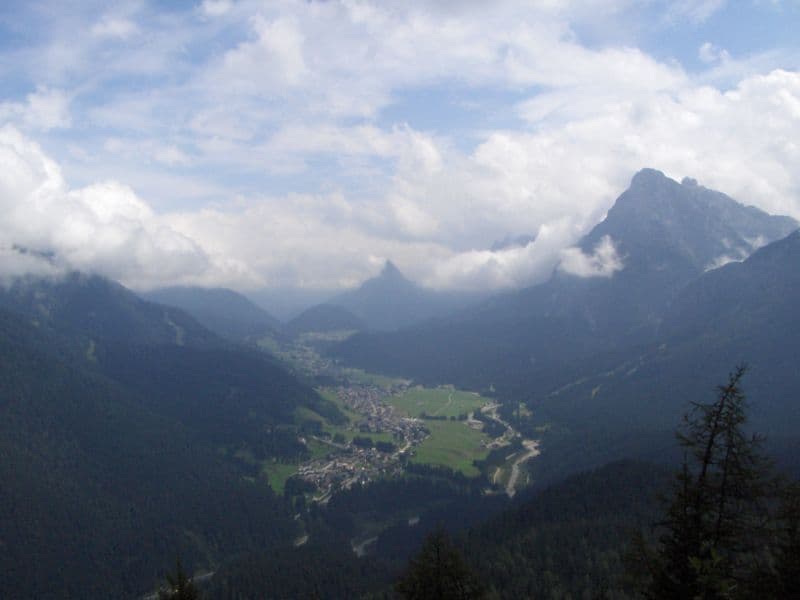 Created by User:Sebi1 / CC BY-SA 3.0, via Wikimedia Commons
Self-guided audio walking tour of Sappada — GPS route, offline playback, story-driven narration in 32 languages.
“Where Alpine tradition speaks a forgotten tongue amidst the Dolomites.”
Not the postcards. The stories even locals don't know — whispered in your ear, right where they happened.
In a country celebrated for its Romance languages, one Italian village holds onto a linguistic secret from a different heritage.
During Carnival, a mysterious, bear-like figure roams Sappada's streets, its identity fiercely guarded and its cowbells clanging a warning.
Sappada's Carnival isn't just about revelry; it's a centuries-old social commentary, playing out over three distinct Sundays.
Discover every secret of Sappada
Every address, every reveal in full — in your ear, right where it happened.
You pick your stops. You walk. The voice reveals what the others miss.


Your self-guided audio tour of Sappada is ready — pick your landmarks, choose your language, and start the moment you arrive.
BuyLume has a built-in augmented-reality guide. Hold your phone up and its camera shows the street ahead of you, with a glowing arrow laid over the real view that always points to your next stop — no map to puzzle over, no wrong turns. Like everything in Lume, it works fully offline.
In the northeastern reaches of Italy, where the Dolomites rise dramatically, lies Sappada (Plodn in its local dialect), a village that feels like a journey back in time. This mountain destination, situated in a sun-drenched, bowl-shaped valley, is celebrated for its pristine natural beauty and traditions that set it apart. Sappada is a place where Germanic and Italian cultures converge, creating a unique reality evident in its architecture, language, and centuries-old customs.
Comprising 15 distinct hamlets, each with its own character and history, Sappada stretches from Comelico to Canal di Gorto, embraced by magnificent peaks. Walking through its villages, particularly Sappada Vecchia and Cima Sappada, is like stepping into a bygone era, with well-preserved wooden houses built in the traditional 'blockbau' style. Beyond its visual charm, Sappada offers a deep array of experiences, from exploring its unique linguistic heritage to partaking in folk traditions.
Today, Sappada is a year-round tourist destination, attracting visitors with its serene atmosphere, outdoor activities, and authentic mountain culture. Whether seeking tranquility amidst striking landscapes, indulging in winter sports, or discovering the deep-rooted customs of a resilient community, Sappada provides an immersive and unforgettable experience in the heart of the Dolomites.
The history of Sappada is deeply intertwined with medieval migrations from Bavaria and eastern Tyrol. Around the year 1000, groups of families, possibly refugees fleeing oppression or settlers drawn by mineral deposits, arrived in the then-uninhabited valley. The Patriarch of Aquileia granted them permission to settle, in return for a yearly payment and obedience. These early inhabitants undertook the arduous task of deforestation and and cultivation, transforming the wilderness into the small town that stands today.
Due to its relative isolation over centuries, Sappada developed as a unique German-speaking linguistic island within Italy. The local dialect, Plodarisch or Plodar schproche, is a variety of Puster Valley Tyrolean Bavarian, closely related to the speech found in Sauris. This linguistic heritage, along with distinct customs and architecture, confirms the transalpine origins of its settlers. While Italian is the official language spoken in public life, Sappadino is still used daily by many inhabitants, particularly the older generations, and efforts are made to preserve it.
Sappada's administrative affiliation has seen several changes throughout history. Initially part of the historic Cadore region, it was ceded to the Bavarian Bishops of Freising in 973 and later given to the Patriarchs of Aquileia in 1077. By 1420, it was incorporated into Venice's mainland territories. In 1852, Sappada was annexed to the province of Belluno, and then to the Kingdom of Italy in 1866. However, feeling a stronger cultural and historical bond with Friuli Venezia Giulia than Veneto, the municipality formally requested to join the former in 2008. This request was approved by the Italian Parliament in 2017, and Sappada officially became part of Friuli Venezia Giulia in 2018.
During the First World War, Sappada maintained positions on the front, and local women, known as 'Carnic carriers,' played a crucial role in supplying soldiers. In more recent history, Sappada has distinguished itself as Italy's first Sustainable Municipality, an award received in 2018 for its commitment to preserving natural and cultural resources. This recognition highlights the village's dedication to sustainable development and its efforts to manage its attractiveness and environment for future generations.
Sappada is a collection of 15 charming hamlets, each offering a glimpse into its unique heritage. Begin your exploration in Sappada Vecchia and Cima Sappada, where you'll find some of the best-preserved examples of traditional wooden 'blockbau' houses, some dating back to the 17th century. These distinctive structures, with their stacked beams and shingled roofs, offer a tangible connection to the village's Germanic roots.
Delve into the local culture at the Giuseppe Fontana Ethnographic Museum in Borgata Cima, which chronicles the history of work and daily life in the valley. Nearby, the House Museum of Peasant Civilization in Borgata Cretta, a mid-19th-century wooden house, reconstructs the living spaces of past generations, offering a fascinating insight into rural life. For those interested in military history, the Small Museum of the Great War in Borgata Mühlbach houses artifacts, uniforms, and tools from Italian and Austrian soldiers of World War I.
Nature lovers will find plenty to explore. Follow the Mühlbach Stream to an old water-powered mill, a serene spot for reflection. Hike to the source of the Piave River at the foot of Monte Peralba, a site of national significance, and enjoy refreshments at Rifugio Sorgenti del Piave. For panoramic views, take the chairlift to Rifugio 2000 and embark on excursions to the Olbe Lakes, situated on a vast plateau. Do not miss the Acquatona waterfalls, a dramatic cascade where the Rio Acquatona plunges 50 meters into a gorge, accessible via 190 steps.
Sappada is a year-round destination, each season offering distinct experiences. Summer (July and August) provides the most favorable weather, with pleasant daytime temperatures averaging 21°C (70°F) and around 8 hours of daily sunshine, ideal for hiking, mountain biking, and exploring the lush landscapes. The chairlifts are also open during these months, facilitating access to higher altitudes.
Winter transforms Sappada into a snowy paradise, perfect for skiing, snowboarding, cross-country skiing, ice climbing, and snowshoeing. January is the coldest month, with temperatures dropping to 0°C (31°F) during the day and -9°C (16°F) at night. The Sappada Carnival (Vosenòcht), a cultural event, typically takes place between February and March. April is a good time to visit, with cool temperatures ranging from 0-10°C (33-50°F), offering a blend of spring and lingering winter activities.
Sappada is located in the Regional decentralization entity of Udine, in the Italian region of Friuli-Venezia Giulia. While having a car offers flexibility for exploring the broader Dolomites region, Sappada is accessible by public transportation. You can take a train to Calalzo di Cadore or Carnia, then connect via bus, which typically takes about an hour. Flying into Trieste Airport (a less than two-hour drive) or Venice Marco Polo Airport (approximately two and a half hours) are convenient options for international travelers.
Accommodation options range from charming chalet hotels and B&Bs to rustic chalets and glamping sites, catering to various preferences and budgets. Many establishments offer modern amenities and spas. Sappada is known for its high-quality services and acclaimed restaurants, some even Michelin-recognized, serving regional cuisine with a contemporary twist. Local products like ricotta cheese and ham make for delicious souvenirs. The village is generally well-maintained and offers a relaxed atmosphere.
Sappada in Korean, in Chinese or in Hebrew — and 29 more languages, every stop narrated by a native voice. The widest language range of any self-guided audio tour.
Available in: