Porta Verona
Observe closely above the main gate as you step into Soave. What hangs there, and for what purpose?
Full story unlocks in the tour
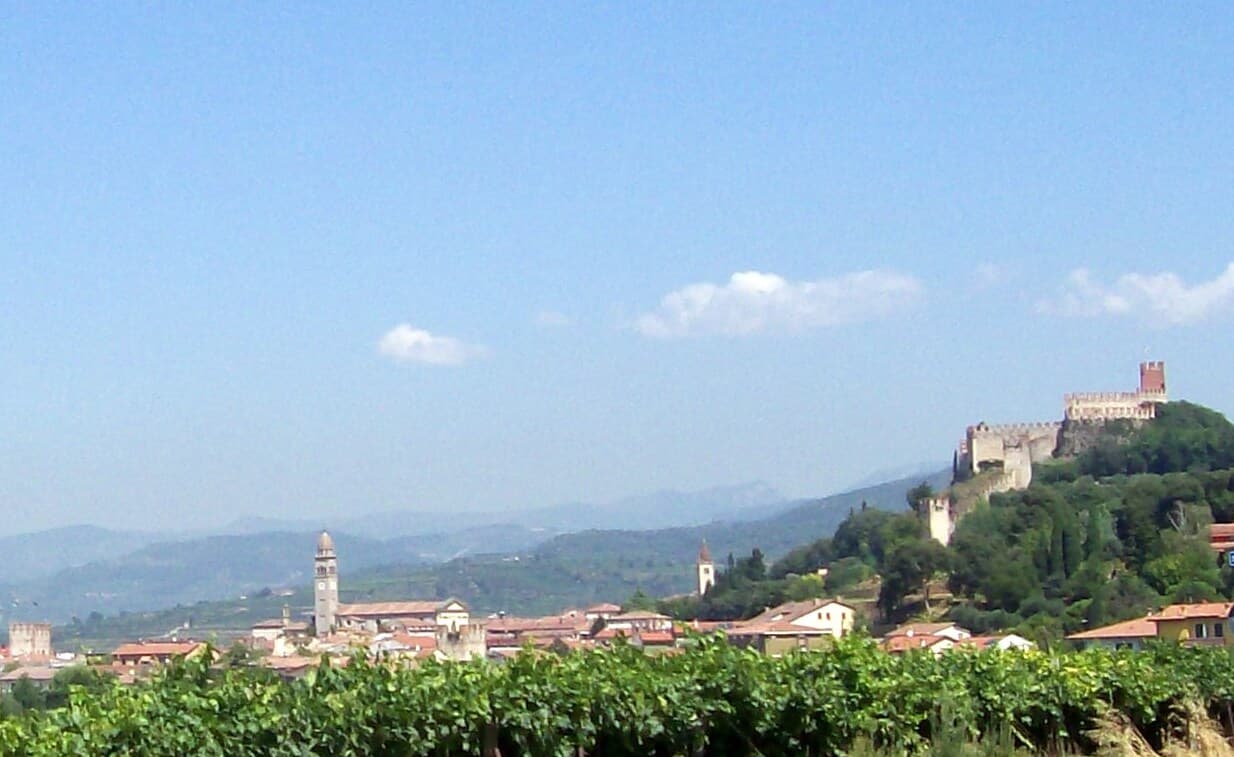 MZ14 / cc0, via Wikimedia Commons
Self-guided audio walking tour of Soave — GPS route, offline playback, story-driven narration in 32 languages.
“Beyond the celebrated white wine, a medieval village awaits, embraced by ancient walls and the echoes of history.”
Not the postcards. The stories even locals don't know — whispered in your ear, right where they happened.
Observe closely above the main gate as you step into Soave. What hangs there, and for what purpose?
This medieval structure in Piazza Antenna serves a surprising dual purpose in the present day.
Is the town's name a pleasant description or a historical echo of a Germanic tribe?
Discover every secret of Soave
Every address, every reveal in full — in your ear, right where it happened.
You pick your stops. You walk. The voice reveals what the others miss.


Your self-guided audio tour of Soave is ready — pick your landmarks, choose your language, and start the moment you arrive.
BuyLume has a built-in augmented-reality guide. Hold your phone up and its camera shows the street ahead of you, with a glowing arrow laid over the real view that always points to your next stop — no map to puzzle over, no wrong turns. Like everything in Lume, it works fully offline.
Soave, a captivating medieval village in Italy's Veneto region, offers a journey through time where ancient walls embrace a lively present. Known globally for its crisp white wine, the town itself is a beautifully preserved historical treasure, recently acknowledged as one of Italy's most beautiful small towns.
Beyond its viticultural renown, Soave invites exploration of its winding streets, impressive Scaliger Castle, and expansive views of rolling vineyards. A short distance from Verona, it provides a tranquil escape, blending profound history with the unhurried rhythm of Italian rural life.
## From Roman Outpost to Medieval Stronghold Soave's origins extend to Roman times, serving as a strategic point along the Via Postumia, a significant road connecting Aquileia to Genoa. While its name might derive from the Latin 'suavis' (gentle) or the Germanic Suebi tribe who settled here around the 6th century, its importance grew considerably in the Middle Ages.
## The Scaliger Dynasty and the Castle The imposing Scaliger Castle, a defining feature of Soave, was first mentioned in 934 during the Magyar invasions. It is believed to have been constructed on the site of an earlier Roman fort. The castle, a typical medieval military edifice, was significantly fortified and expanded in the 13th century under the powerful Scaliger (Della Scala) family, who governed Verona and its surrounding territories. The impressive city walls, with their 24 observation towers, were a later addition, commissioned by Cansignorio della Scala in 1375. These fortifications still encircle the historic core, making Soave one of Italy's most well-preserved medieval villages.
## Venetian Rule and Decline Following the Scaliger dynasty, Soave came under the control of the Visconti of Milan, then the Carraresi from Padua, before entering a more stable period under the Venetian Republic, the Serenissima. During this era, the castle saw further expansion, including an outer courtyard added by the Venetians in the 15th century. However, after the decline of the Venetian Republic and periods of French and Austrian rule, the castle eventually fell into disrepair.
## Modern Revival In 1889, Giulio Camuzzoni, Verona's first mayor after Italy's unification, acquired the dilapidated castle and embarked on a passionate and extensive restoration project, returning it to its former grandeur. This dedication helped preserve Soave's medieval character, which continues to charm visitors today. In recent years, the town's beauty has been officially recognized, earning it the title of one of Italy's most beautiful small towns in the esteemed Borgo dei Borghi competition.
Begin your exploration at the iconic Scaliger Castle, which grandly overlooks the town from Monte Tenda. Wander through its well-preserved courtyards, including the "della Madonna" with its 14th-century fresco, and ascend to the keep for expansive views of the vineyards and the Padana plain.
Descend into the walled town through Porta Verona, the main gate, and stroll along Via Roma and Camuzzoni Street, the ancient Roman cardo. Here, you will encounter historical buildings such as the Palazzo di Giustizia (Courthouse), a Gothic structure now partly housing a wine bar, and the Palazzo Cavalli, in Venetian Gothic style.
The Cathedral of San Lorenzo Martire, with its neoclassical façade, is a notable religious site. Do not miss the opportunity to visit one of the many wineries in and around Soave for a tasting of the celebrated white wine, or explore the surrounding vineyard-covered hills by foot or e-bike.
Soave is delightful from May to October, offering pleasant temperatures for exploring. September and October are particularly agreeable, as the vineyards transform with autumnal colors, and the Festa dell'Uva (Grape Festival) occurs in mid-September. May also hosts the Medieval Soave DOC White Wine Festival. Consider avoiding July and August if you prefer to escape the summer warmth and humidity.
Soave is conveniently situated about 10 miles (16 kilometers) from Verona and is easily accessible via the A4 motorway. Renting a car offers the most flexibility for exploring the surrounding countryside and wineries. If traveling by train, disembark at San Bonifacio station, approximately 7 kilometers from Soave, and then take a local bus (Line 130 or 226) or a taxi. The town center is compact and very walkable. Many wineries recommend booking tastings in advance. While English is often spoken in tourist areas, a few Italian phrases can enrich your experience.
Soave in Korean, in Chinese or in Hebrew — and 29 more languages, every stop narrated by a native voice. The widest language range of any self-guided audio tour.
Available in: