The "Old Mint" Museum (Alte Münze)
This museum offers a surprising glimpse into a specific period of Stolberg's economic power.
Full story unlocks in the tour
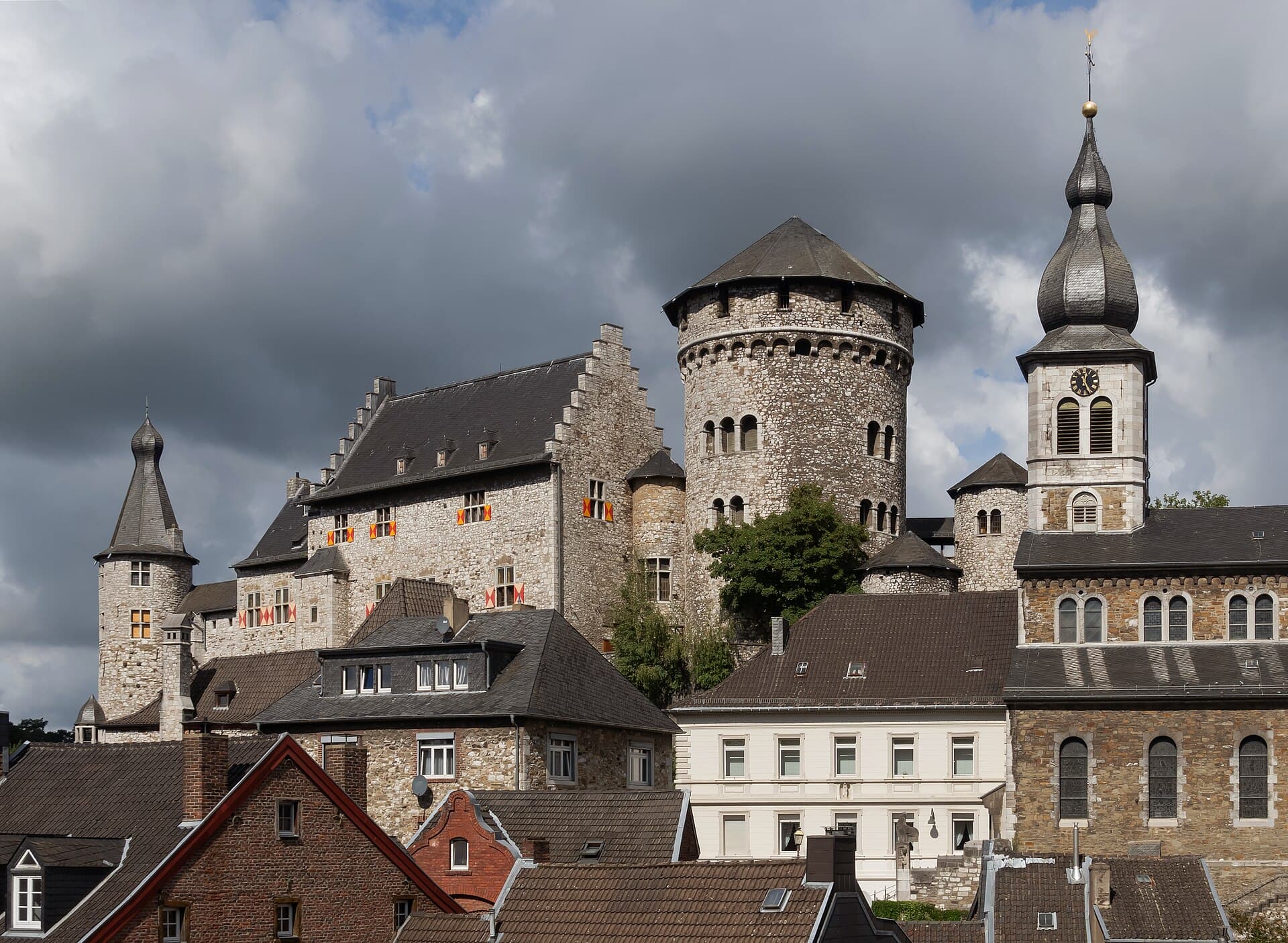 Michielverbeek / CC BY-SA 4.0, via Wikimedia Commons
Self-guided audio walking tour of Stolberg — GPS route, offline playback, story-driven narration in 32 languages.
“Where half-timbered houses recount centuries of copper, counts, and dramatic change.”
Not the postcards. The stories even locals don't know — whispered in your ear, right where they happened.
This museum offers a surprising glimpse into a specific period of Stolberg's economic power.
Beneath a seemingly ordinary hill, a geological anomaly laid the groundwork for Stolberg's industrial ascent and fostered a rare botanical spectacle.
The town carries the moniker 'Die Kupferstadt' (the Copper City), though the name holds a nuanced meaning.
Discover every secret of Stolberg
Every address, every reveal in full — in your ear, right where it happened.
You pick your stops. You walk. The voice reveals what the others miss.


Your self-guided audio tour of Stolberg is ready — pick your landmarks, choose your language, and start the moment you arrive.
BuyLume has a built-in augmented-reality guide. Hold your phone up and its camera shows the street ahead of you, with a glowing arrow laid over the real view that always points to your next stop — no map to puzzle over, no wrong turns. Like everything in Lume, it works fully offline.
Stolberg, a historic European city in Germany's Harz Mountains, presents a remarkably cohesive townscape of medieval half-timbered houses, many dating back four centuries. Situated across four narrow valleys, the town's architecture evokes a journey back to the Middle Ages, with over 380 beautifully restored half-timbered buildings. This evocative setting, combined with its status as a climatic health resort, makes Stolberg a destination for those seeking both historical charm and natural beauty.
The town's dramatic vertical composition is crowned by the commanding Stolberg Castle, which has watched over the winding streets and the gentle River Thyra for centuries. Beyond its visual appeal, Stolberg holds a significant place on the German Half-Timbered Houses Route and has been recognized as a "Historic European City" since 1993, reflecting its well-preserved cultural and urban heritage.
## From Mining Settlement to Brass Capital Stolberg's origins trace back to a mining settlement established around the year 1000, though evidence of mining activities in the area dates as far back as 794. The town's name, derived from the German words "Stollen" (mining gallery) and "Berg" (hill), directly reflects its deep connection to the extraction of iron, copper, silver, tin, and gold. Stolberg received its town status before 1300 and first appeared in historical documents in 1170.
## The Rise of the Counts and the Castle From 1201, the settlement became intrinsically linked with the noble House of Stolberg, serving as their residence and family seat. Stolberg Castle, with its oldest round tower dating to around 1200, began to dominate the town's skyline and its destiny. The 16th century brought both triumphs and turmoil, including the birth of radical Reformation leader Thomas Müntzer in Stolberg, a key figure in early 16th-century religious and social upheavals. The town was also where Countess Juliana of Stolberg, ancestress of the Dutch royal family, had her ancestral roots.
## The "Copper City" and Industrial Innovation Stolberg evolved into an important center for brass production around 1600, when Protestant brass producers from Aachen sought refuge from religious persecution and economic restrictions. This led to Stolberg earning the nickname "Die Kupferstadt" (the Copper City), a name derived from brass, or "yellow copper." The wealth generated by the copper masters is still visible in the 18 city palaces, known as Kupferhöfe (copper yards), they built between the 17th and 18th centuries. Stolberg's industrial prowess continued, with the town becoming a hub for various industries, including the invention of the press stud and the introduction of penicillin to the German market after World War II.
## Modern Challenges and Preservation By the 19th and 20th centuries, Stolberg transitioned from a mining community to a recognized health resort by 1946. However, the town faced a significant challenge in July 2021 when it was severely impacted by a "flood of the century," causing extensive damage to hundreds of buildings in the historic center. Despite this, the town is committed to rebuilding and preserving its cultural heritage, with ongoing efforts to restore affected areas.
Stolberg's allure lies in its preserved medieval character and the stories etched into its architecture. Begin at the Marktplatz, the central square, where you can admire the ensemble of half-timbered houses. From here, the commanding Stolberg Castle (Schloss Stolberg) draws the eye. This 13th-century fortress, once home to the Counts and Princes of Stolberg, now houses a museum offering insights into noble life and features a Baroque altar in its restored palace church. Even without entering, the climb to the castle provides sweeping views of the town and surrounding Harz forests.
Explore the Historic Half-Timbered Old Town, a cohesive collection of nearly 400 buildings spanning centuries, with streetscapes reflecting late Gothic and Renaissance styles. Seek out the "Old Mint" Museum (Alte Münze), a 16th-century mint workshop that offers a unique glimpse into the town's coining history. Another significant historical building is the Kleines Bürgerhaus at 14 Rittergasse, dating from the 15th century, now open as a museum. For a broader perspective, ascend the 580-meter-high Auerberg to the Joseph's Cross, the world's largest iron double cross, offering expansive views from the Kyffhäuser to the Brocken mountains. The Kupferhöfe (Copper Yards), former brass production sites and mansions of wealthy manufacturers, serve as reminders of Stolberg's industrial past.
The most pleasant time to visit Stolberg for outdoor activities and general sightseeing is from early July to late August. During these months, temperatures are comfortable, typically ranging between 65°F and 80°F, with July being the clearest month for skies. While June also offers good weather, July and August are ideal for maximizing dry, warm days. The town experiences warm summers and cold winters, with December being the cloudiest month.
Stolberg is situated in the Harz Mountains, making it a good base for hiking and exploring the natural surroundings. The town itself is compact, with its historic center easily explored on foot. When searching for accommodations, it's advisable to specify "Stolberg (Harz)" to differentiate it from another German town with the same name. Hotels, particularly near the central market square, offer convenient access to sights. Parking is often available for guests at hotels. While Stolberg experienced significant flooding in 2021, efforts are underway for reconstruction and preservation. The town is well-connected to nearby cities like Aachen, Liège, and Maastricht, making it accessible for regional travel.
Stolberg in Korean, in Chinese or in Hebrew — and 29 more languages, every stop narrated by a native voice. The widest language range of any self-guided audio tour.
Available in: