La Motte de Vesoul
The iconic hill overlooking Vesoul holds a secret beyond its panoramic views and the Chapel of Notre-Dame-de-la-Motte.
Full story unlocks in the tour
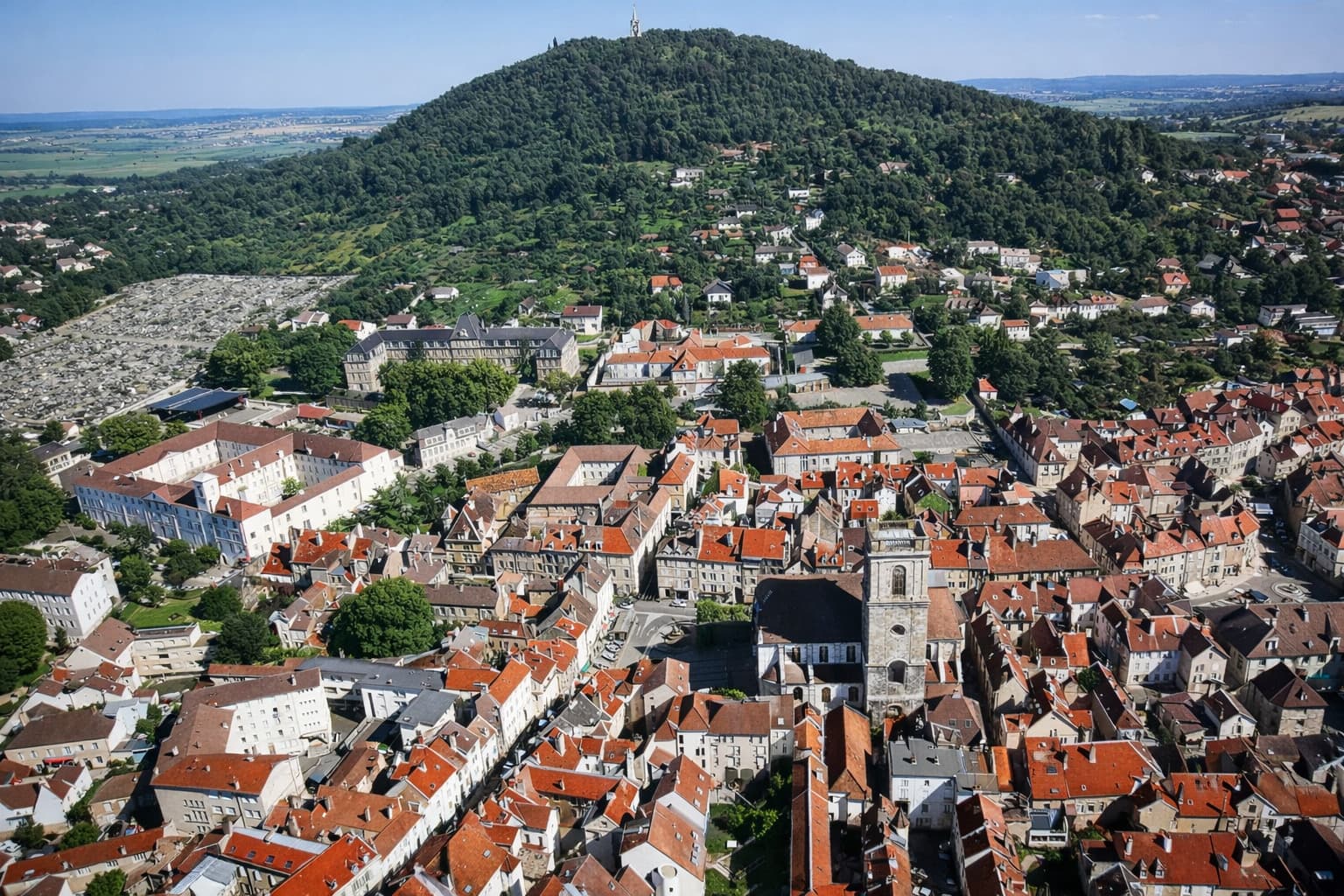 Bhuoc9 / CC BY-SA 4.0, via Wikimedia Commons
Self-guided audio walking tour of Vesoul — GPS route, offline playback, story-driven narration in 32 languages.
“Where history echoes and Brel's melody lingers.”
Not the postcards. The stories even locals don't know — whispered in your ear, right where they happened.
The iconic hill overlooking Vesoul holds a secret beyond its panoramic views and the Chapel of Notre-Dame-de-la-Motte.
Wandering the medieval streets of Vesoul, you might notice a certain architectural consistency, hinting at a guiding philosophy.
This unassuming street is the birthplace of a local artist whose work unexpectedly influenced some of the biggest names in American and Italian cinema.
Discover every secret of Vesoul
Every address, every reveal in full — in your ear, right where it happened.
You pick your stops. You walk. The voice reveals what the others miss.

Your self-guided audio tour of Vesoul is ready — pick your landmarks, choose your language, and start the moment you arrive.
BuyLume has a built-in augmented-reality guide. Hold your phone up and its camera shows the street ahead of you, with a glowing arrow laid over the real view that always points to your next stop — no map to puzzle over, no wrong turns. Like everything in Lume, it works fully offline.
Vesoul, a city in eastern France, serves as the administrative center for the Haute-Saône department. Its name, derived from 'Vesulium' (meaning 'small mountain' in Gallo-Roman), aptly describes its setting around La Motte, a hill that rises prominently from the surrounding landscape. The city's identity is deeply intertwined with its geography, with the Durgeon River flowing nearby and the Saône not far off.
Over centuries, Vesoul has evolved from a fortified medieval settlement to a regional hub. The city's architecture reflects its journey, with older structures telling tales of resilience and adaptation. While it maintains a calm, provincial atmosphere, Vesoul offers a genuine glimpse into French life, away from the more frequented tourist paths. It's a place where the rhythms of daily life unfold with a quiet grace, inviting visitors to slow down and observe.
The area around Vesoul has seen human activity since ancient times. Archaeological evidence suggests early settlements, likely drawn to the defensible position of La Motte. During the Roman era, the region was part of Gaul, and while Vesoul itself wasn't a major Roman city, its strategic location meant it was influenced by Roman infrastructure and culture. The name 'Vesulium' itself points to this period, suggesting a connection to the landscape.
The Middle Ages were a period of significant development and upheaval for Vesoul. The city grew around the base of La Motte, becoming a fortified stronghold. Its strategic position made it a coveted prize, leading to numerous sieges and destructions. Before the 16th century, the city was repeatedly ravaged by conflicts. This history of rebuilding led to a pragmatic approach to architecture, favoring sturdy, unpretentious designs over elaborate ornamentation, a principle embodied in the city's motto, 'moderata durant' (what is moderate lasts).
By the Renaissance, Vesoul began to stabilize and flourish. The city's administrative role grew, and its economy diversified. The 18th century saw the erection of a large wooden cross on La Motte, not purely for religious reasons, but as a practical measure to protect vineyards from lightning. The 19th and 20th centuries brought further modernization, with the arrival of the railway and industrial development. Today, Vesoul retains its character as a regional center, balancing its historical foundations with contemporary life. The city honors its past while looking towards the future, maintaining a distinct identity shaped by centuries of resilience and evolution.
Explore Vieux Vesoul, the Old Town, where narrow lanes wind past buildings that speak of centuries past. The sober, enduring architecture reflects the city's historical commitment to solid construction. Ascend La Motte de Vesoul for sweeping views of the city and the surrounding landscape. At its summit, the Chapel of Notre-Dame-de-la-Motte offers a tranquil space. Discover the Musée Georges-Garret, which houses a collection of fine arts, archaeology, and local history, providing insight into the region's heritage. The Place de la République, a central square, provides a lively spot to observe daily life. For a moment of quiet contemplation, the banks of the Durgeon River offer pleasant walks.
The spring months (April to June) bring mild temperatures and blooming flora, making it ideal for exploring the city's outdoor spaces. Autumn (September to October) offers pleasant weather and fewer crowds, with the changing leaves adding a touch of color to the landscape. Summer (July and August) is warm and lively, while winter (November to March) can be chilly but offers a quiet charm.
Vesoul is accessible by train, with regular services connecting it to larger cities like Besançon and Paris. The city center is compact and walkable, making it easy to explore on foot. Local bus services are available for longer distances. Accommodation options include hotels, guesthouses, and self-catering apartments. Dining ranges from traditional French cuisine to more casual eateries. Many establishments observe a midday closing, so plan your meals accordingly. A basic understanding of French will enhance your experience, though many in the tourism sector may speak English.
Vesoul in Korean, in Chinese or in Hebrew — and 29 more languages, every stop narrated by a native voice. The widest language range of any self-guided audio tour.
Available in: