Underground Zeitz
Beneath the charming streets of Zeitz lies a vast, subterranean world. What purpose did these extensive passages serve for centuries?
Full story unlocks in the tour
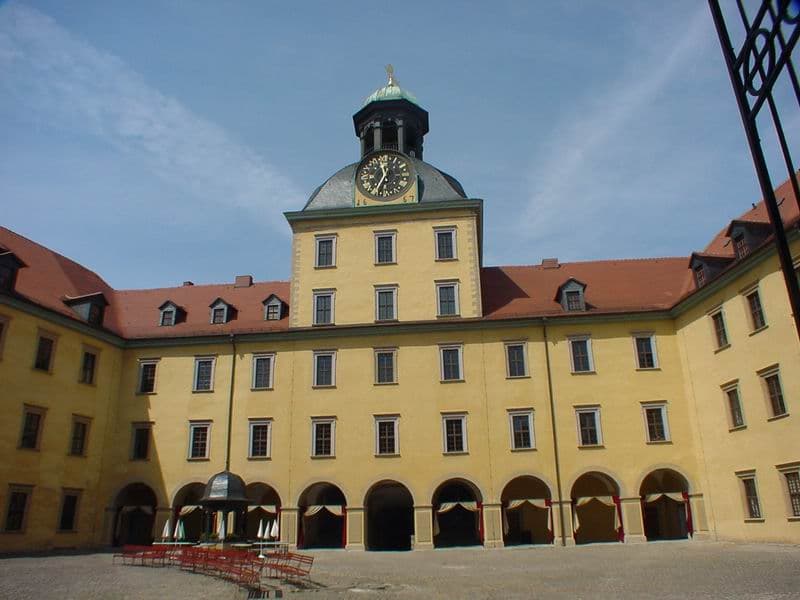 Mewes at German Wikipedia / Public domain, via Wikimedia Commons
Self-guided audio walking tour of Zeitz — GPS route, offline playback, story-driven narration in 32 languages.
“Where centuries of stories echo beneath baroque facades.”
Not the postcards. The stories even locals don't know — whispered in your ear, right where they happened.
Beneath the charming streets of Zeitz lies a vast, subterranean world. What purpose did these extensive passages serve for centuries?
This impressive Baroque castle holds a surprising collection that might evoke childhood memories.
A pivotal moment in the Reformation is linked to this church, thanks to a rare discovery made within its library.
Discover every secret of Zeitz
Every address, every reveal in full — in your ear, right where it happened.
You pick your stops. You walk. The voice reveals what the others miss.

Your self-guided audio tour of Zeitz is ready — pick your landmarks, choose your language, and start the moment you arrive.
BuyLume has a built-in augmented-reality guide. Hold your phone up and its camera shows the street ahead of you, with a glowing arrow laid over the real view that always points to your next stop — no map to puzzle over, no wrong turns. Like everything in Lume, it works fully offline.
Zeitz, a city in Saxony-Anhalt, Germany, is situated on the White Elster River, approximately 40 kilometers south of Leipzig. First documented as "Cici" in 967, Zeitz carries a history that intertwines medieval ecclesiastical power, ducal residences, and industrial innovation.
Often unfairly portrayed in media, Zeitz reveals a rich array of architectural styles, from half-timbered houses and Romanesque structures to Gothic, Renaissance, and Baroque buildings. The city's significant past as a bishop's see and later as the capital of the Duchy of Saxe-Zeitz (1652-1718) is evident in its well-preserved landmarks.
Beyond its historical facades, Zeitz offers a unique blend of cultural experiences and a surprising subterranean world, inviting visitors to delve deeper than the surface suggests.
## From Bishopric to Industrial Hub Zeitz's origins trace back to its first documented mention in 967 as "Cici." In 968, Emperor Otto I established the Bishopric of Zeitz to advance Christian missions in the east, making the city a significant spiritual and administrative center. The bishops resided in Zeitz from 968 to 1028, and again from the late 13th century onwards. The imposing St. Michael's Church and remnants of medieval fortifications still stand as testaments to this era.
After the dissolution of the bishopric in 1564, Zeitz gained new prominence from 1652 to 1718 as the seat of government for the Duchy of Saxe-Zeitz. Duke Moritz of Saxony-Zeitz had the magnificent Moritzburg Castle built on the foundations of the former bishop's castle, leading to the construction of several beautiful baroque buildings throughout the town.
The 19th century marked a radical transformation as Zeitz embraced the Industrial Revolution, becoming a modern industrial city. It gained worldwide recognition for its manufacturing of baby carriages, pianos, and chemical products, as well as advancements in mechanical engineering. Notable companies like ZEMAG (Zeitzer Eisengießerei und Maschinenfabrik AG) and the Zeitz sugar factory were established during this period.
The 20th century presented new challenges, including world wars and political shifts. During the GDR era, Zeitz remained an important industrial location, particularly in chemical and brown coal processing, though its historic architecture suffered from neglect. Following German reunification in 1989, the city underwent significant structural changes, leading to the loss of many industrial cores. However, efforts have been made to preserve its cultural heritage and adapt to new economic realities, with the Chemical and Industrial Park Zeitz now focusing on sustainable chemistry.
Begin your exploration at the Altmarkt, the historic market square that has existed since the 12th century. Here, you'll find the Gewandhaus, a 15th-century building that now houses the Tourist Information Center and features a carillon. Seek out the whimsical 'Mice-Bench' nearby.
Dominating the skyline is Moritzburg Castle, an early Baroque residence built between 1657 and 1678. Explore its opulent rooms and discover the unique German Stroller Museum within its walls. Adjacent to the castle is the Zeitz Cathedral of St. Peter and Paul, a Gothic church with Romanesque elements. Its crypt dates back to the 11th century and houses the tombs of the Dukes of Saxe-Zeitz and Georgius Agricola.
Another significant religious site is St. Michael's Church, one of Zeitz's oldest architectural monuments, with its first mention dating to 1154. Admire its Romanesque origins, Gothic transformations, and distinctive Baroque towers.
For a truly unique experience, descend into Underground Zeitz, a fascinating network of medieval cellars and passages, originally used for beer storage. Guided tours offer a glimpse into this concealed world beneath the city.
Beyond the city center, consider visiting the Herrmannschacht briquette factory, one of the world's oldest brown coal briquette factories, offering a tangible connection to Zeitz's industrial past.
The best time to visit Zeitz is generally from May through September, when the weather is pleasant for exploring the city and its outdoor attractions. For those interested in the region's viticulture and beautiful autumn foliage, September and October offer a particularly appealing experience. Spring (April-May) and autumn (September-October) also provide milder weather and fewer crowds compared to the peak summer months.
Zeitz is conveniently accessible by train, with the Elstertalbahn connecting it to Leipzig and Gera. A branch line also links Zeitz with Weißenfels. The Zeitz railway station is located north of the city center. Several federal highways intersect in Zeitz, providing good car access, including connections to the Berlin-Munich autobahn. For getting around within the city, local bus and train services are available. The Tourist Information Centre is located in the historic Gewandhaus on the Altmarkt, offering assistance and information for visitors. Many attractions, such as Zeitz Cathedral, offer accessibility for visitors with limited mobility.
Zeitz in Korean, in Chinese or in Hebrew — and 29 more languages, every stop narrated by a native voice. The widest language range of any self-guided audio tour.
Available in: