Gare d'Albury
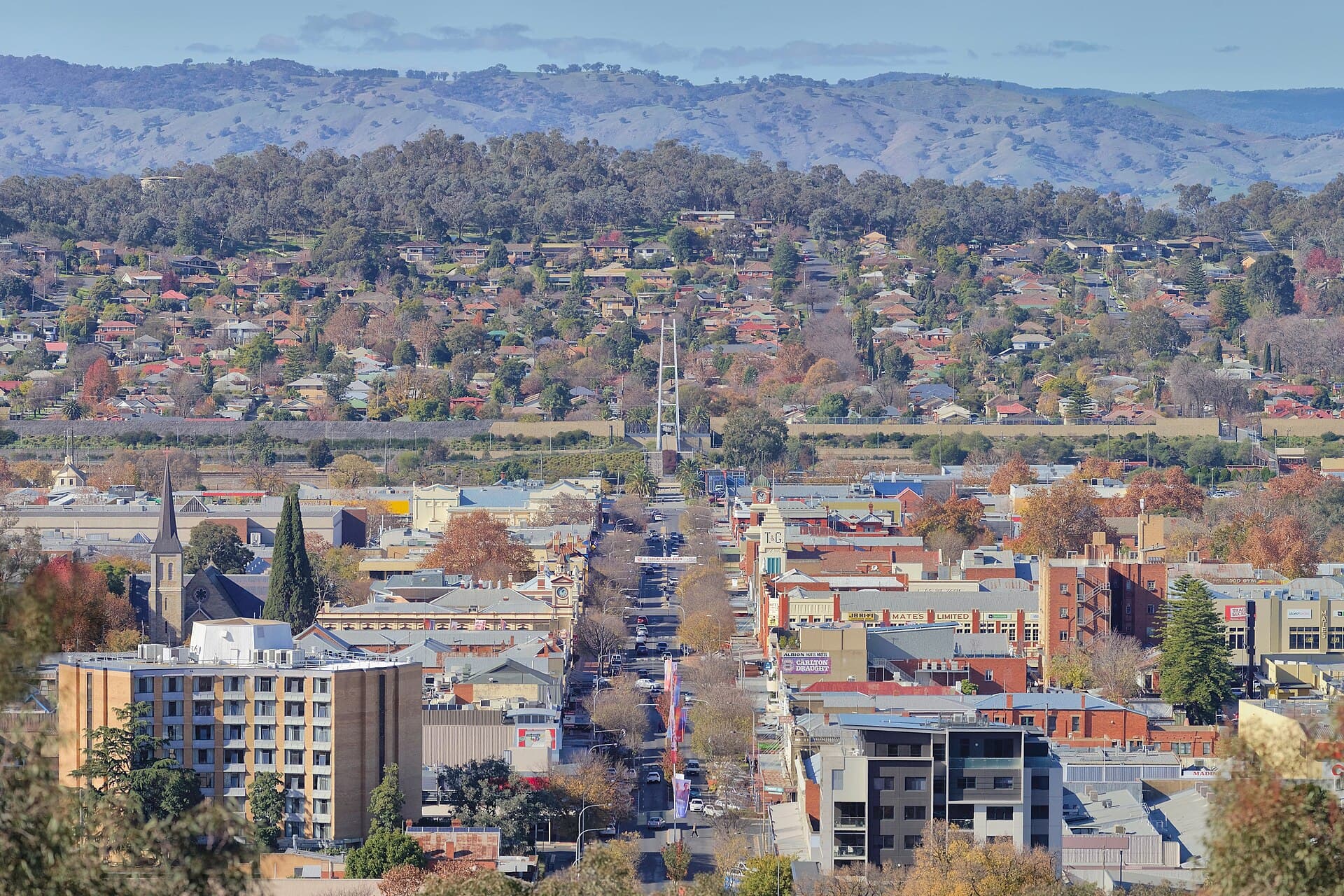
La majestueuse gare d'Albury, avec son imposante tour de l'horloge et son style italianisant, était bien plus qu'un simple hub de transport.
L'histoire complète se débloque dans le tour
 Thennicke / CC BY-SA 4.0, via Wikimedia Commons
Visite audio autoguidée de Albury — parcours GPS à pied, lecture hors ligne, narration en 32 langues.
“Là où la rivière Murray sculpte une histoire entre deux États, Albury vous invite à vous attarder.”
Pas les cartes postales. Les histoires que même les habitants ignorent — soufflées à l'oreille, là où elles se sont passées.
La majestueuse gare d'Albury, avec son imposante tour de l'horloge et son style italianisant, était bien plus qu'un simple hub de transport.
Lorsque les jardins botaniques d'Albury ont été officiellement établis en 1877, la ville ne comptait que 3 000 habitants.
L'Albury LibraryMuseum, avec sa façade distinctive orange et grise en croisillons, est une merveille architecturale.
Découvrez tous les secrets de Albury
Chaque adresse, chaque révélation en entier — dans ton oreille, là où elle s'est passée.
Tu choisis tes lieux. Tu marches. La voix te révèle ce que les autres ignorent.


Votre visite audioguidée de Albury vous attend — choisissez vos lieux, votre langue, et lancez-vous dès votre arrivée.
AcheterLume intègre un guide en réalité augmentée. Levez votre téléphone : sa caméra montre la rue devant vous, avec une flèche lumineuse posée sur l'image réelle qui pointe toujours vers votre prochain arrêt — aucune carte à déchiffrer, aucun mauvais virage. Comme tout dans Lume, ça fonctionne entièrement hors-ligne.
Albury, une ville régionale située sur la rive nord de la rivière Murray, agit comme une porte d'entrée dynamique entre la Nouvelle-Galles du Sud et le Victoria. Cet emplacement stratégique a façonné son identité, favorisant un mélange de beauté naturelle, de profondeur historique et de culture contemporaine. Bien que souvent considérée comme une étape pratique entre Sydney et Melbourne, Albury offre une destination attrayante à part entière, invitant les visiteurs à explorer ses quartiers riverains, son architecture patrimoniale et sa scène artistique florissante.
La ville, jumelée avec Wodonga de l'autre côté de la Murray, fonctionne comme une seule zone urbaine, offrant un éventail d'expériences plus large qu'une ville isolée. Des promenades tranquilles le long de la rivière à la découverte de l'histoire locale à son LibraryMuseum primé, Albury présente une atmosphère détendue mais engageante. Ses rues larges et ses bâtiments publics imposants témoignent d'une ambition passée, révélant une ville qui a autrefois concouru pour le titre de capitale de l'Australie.
L'histoire d'Albury est profondément liée à la rivière Murray, qui a servi d'artère de transport vitale bien avant les autoroutes modernes. Les explorateurs européens Hume et Hovell furent les premiers non-autochtones à documenter la région en 1824, nommant la rivière 'Hume's River'. La ville fut officiellement établie en 1839 et devint rapidement un point de passage crucial, notamment pendant les ruées vers l'or des années 1850.
Avec la séparation du Victoria de la Nouvelle-Galles du Sud en 1851, la rivière Murray devint la frontière, transformant Albury en une importante 'ville frontière' et poste de douane. Cela entraîna une augmentation du commerce avec Melbourne et la construction du premier pont en 1860. L'achèvement du chemin de fer de Melbourne à Wodonga en 1873 renforça davantage l'importance d'Albury en tant que canal pour les produits de la Riverina, contribuant à sa confiance municipale.
L'un des monuments historiques les plus remarquables d'Albury est sa grande gare ferroviaire, construite entre 1880 et 1881. Conçue dans un style italianisant sous la direction de John Whitton, ingénieur en chef des chemins de fer de la Nouvelle-Galles du Sud, l'ouverture de la gare en 1882 fut un événement significatif, auquel assistèrent les premiers ministres de la Nouvelle-Galles du Sud et du Victoria. Pendant près de 80 ans, Albury a servi de gare de rupture de charge, obligeant les passagers et les marchandises voyageant entre Sydney et Melbourne à changer de train en raison des écartements de voie différents. Le quai de la gare, long de 459,6 mètres, est l'un des plus longs d'Australie.
Au début du XXe siècle, Albury fut même envisagée comme un site potentiel pour la capitale nationale de l'Australie, témoignant de son emplacement stratégique et de son infrastructure naissante. Bien que Canberra ait finalement été choisie, les rues larges et les imposants bâtiments publics de la ville reflètent encore cette ambition précoce. Tout au long du XXe siècle, Albury a continué de croître, évoluant en un centre régional prospère doté d'une économie diversifiée qui comprend désormais les soins de santé, la fabrication et les services professionnels.
Commencez votre exploration le long de la rivière Murray, l'élément vital d'Albury. Le Yindyamarra Sculpture Walk est un sentier culturel de 5 kilomètres présentant 11 sculptures aborigènes qui racontent des histoires du patrimoine Wiradjuri le long de la berge. Vous pouvez également profiter de pique-niques et de baignades au Noreuil Park, un endroit populaire au bord de la rivière avec des zones ombragées et des possibilités de kayak ou de stand-up paddle.
Imprégnez-vous de la nature aux Jardins botaniques d'Albury, établis en 1877. Ces jardins de 4 hectares présentent à la fois des espèces indigènes australiennes et exotiques, avec un remarquable arbre aux mouchoirs centenaire et un jardin pour enfants. Pour des vues panoramiques sur Albury, Wodonga et la campagne environnante, montez à Monument Hill, qui abrite un mémorial en l'honneur des héros locaux de la Première Guerre mondiale.
L'Albury LibraryMuseum est une installation primée qui combine une bibliothèque moderne avec des expositions muséales captivantes. Son exposition permanente, 'Bungambrawatha: Histoires d'Albury', retrace l'histoire de la ville depuis ses racines indigènes jusqu'à nos jours. Pour l'art contemporain, visitez le Murray Art Museum Albury (MAMA), qui présente des expositions australiennes et internationales. À seulement 15 minutes du centre-ville, le lac Hume offre un vaste réservoir pour les sports nautiques, les pique-niques et les promenades pittoresques le long du barrage.
Les meilleures périodes pour visiter Albury sont l'automne (de mars à mai) et le printemps (de septembre à novembre). Ces saisons offrent un temps agréable, avec des températures douces idéales pour les activités de plein air comme la marche et le vélo. Le printemps, en particulier, voit les jardins et parcs de la ville en pleine floraison. Pour les activités par temps chaud telles que la baignade dans la rivière Murray ou la navigation sur le lac Hume, la période de mi-décembre à mi-mars est recommandée, bien que les températures puissent être élevées. L'hiver (de juin à août) est plus frais et plus calme, propice à l'exploration des attractions intérieures et à la découverte de la scène culinaire locale.
Albury est facilement accessible par la route, le rail et l'air. Elle se trouve à environ 3h30 de route de Melbourne et à 5h30 de route de Sydney via la Hume Highway. V/Line et NSW TrainLink proposent des services ferroviaires réguliers depuis les deux grandes villes, et l'aéroport d'Albury offre des vols quotidiens. Une fois à Albury, un véhicule privé offre la plus grande flexibilité pour explorer, avec un parking gratuit largement disponible à la plupart des attractions. La zone centrale, y compris les jardins botaniques, le MAMA et la place QEII, est facilement accessible à pied depuis les hébergements de la ville. Pour de plus longues distances ou des excursions au lac Hume et aux sentiers de randonnée, un trajet de 15 à 20 minutes en voiture depuis le centre-ville est nécessaire. Le centre d'information touristique d'Albury, situé au sein de l'Albury LibraryMuseum, fournit des cartes et des informations locales.
Albury en coréen, en chinois ou en hébreu — et dans 29 autres langues, chaque étape narrée par une voix native. La plus large gamme de langues de tous les audioguides autoguidés.
Disponible en :