Baoding Military Academy
Before it was the birthplace of modern Chinese military leadership, this academy held a secret about its founder's true intentions.
Full story unlocks in the tour
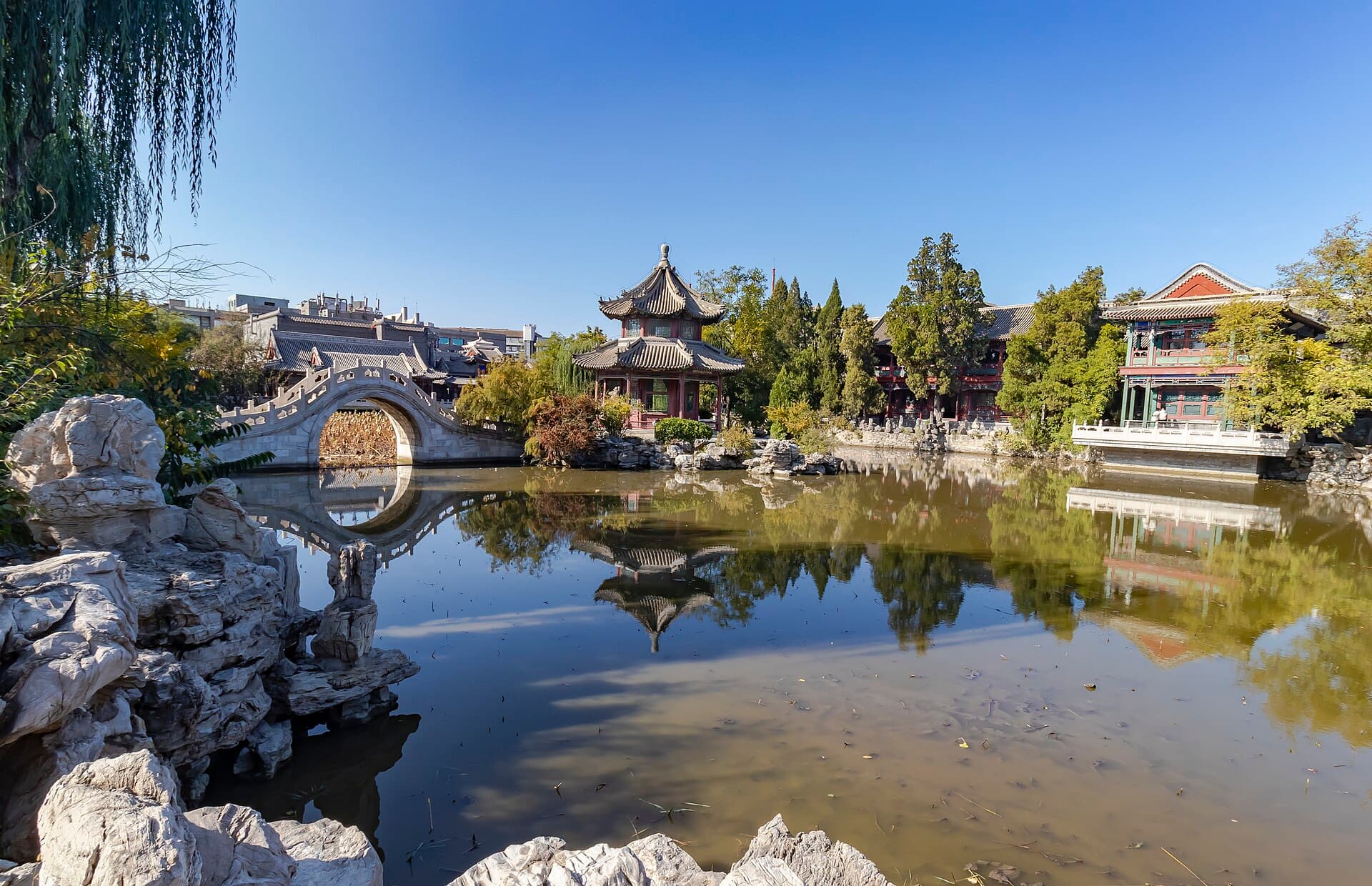 ScareCriterion12 / CC BY-SA 4.0, via Wikimedia Commons
Self-guided audio walking tour of Baoding — GPS route, offline playback, story-driven narration in 32 languages.
“Baoding: Where ancient echoes meet green innovation.”
Not the postcards. The stories even locals don't know — whispered in your ear, right where they happened.
Before it was the birthplace of modern Chinese military leadership, this academy held a secret about its founder's true intentions.
This tranquil garden, a symbol of scholarly contemplation, once played a surprising role in the city's defense.
Despite its historical reliance on heavy industry, Baoding holds a unique distinction as a pioneer in environmental sustainability.
Discover every secret of Baoding
Every address, every reveal in full — in your ear, right where it happened.
You pick your stops. You walk. The voice reveals what the others miss.


Your self-guided audio tour of Baoding is ready — pick your landmarks, choose your language, and start the moment you arrive.
BuyLume has a built-in augmented-reality guide. Hold your phone up and its camera shows the street ahead of you, with a glowing arrow laid over the real view that always points to your next stop — no map to puzzle over, no wrong turns. Like everything in Lume, it works fully offline.
Baoding, a prefecture-level city in central Hebei province, sits approximately 150 kilometers southwest of Beijing, earning its historical moniker as the 'southern gateway' to the capital. This sprawling metropolis, home to over 11 million inhabitants as of the 2020 census, is a place where ancient history and modern ambition intertwine. From its origins as a military and administrative outpost to its current role as a dynamic industrial and educational center, Baoding offers a glimpse into a less-traveled, yet profoundly significant, part of northern China.
The city's name, first appearing during the Mongol Yuan Dynasty, is symbolic, translating to 'protecting the capital and stabilizing the country,' a testament to its enduring strategic importance. While not a conventional tourist resort, Baoding draws travelers seeking authentic architectural monuments from imperial China and unique natural sites. It is a place where the energy of a massive metropolis harmoniously coexists with a profound historical heritage.
Baoding's history stretches back over two millennia, with its earliest recorded significance during the Warring States period (475–221 BCE), when it lay along the dividing line between the Yan and Zhao states. One of Yan's capitals, Xiadu, located in present-day Yi County, may have been one of the world's largest cities around 400–300 BCE, with an estimated population exceeding 300,000.
During the Northern Song Dynasty in 960 CE, the Bao prefecture ('Baozhou') was established in Baoding, serving as a military district to defend against nomadic incursions. A fortified city was built in 992 CE, successfully repelling numerous attacks. However, the city was destroyed during the Mongol conquest in 1213 CE, only to be reconstructed in 1227 CE by the Mongols, who recognized its strategic importance in safeguarding their new capital, Khanbaliq (modern-day Beijing). The region officially acquired the name 'Baoding' in 1275 CE, meaning 'protecting the capital and stabilizing the country.'
Baoding's 'architectural golden age' unfolded during the Ming and Qing dynasties when it served as the capital of Zhili Province. From 1669 until the fall of the Qing dynasty in 1912, Baoding was the residence of the Viceroy of Zhili, making it the primary political and military center of the region. This era saw the development of its historical center, including the Ancient Residence of the Zhili Provincial Governor, a vast complex built according to strict administrative conventions.
In the early 20th century, Baoding continued its military legacy with the establishment of the Baoding Military Academy in 1902 by Viceroy Yuan Shikai, which became the birthplace of many prominent generals. The city served as the provincial capital of Hebei at various times, notably from 1935 to 1958. Today, Baoding retains its historical landmarks while embracing modern industrial and technological advancements, including becoming a significant hub for renewable energy.
Begin your exploration at the Ancient Residence of the Zhili Provincial Governor, a sprawling complex reflecting the administrative power of the Qing Dynasty. This grand building served as both the workplace and home for influential officials, offering a tangible connection to imperial governance.
Adjacent to it lies the Ancient Lotus Pond (Gu Lianchi), one of China's ten most famous classical gardens. Founded during the Yuan Dynasty, its elegant pavilions, bridges, and artificial hills create a harmonious space, particularly picturesque during the lotus blooming season from June to August.
For a deeper dive into local history, the Baoding Museum offers extensive exhibits on the city's past and the Great Wall. A newer addition is the Baoding Natural History Museum, opened in early 2024, which claims to be one of Asia's largest natural history museums and houses the world's only complete skeleton of a Chinese velociraptor.
Outside the city center, the Western Qing Tombs are the final resting place for several Qing Dynasty emperors, including Yongzheng and Daoguang, offering a significant historical site. Nature enthusiasts can venture to Yesanpo National Park, a sprawling scenic area with mountains, rivers, and caves, ideal for escaping summer heat. Another natural highlight is Lake Baiyangdian, the largest natural freshwater body in northern China, known for its reed beds and water villages, where visitors can take boat trips.
Baoding experiences a continental, monsoon-influenced climate with distinct seasons. Summers (June to August) are hot and humid, with most rainfall concentrated in July and August. Winters (December to February) are cold, windy, and dry, with temperatures often below freezing. Spring (April to May) and autumn (September to October) are considered the most pleasant times to visit, offering mild and agreeable weather. Specifically, mid-April to mid-May and mid-September to mid-October are ideal for avoiding extreme temperatures and heavy rains.
Baoding is well-connected, serving as a transportation hub with railways and express highways linking it to major cities like Beijing and Tianjin. Within the city, taxis are readily available, and a comprehensive bus system operates, though there is no metro. Some city buses even feature unique 'antique' or 'museum' aesthetics, showcasing local specialties. Most international travelers will require a visa to visit China, including Baoding, so it's advisable to check current requirements and apply in advance. The local cuisine is characteristic of northern China, with hearty wheat-based dishes like noodles, dumplings, and steamed buns. A local specialty not to miss is the 'donkey burger' (Lürou Huoshao), crispy flatbreads filled with tender braised donkey meat, found on many street corners.
Baoding in Korean, in Chinese or in Hebrew — and 29 more languages, every stop narrated by a native voice. The widest language range of any self-guided audio tour.
Available in: