Viale dei Cipressi
The avenue of cypresses leading to Bolgheri is more than just a beautiful road; it holds a poetic secret.
Full story unlocks in the tour
 Janericloebe / Public domain, via Wikimedia Commons
Self-guided audio walking tour of Bolgheri — GPS route, offline playback, story-driven narration in 32 languages.
“Where ancient cypresses guard a village born of wine and poetry.”
Not the postcards. The stories even locals don't know — whispered in your ear, right where they happened.
The avenue of cypresses leading to Bolgheri is more than just a beautiful road; it holds a poetic secret.
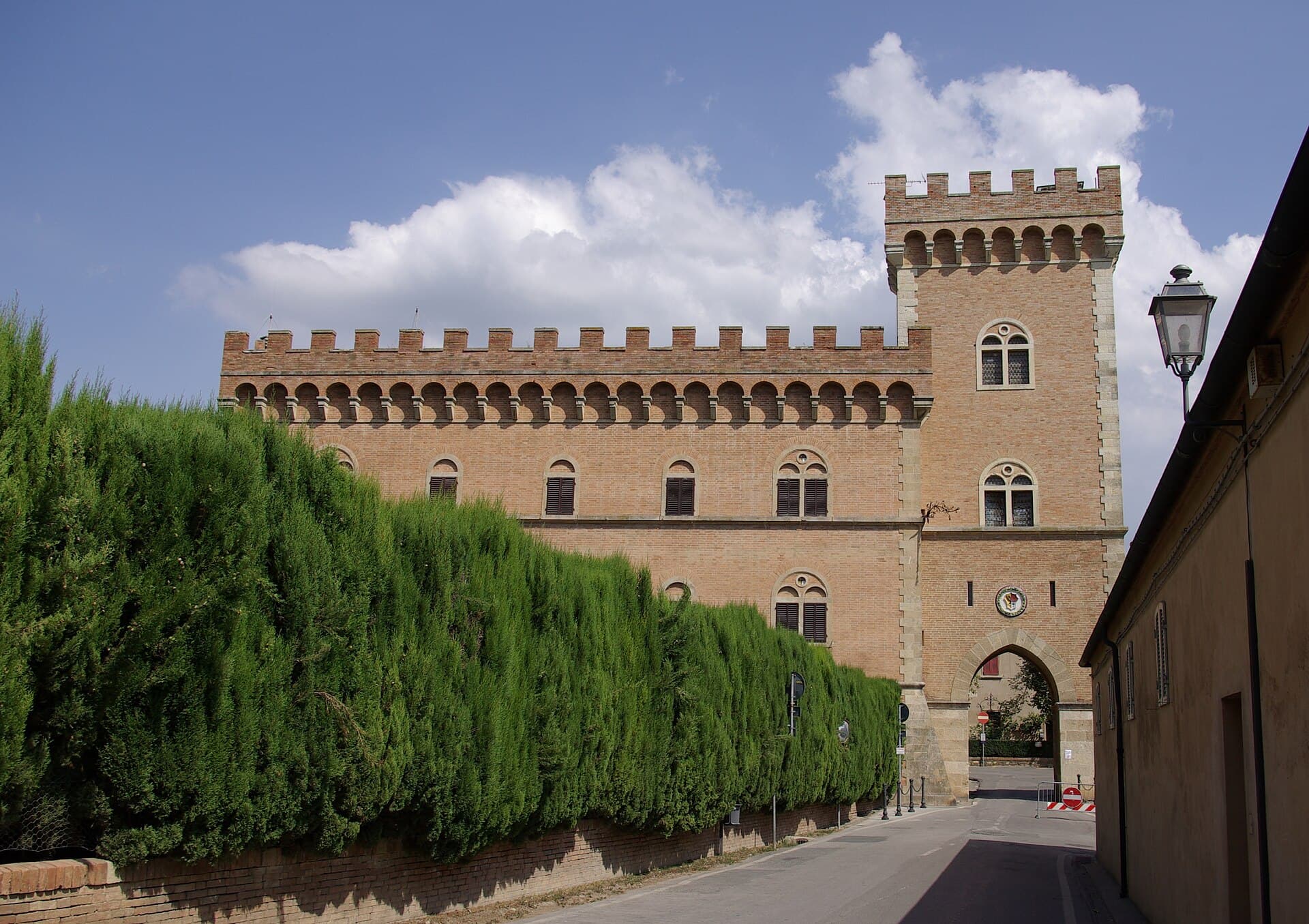
The imposing red-brick castle that greets you at the end of the cypress avenue holds a clue to Bolgheri's strategic past.
Beyond the famous poet, another family member holds a special, and rather charming, place in Bolgheri's heart.
Discover every secret of Bolgheri
Every address, every reveal in full — in your ear, right where it happened.
You pick your stops. You walk. The voice reveals what the others miss.


Your self-guided audio tour of Bolgheri is ready — pick your landmarks, choose your language, and start the moment you arrive.
BuyLume has a built-in augmented-reality guide. Hold your phone up and its camera shows the street ahead of you, with a glowing arrow laid over the real view that always points to your next stop — no map to puzzle over, no wrong turns. Like everything in Lume, it works fully offline.
Bolgheri, a small, captivating village in Tuscany's Livorno province, is a place where time seems to slow, inviting visitors to savor its unique blend of history, culture, and world-renowned wines. Approaching Bolgheri is an experience in itself, as you journey along the Viale dei Cipressi, a majestic five-kilometer avenue lined with over 2,500 ancient cypress trees, immortalized in poetry.
Beyond its picturesque entrance, Bolgheri reveals a charming medieval hamlet, guarded by a 13th-century red-brick castle. Its narrow, stone-paved streets are a delight to explore, dotted with artisan workshops, cozy osterias, and wine shops offering the region's celebrated 'Super Tuscan' wines. Surrounded by rolling vineyards and olive groves, with the Tyrrhenian Sea just a few miles away, Bolgheri provides a serene escape, perfect for those seeking fine food, exceptional wine, and the tranquil beauty of the Tuscan countryside.
The territory surrounding Bolgheri reveals a history stretching back to the 12th century B.C., with evidence of early human activity primarily in the hillsides, as the flatlands were once swampland. The ancient Etruscan civilization significantly influenced the area, establishing viticultural practices long before the rise of Rome, making this one of Europe's earliest grape cultivation regions. Following the fall of the Western Roman Empire and a period of conflict, stability emerged under the Lombards between the 6th and 8th centuries. Bolgheri's coastal location made it vulnerable to sea raids, leading to its fortification under King Liutprand. Settlements were strategically placed on hilltops to avoid unhealthy swamp conditions and for defense.
It was during this Lombard era that Walfredo, the forefather of the influential Della Gherardesca family, was born. This family has played a fundamental role in Bolgheri's development from before 1000 A.D. to the present day. The name 'Bolgheri' itself is thought to be of Lombard origin, possibly from a military settlement of Bulgars. Around the year 1000, the Counts Della Gherardesca built a new fortified castle on a nearby hill, and the current village gradually developed around this stronghold. The imposing red-brick fortress, still bearing the Della Gherardesca coat of arms, remains a distinctive landmark.
Despite its ancient origins, the flat terrain where many of today's vineyards are located remained largely undeveloped for centuries. Significant land improvements and viticulture began to take shape in the late 1600s under the Della Gherardesca Counts. Guidalberto Della Gherardesca made a profound contribution in the 19th century, planting the famous Cypress Avenue and renovating vineyards, laying the groundwork for the region's future.
Bolgheri's modern history was revolutionized in 1930 when Marchese Mario Incisa Della Rocchetta moved to Tuscany. Inspired by fine French wines, he began cultivating Cabernet Sauvignon and Cabernet Franc on his Tenuta San Guido estate in the 1940s. This pioneering effort led to the commercial release of Sassicaia in 1968, a wine that defied traditional Tuscan norms by not using Sangiovese and quickly gained international acclaim, effectively placing Bolgheri on the global wine map. The Bolgheri DOC was established in 1984, initially for white and rosé wines, with red wines officially recognized in 1994. In 2013, Sassicaia gained its own unique DOC, a testament to its exceptional quality and singular origin.
Your journey to Bolgheri begins with the Viale dei Cipressi, a five-kilometer avenue lined with over 2,500 ancient cypress trees. This iconic road, celebrated in Giosuè Carducci's poetry, leads directly to the village and offers memorable photographic opportunities, especially at sunrise.
At the end of the cypress avenue, you will arrive at the Bolgheri Castle, a striking 13th-century red-brick fortress that serves as the village's entrance. Pass beneath its tower, adorned with the Della Gherardesca family's coat of arms, to step into the charming medieval heart of Bolgheri.
Inside the village, wander through the narrow, stone-paved alleys, discovering artisan workshops, quaint shops, and inviting osterias. Do not miss the Church of Santi Giacomo and Cristoforo, one of the oldest buildings in town, dating back to the Middle Ages. Seek out Piazza Alberto and the statue of Nonna Lucia, the beloved grandmother of poet Carducci, a local symbol. For wine enthusiasts, a visit to one of Bolgheri's renowned wineries for a tasting is a rewarding experience, with many estates offering tours by appointment.
Beyond the village, consider exploring the Padule di Bolgheri Animal Reserve, Italy's first private protected area, offering a valuable wildlife refuge. The surrounding countryside, with its vineyards and olive groves, is ideal for walking, cycling, or horseback riding.
Bolgheri is a delightful destination year-round, but certain seasons offer unique advantages. For wine enthusiasts, September and October are particularly exciting, as the vendemmia (grape harvest) is underway, and many estates offer special events and tastings of newly released wines. Temperatures are still pleasant, making it ideal for outdoor exploration.
April and May are also excellent, with the countryside in full bloom and fewer crowds, perfect for unhurried cellar visits and tastings. Summer (June-August) can be hot and crowded, while November and December offer a quieter, more intimate atmosphere with the landscape taking on warm autumn tones. Bolgheri's coastal proximity helps moderate temperatures, making extreme heat less likely during the hottest months.
Bolgheri is part of the municipality of Castagneto Carducci, located in the province of Livorno, Tuscany. The village is easily accessible by car, which is highly recommended for exploring the surrounding wine road and countryside. If coming from the north, take the SS1 - E80 (Aurelia) to the 'La California' exit; from the south, exit at 'Donoratico.' From either exit, follow signs to Bolgheri. The closest train station is in Donoratico, but there are no direct buses to Bolgheri, so a car or taxi is necessary from the station.
Within the village, cars are not permitted inside the ancient walls, encouraging leisurely strolls through its charming streets. Many wineries require advance reservations for tours and tastings, especially during peak seasons, so plan ahead. Bolgheri offers a range of accommodations, from hotels within the village to agriturismo farmstays in the surrounding countryside. The local cuisine focuses on traditional Tuscan dishes, often paired with the region's exceptional wines.
Bolgheri in Korean, in Chinese or in Hebrew — and 29 more languages, every stop narrated by a native voice. The widest language range of any self-guided audio tour.
Available in: