Filippo Brunelleschi, the architect of Florence's iconic dome, kept his revolutionary construction methods a closely guarded secret. But how did he convince the skeptical Florentine officials that he, a goldsmith, could achieve the impossible?
Photo: Jonathan Körner / UnsplashRenaissance Florence
Self-guided audio walking tour of Renaissance Florence — GPS route, offline playback, story-driven narration in 32 languages.
“Walk the streets where genius flowered: Uncover the art, architecture, and untold stories of Renaissance Florence.”
Renaissance Florence, as no one tells it.
Not the postcards. The stories even locals don't know — whispered in your ear, right where they happened.
Giotto's Bell Tower stands tall and elegant today, but the master's original design contained a significant flaw that could have led to its downfall.
During World War II, as other bridges across the Arno were destroyed, the Ponte Vecchio was miraculously spared. The reason, according to local legend, involves one of history's most notorious figures.
Discover every secret of Renaissance Florence
Every address, every reveal in full — in your ear, right where it happened.
You pick your stops. You walk. The voice reveals what the others miss.


How long do you have in Renaissance Florence?
Your self-guided audio tour of Renaissance Florence is ready — pick your landmarks, choose your language, and start the moment you arrive.
BuyThe story of Renaissance Florence
Step into the cradle of the Renaissance, where every stone speaks of artistic revolution and architectural daring. This self-guided audio walk invites you to explore Florence through its magnificent outdoor masterpieces, tracing the footsteps of the geniuses who reshaped the world. From the audacious dome that defied gravity to the squares that witnessed both triumph and turmoil, you'll discover the enduring legacy of an era that celebrated human potential. Prepare to peel back the layers of history, uncovering not just the iconic sights, but the surprising stories and clever solutions that lie beneath their celebrated surfaces.
The Florentine Renaissance, flourishing roughly from the 14th to the 16th century, marked a pivotal period in European history, characterized by a fervent rebirth of classical art, literature, and philosophy. Florence, a prosperous mercantile republic, became its epicenter, driven by powerful families like the Medici, who were not only astute bankers but also passionate patrons of the arts. This era saw a dramatic shift from the medieval focus on the divine to a renewed emphasis on humanism, individualism, and scientific inquiry. Artists and architects, once considered humble artisans, rose to prominence, their innovations celebrated and their creations revered.
Central to this artistic explosion was a revolution in architectural thought. Filippo Brunelleschi, a goldsmith by trade, famously engineered the dome of the Florence Cathedral, solving a centuries-old architectural puzzle without the traditional buttresses or extensive scaffolding common in Gothic construction. His ingenious double-shelled design and innovative lifting mechanisms were a testament to the era's spirit of problem-solving and technical prowess. Meanwhile, artists like Donatello and Michelangelo breathed new life into sculpture, drawing inspiration from classical forms while infusing their works with unprecedented realism and emotional depth. The city's public spaces, such as the Piazza della Signoria, transformed into open-air museums, adorned with powerful sculptures that served as both artistic statements and political symbols. This period of intense creativity and intellectual ferment laid the groundwork for the modern world, making Florence an unparalleled destination for anyone seeking to understand the origins of Western art and architecture.
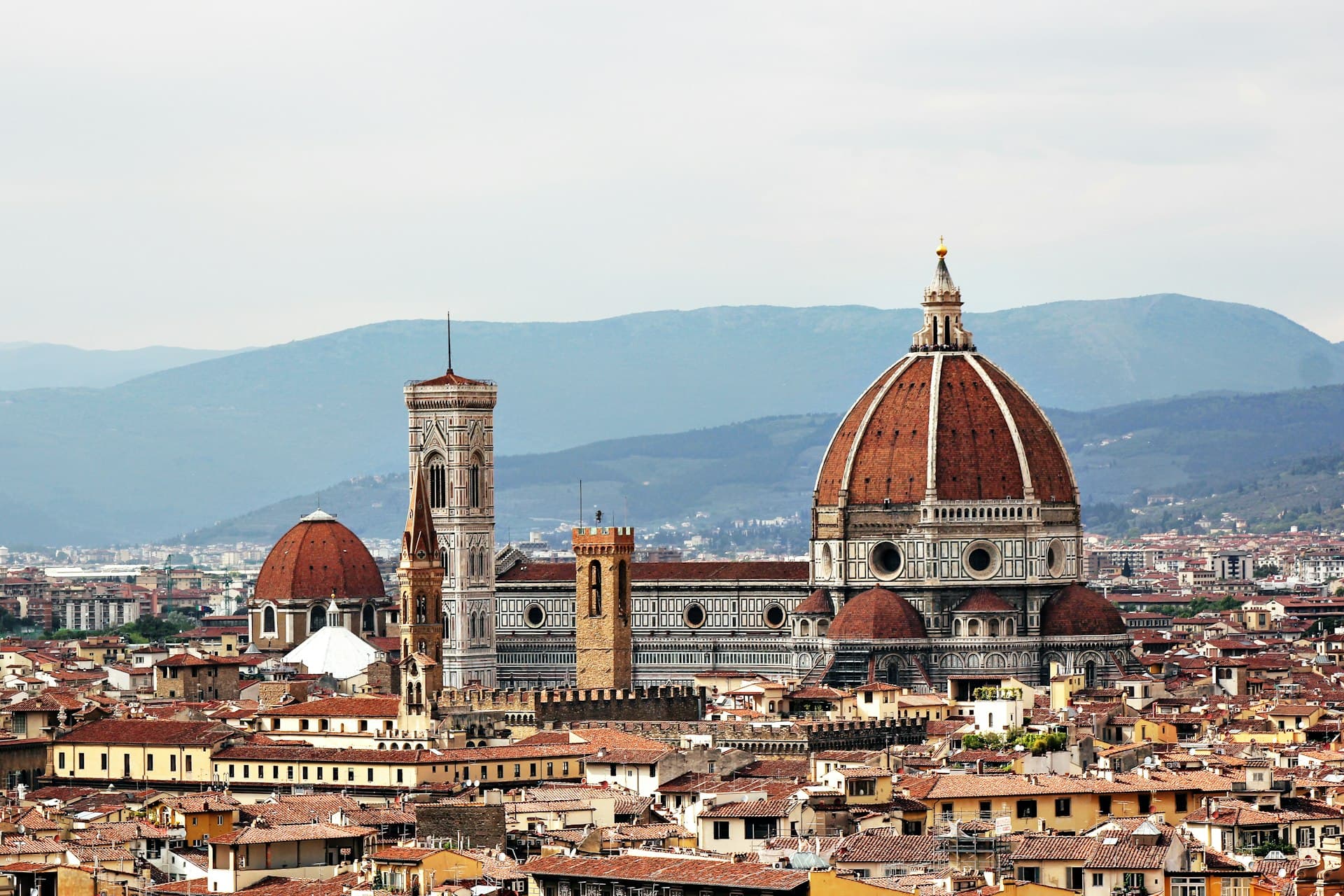
This walk focuses on the exteriors and public spaces that define Renaissance Florence. You'll begin at the Duomo and Brunelleschi's Dome, marveling at the sheer scale and ingenious engineering of the dome, a symbol of human achievement. Adjacent to it stands the Baptistery of San Giovanni, with its renowned 'Gates of Paradise' by Ghiberti, and Giotto's Campanile, a slender bell tower adorned with intricate marble and sculptures.
Continue to Piazza della Signoria, the political core of Florence. Here, you'll encounter the imposing Palazzo Vecchio, a replica of Michelangelo's David, and the Loggia dei Lanzi, an open-air gallery showcasing Renaissance sculptures like Cellini's 'Perseus with the Head of Medusa' and Giambologna's 'Rape of the Sabine Women'. Your journey then leads to the iconic Ponte Vecchio, Florence's oldest bridge, lined with charming shops. Finally, explore the exterior of Palazzo Medici Riccardi, the first grand Renaissance palace, and the striking polychrome marble facade of the Basilica of Santa Croce, the burial place of many Italian luminaries.
Florence is beautiful year-round, but for comfortable walking and smaller crowds, consider visiting in the shoulder seasons: April-May or September-October. The weather is generally pleasant, allowing for enjoyable exploration of outdoor sites. Summer (June-August) can be very warm and busy, while winter (November-March) offers a quieter experience but with cooler temperatures and shorter daylight hours. Check local holiday schedules, as some attractions may have altered hours.
This walking tour covers significant ground, so wear comfortable shoes. Many of Florence's streets are cobblestone, which can be uneven. Stay hydrated, especially during warmer months. Public restrooms are available at various points, often requiring a small fee. While most major attractions are within walking distance, consider a bus pass for longer distances or if you need a break from walking. Keep an eye on your belongings in crowded areas. For those interested in climbing Brunelleschi's Dome or Giotto's Campanile, be aware of the numerous steps and book tickets in advance, especially during peak season, as entry is often timed.
- Was Brunelleschi an architect by training?
- No, Filippo Brunelleschi was initially trained as a goldsmith and sculptor. His architectural genius, particularly evident in the Duomo's dome, was largely self-taught and revolutionary for its time.
- Is the David statue in Piazza della Signoria the original?
- No, the statue of David in Piazza della Signoria is a replica. The original masterpiece by Michelangelo is housed in the Galleria dell'Accademia to protect it from the elements.
- Why is the Ponte Vecchio lined with shops?
- The tradition of shops on the Ponte Vecchio dates back centuries. Originally, it housed butchers and tanners, who were later replaced by goldsmiths and jewelers by a Medici decree, reportedly due to the unpleasant odors of the earlier trades.
- Did the Medici family live in Palazzo Vecchio?
- The Medici family did reside in Palazzo Vecchio (then called Palazzo della Signoria) for a period, with Cosimo I moving his main residence there in 1540. However, they later moved to the Pitti Palace.
- Is the facade of Santa Croce from the Renaissance period?
- Surprisingly, no. While the Basilica of Santa Croce dates back to the 13th century, its elaborate Neo-Gothic marble facade was only completed in the mid-19th century, designed by Niccolò Matas.
- What is the Vasari Corridor?
- The Vasari Corridor is a secret, elevated passageway built by Giorgio Vasari for Cosimo I de' Medici in 1565. It allowed the Medici family to move between Palazzo Vecchio and Palazzo Pitti, passing over the Ponte Vecchio, without having to mix with the public.