Certaldo Alto's main street, Via Boccaccio
Unlike most medieval towns with a grand central piazza, Certaldo Alto's heart beats along a different kind of public space.
Full story unlocks in the tour
 Chensiyuan / CC BY-SA 4.0, via Wikimedia Commons
Self-guided audio walking tour of Certaldo — GPS route, offline playback, story-driven narration in 32 languages.
“Where red brick streets echo with medieval tales and literary giants.”
Not the postcards. The stories even locals don't know — whispered in your ear, right where they happened.
Unlike most medieval towns with a grand central piazza, Certaldo Alto's heart beats along a different kind of public space.
Beyond its imposing facade adorned with coats of arms, this medieval palace holds a chilling secret within its walls.
Adjacent to the Palazzo Pretorio, a seemingly modest church holds a powerful and poignant masterpiece, moved from its original, somber location.
Discover every secret of Certaldo
Every address, every reveal in full — in your ear, right where it happened.
You pick your stops. You walk. The voice reveals what the others miss.

Your self-guided audio tour of Certaldo is ready — pick your landmarks, choose your language, and start the moment you arrive.
BuyLume has a built-in augmented-reality guide. Hold your phone up and its camera shows the street ahead of you, with a glowing arrow laid over the real view that always points to your next stop — no map to puzzle over, no wrong turns. Like everything in Lume, it works fully offline.
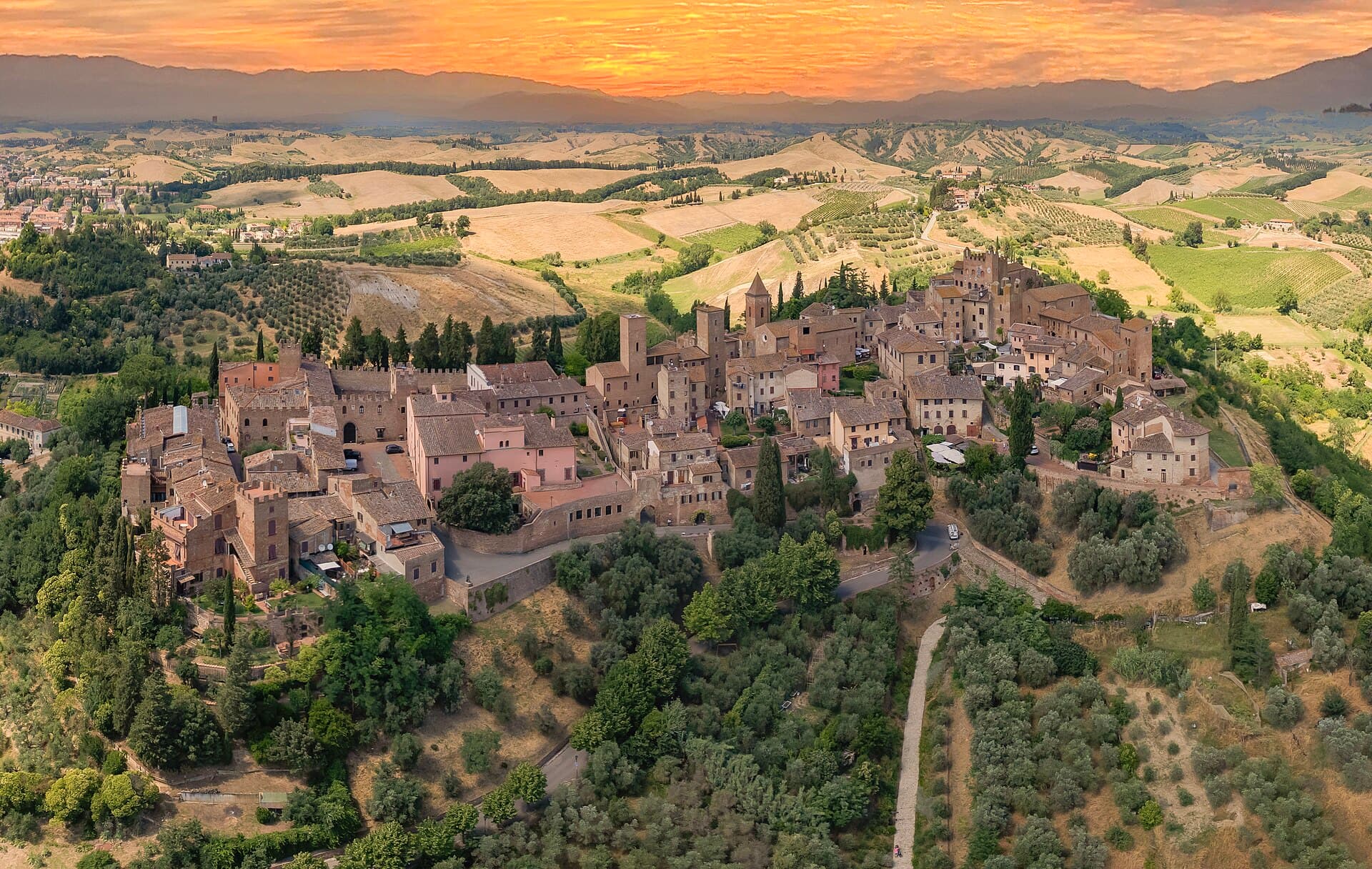
Certaldo, a captivating town in the heart of Tuscany's Val d'Elsa, offers a journey through time, split distinctly into two parts. Down in the valley lies Certaldo Basso, the modern, bustling hub with contemporary neighborhoods and economic activity. On the hill above, connected by a scenic funicular, is Certaldo Alto, a perfectly preserved medieval village that seems to have paused in the 14th century.
This upper town, often referred to as 'Castello,' is a place of narrow, red-brick lanes, fortified towers, and ancient walls that evoke a unique, quiet, and magical atmosphere. It is renowned as the birthplace and final resting place of Giovanni Boccaccio, one of Italy's greatest writers and the author of The Decameron. The town's commitment to preserving its heritage has earned it the Touring Club's Orange Flag recognition, marking it as one of Italy's best villages for its tourist offerings, art, culture, and respect for nature.
Certaldo's strategic location, roughly equidistant from Florence, Siena, and San Gimignano, makes it an ideal base for exploring the classic Tuscan landscape of rolling hills, vineyards, and olive groves. Whether you're seeking a day trip filled with history and literature or a longer stay to immerse yourself in the region, Certaldo offers a wealth of authentic experiences.
## Etruscan Roots and Medieval Ascendance Certaldo's story begins long before its medieval fortifications. Archaeological finds, including ceramics, utensils, and Etruscan tombs on hills like Poggio del Boccaccio, indicate Etruscan-Roman origins, with the very name Certaldo possibly derived from ancient descriptions of its oak-covered hills. The town reappears in historical records in the mid-1100s when an Imperial edict placed its castle under the hereditary control of the Alberti counts.
By the late 13th and early 14th centuries, Certaldo definitively fell under the influence of Florence. From 1415 to the late 1700s, Certaldo served as the uninterrupted seat of the Vicariate of the Elsa Valley, a significant administrative and judicial center for the surrounding region. The impressive Palazzo Pretorio, originally the Alberti family's dwelling, was transformed into a public building, housing Florentine magistrates who administered justice.
## Boccaccio's Legacy and Wartime Scars Certaldo is most famously known as the home of Giovanni Boccaccio, the renowned 14th-century Italian writer and poet, author of The Decameron. He was likely born in Certaldo in 1313 and certainly died there in 1375, spending a significant part of his adult life in the town. His masterpiece, The Decameron, written just after the Black Death, profoundly influenced European literature. Today, his house serves as a museum and a national center for Boccaccio studies.
Certaldo, particularly Certaldo Alto, suffered significant damage from Allied bombing during World War II, necessitating extensive rebuilding and restoration efforts in the 20th century to preserve its medieval character. These efforts ensured that the historic buildings, churches, and squares maintained their authentic appearance, allowing visitors to experience the beautifully preserved medieval lanes and piazzas today. The local government, which had moved to Certaldo Basso in the mid-1800s, eventually saw a renewed appreciation for Certaldo Alto's heritage.
## Festivals and Modern Connections Certaldo continues to celebrate its history and culture through various events. The Mercantia street theatre festival, first held in 1986, transforms Certaldo Alto into a candlelit carnival of performers and artists each July. The town also hosts medieval feasts, food festivals like Boccaccesca, and Carnivale, embracing its heritage throughout the year. The modern Certaldo Basso is connected to Certaldo Alto by a convenient funicular railway, inaugurated in 1999, making the historic upper town easily accessible for all visitors.
Certaldo Alto, the medieval upper town, is where most of the historical attractions are concentrated. Begin your exploration at the Palazzo Pretorio, the imposing former residence of Florentine governors. Its facade is adorned with numerous coats of arms from past vicars, and inside, you'll find original frescoes, courtrooms, and even former prison cells. Adjacent to the Palazzo is the Church of Saints Thomas and Prosper, a small Romanesque-Gothic brick church housing Benozzo Gozzoli's moving 'Tabernacle of the Executed' frescoes.
A short stroll along the main street, Via Boccaccio, will lead you to Boccaccio's House, now a museum and library dedicated to the famous writer. The house preserves traces of its medieval structure and offers insights into Boccaccio's life and work. Do not miss the Church of Santi Jacopo e Filippo, where Boccaccio's cenotaph is located, and the adjacent 14th-century cloister, which leads to the Museum of Sacred Art. Wander through the narrow, red-brick lanes, discovering unexpected viewpoints and glimpses of private gardens. Explore the ancient city gates: Porta Alberti, Porta al Sole, and Porta al Rivellino, which offer views of the surrounding Val d'Elsa. For a unique cultural experience, plan your visit during the Mercantia street theatre festival in July, when Certaldo Alto transforms into an open-air stage.
The ideal time to visit Certaldo is during spring (May-June) and autumn (September) when the weather is mild and pleasant, and the medieval lanes of Certaldo Alto are at their most inviting. These seasons offer comfortable temperatures and generally fewer crowds. If you wish to experience the lively Mercantia street theatre festival, plan your trip for July. Summers (late June to late August) are hot, with daytime highs reaching 31°C (88°F) in August, while winters (November to March) are cold, with January lows around 2°C (36°F).
Certaldo is easily accessible by train, located on the Florence-Empoli-Siena railway line. Direct trains from Florence Santa Maria Novella take approximately 50 minutes, while from Siena Centrale, the journey is about 35 minutes. If driving, take the Empoli Ovest exit from the FI-PI-LI road or the Poggibonsi exit from the Florence-Siena road link. Certaldo Alto has limited vehicular access, primarily for residents, so visitors should park in Certaldo Basso.
The two parts of town are connected by a funicular railway, which runs every 15 minutes. The Certaldo Basso station is in Piazza Boccaccio, and the Certaldo Alto station is near Porta Alberti. A single ticket costs €1, with a return journey at €1.20. Alternatively, you can walk up to Certaldo Alto via ancient streets like Costa Alberti or Costa Vecchia, a 15-20 minute uphill walk. A tourist information office is located on Piazzetta del Vicariato in Certaldo Alto. Certaldo hosts a large market every Wednesday, closing down the main road in Certaldo Basso.
Certaldo in Korean, in Chinese or in Hebrew — and 29 more languages, every stop narrated by a native voice. The widest language range of any self-guided audio tour.
Available in: