Chinchilla Castle
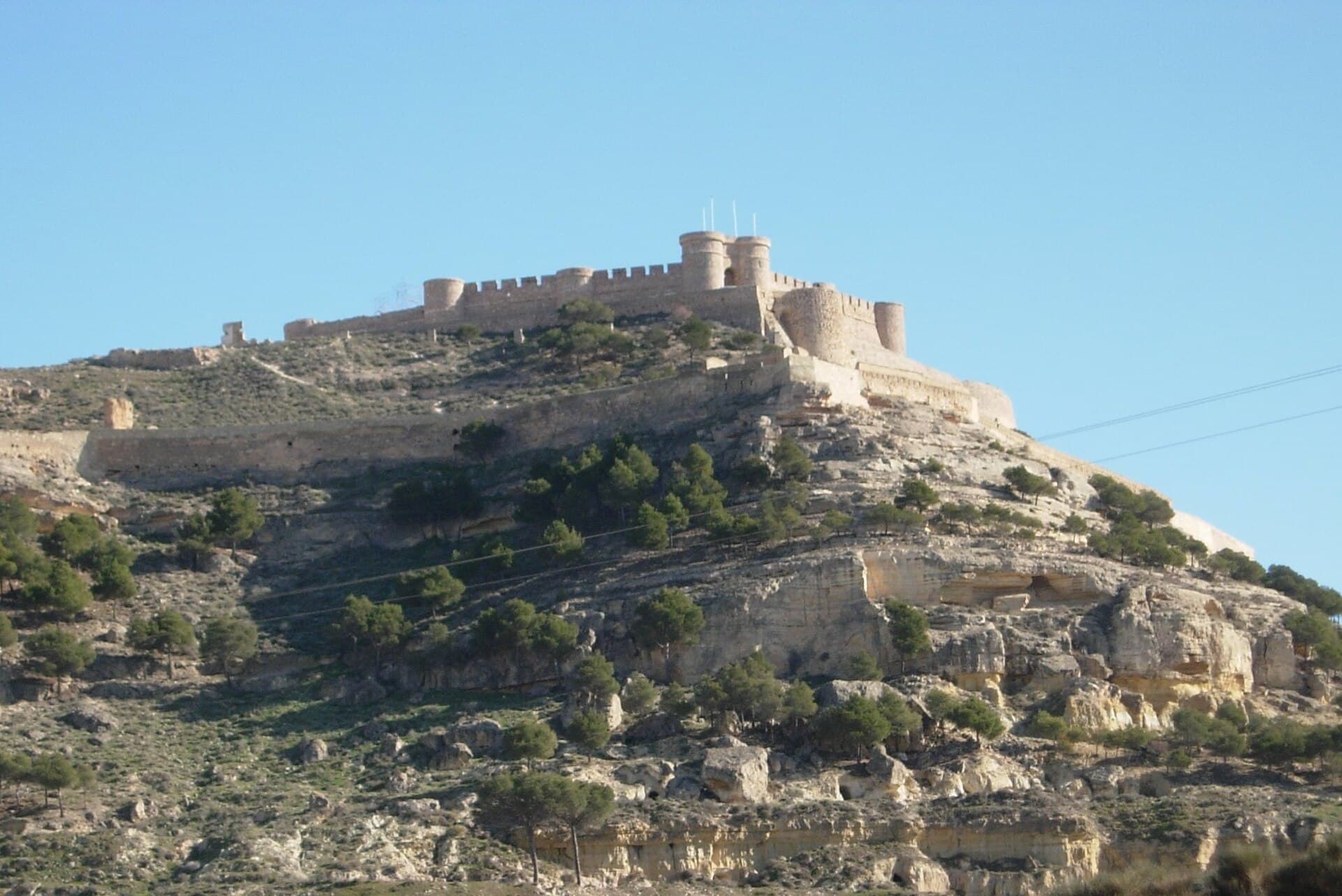
The formidable walls of Chinchilla Castle once held a figure whose name still resonates with intrigue and scandal.
Full story unlocks in the tour
 Héctor S. Marqueño / CC BY-SA 2.5, via Wikimedia Commons
Self-guided audio walking tour of Chinchilla de Monte-Aragón — GPS route, offline playback, story-driven narration in 32 languages.
“Where history is carved into the very rock and echoes through ancient streets.”
Not the postcards. The stories even locals don't know — whispered in your ear, right where they happened.
The formidable walls of Chinchilla Castle once held a figure whose name still resonates with intrigue and scandal.
Beneath the historic town, a network of homes offers a glimpse into a unique way of life.
The main church of Chinchilla de Monte-Aragón holds a secret within its seemingly Baroque interior.
Discover every secret of Chinchilla de Monte-Aragón
Every address, every reveal in full — in your ear, right where it happened.
You pick your stops. You walk. The voice reveals what the others miss.

Your self-guided audio tour of Chinchilla de Monte-Aragón is ready — pick your landmarks, choose your language, and start the moment you arrive.
BuyLume has a built-in augmented-reality guide. Hold your phone up and its camera shows the street ahead of you, with a glowing arrow laid over the real view that always points to your next stop — no map to puzzle over, no wrong turns. Like everything in Lume, it works fully offline.
Chinchilla de Monte-Aragón, often simply called Chinchilla, is a historic town in the province of Albacete, within Spain's Castilla-La Mancha region. Situated on a hill overlooking the plains of La Mancha, it stands as a testament to centuries of diverse civilizations. The town's strategic location, once on the ancient Roman road known as the Vía Augusta, has made it a significant crossroads since Neolithic times.
Designated a Conjunto Histórico (Historic-Artistic Site), Chinchilla de Monte-Aragón invites a leisurely exploration of its medieval street plan, where grand houses and traditional courtyards reveal the town's layered past. Its imposing 15th-century castle, rebuilt by a medieval prince, and its fortified walls, which earned it the royal titles "Noble and Most Loyal" from the Catholic Monarchs, dominate the skyline. Just 15 kilometers from Albacete, the provincial capital, Chinchilla offers a captivating journey through time.
The history of Chinchilla de Monte-Aragón stretches back to the Neolithic period, its elevated position above a marshy plain making it an attractive settlement. Its mention in the Antonine Itinerary confirms its importance as a Roman crossroads on the Vía Augusta. Under Moorish rule, it was known as Ghenghalet or Yinyalá, and by 928, it was a significant town within the Kingdom of Murcia during the Córdoban caliphate.
Alfonso X, aided by the Orders of Calatrava and Santiago, reclaimed Chinchilla from Arab control in 1242. The Treaty of Alcaraz in the following year solidified Castilian authority over the territory. The town then came under the lordship of the Villena family, with Don Juan Manuel, son of Infante Manuel de Castilla, undertaking a significant rebuilding of the castle in the late 13th century.
Chinchilla's loyalty was further recognized in 1422 when Juan II granted it the title of city after it resisted an attempted takeover by Infante Enrique of Aragon. Following the wars between Isabella and Juana la Beltraneja, Chinchilla officially joined the Crown of Castile in 1480. The Catholic Monarchs further honored the town in 1488, swearing its privileges and bestowing the titles "Noble and Most Loyal," which are still proudly displayed on the town's coat of arms today.
The 15th century saw the castle restored by Juan Pacheco, the first Marquis of Villena, whose coat of arms can still be seen on its walls. For nearly three centuries, the fortress served as a prison, housing figures like Cesare Borgia. The castle also played a role in later conflicts, serving as barracks during the War of the Spanish Succession and for Napoleonic troops during the War of Spanish Independence, sustaining damage in 1812.
In a brief period between 1822 and 1823, Chinchilla was even chosen as a provincial capital, though this designation was short-lived, with the capital moving to Albacete in 1833. Today, Chinchilla de Monte-Aragón, with its estimated population of around 4,659 in 2025, maintains its medieval character and historical significance, offering a captivating glimpse into Spain's past.
The most prominent landmark is the Chinchilla Castle, a 15th-century fortress built on earlier Roman, Gothic, and Arab foundations. Visitors can explore its exterior, admire the thick defensive walls, and take in expansive views of the La Mancha plain. The castle is surrounded by a formidable moat, ten meters wide and six meters deep, carved from solid rock.
At the heart of the town lies the Plaza Mayor, also known as Plaza de la Mancha, a picturesque square featuring arcaded buildings and traditional balconies. Here, you'll find the City Hall, dating from the 16th to 18th centuries.
The Church of Santa María del Salvador is the town's most important religious building, showcasing a blend of Gothic, Renaissance, and Baroque styles. Its interior houses notable artwork, including a 16th-century altarpiece and a 14th-century alabaster statue of the Virgen de las Nieves, the city's patron saint. Other historical buildings include the Convent of Santo Domingo, the Hospital of San Julián, and several emblazoned houses from the 16th to 18th centuries, such as the ancestral homes of López de Haro and Núñez Robles.
For a unique experience, explore the Cuevas del Agujero Cave District, a neighborhood of ancient cave dwellings carved into the rock, many still inhabited. You can also visit the National Ceramic Museum for a collection of traditional Manchego ceramics.
Chinchilla de Monte-Aragón experiences significant temperature variations throughout the year. The best time to visit for pleasant weather is during April, May, June, September, and October, when average temperatures range from 20°C to 30°C. These months are ideal for sightseeing and outdoor exploration. While summers can be hot with daytime highs reaching 34°C in July, and winters cold with January lows around 2°C, the town generally has dry conditions year-round, with the driest month being July.
Chinchilla de Monte-Aragón is located approximately 15 kilometers from Albacete, the capital of the province, and is well-connected by highway. Many residents commute to Albacete for work or study. The municipality includes several smaller villages, such as El Villar de Chinchilla, known for its special Almansa Denominación de Origen wines.
For dining, you'll find several Spanish restaurants and bars in and around Chinchilla, offering regional specialties like Queso Manchego, Pisto Manchego, and Migas. The town also hosts cultural events, including the Classic City of Chinchilla Theater Festival in July, and the Festival Nacional de la Canción. Public parking is available, though some historic areas, like the cave house district, may require parking about 50 meters away and walking down stairs.
Chinchilla de Monte-Aragón in Korean, in Chinese or in Hebrew — and 29 more languages, every stop narrated by a native voice. The widest language range of any self-guided audio tour.
Available in: