Casas Colgadas (Hanging Houses)
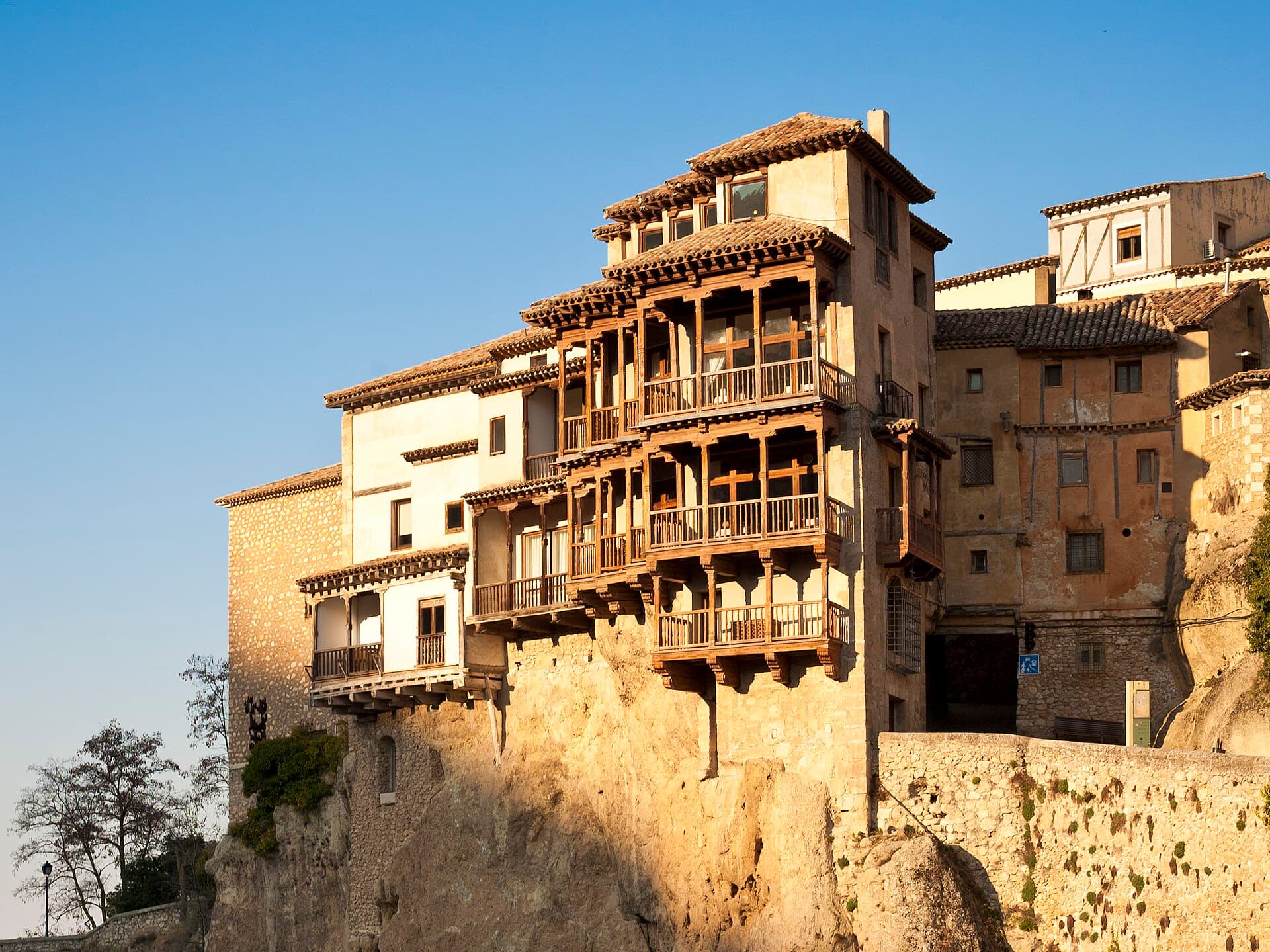
The iconic Hanging Houses of Cuenca appear to defy gravity, yet their original purpose was not merely aesthetic.
Full story unlocks in the tour
 Claussmoon / CC BY-SA 3.0, via Wikimedia Commons
Self-guided audio walking tour of Cuenca — GPS route, offline playback, story-driven narration in 32 languages.
“Where medieval marvels meet abstract art, clinging to ancient cliffs.”
Not the postcards. The stories even locals don't know — whispered in your ear, right where they happened.
The iconic Hanging Houses of Cuenca appear to defy gravity, yet their original purpose was not merely aesthetic.
Cuenca's Cathedral conceals a secret about its architectural style that might surprise you, considering its Spanish setting.
This internationally acclaimed museum, housed within the Hanging Houses, was once lauded as 'the most beautiful small museum in the world.'
Discover every secret of Cuenca
Every address, every reveal in full — in your ear, right where it happened.
You pick your stops. You walk. The voice reveals what the others miss.


Lume has a built-in augmented-reality guide. Hold your phone up and its camera shows the street ahead of you, with a glowing arrow laid over the real view that always points to your next stop — no map to puzzle over, no wrong turns. Like everything in Lume, it works fully offline.
Cuenca, a city seemingly suspended between heaven and earth, rises dramatically from a pyramid-like hill in east-central Spain. Its historic quarter, a UNESCO World Heritage site, sits nearly 1,000 meters above sea level, carved by the deep gorges of the Júcar and Huécar rivers. This striking topography has shaped Cuenca's identity, leading to the creation of its famous Casas Colgadas, or Hanging Houses, which appear to defy gravity as they cling to the cliff edges.
Beyond its dramatic natural setting, Cuenca is a city where medieval charm converges with a surprising modern artistic spirit. Its winding streets, ancient stone buildings, and a magnificent Gothic cathedral recount centuries past, from its Moorish origins to its Christian conquest. Yet, within these historic walls, you will also discover a contemporary art scene, notably the Museum of Spanish Abstract Art housed in one of its most recognizable structures. Cuenca offers a singular blend of history, nature, and culture, inviting visitors to explore its depths and marvel at its improbable beauty.
## From Moorish Stronghold to Christian City Cuenca's strategic location, between the deep gorges of the Júcar and Huécar rivers, made it a coveted site throughout history. The area was inhabited by various tribes, including the Concani, Lobetani, and Celtiberians, before the Romans established settlements in the wider province. However, the specific site of modern-day Cuenca remained uninhabited during the Roman era.
The city's definitive origins trace back to the Muslim capture of the area in 714 CE. Recognizing the defensive value of the location, they built a fortress, known as Qal'at Kūnka, around the 10th century. This stronghold became a significant center for the Arabised Berber lineage of the Banū Zennum. Cuenca's economy flourished under Muslim rule, driven by agriculture and a thriving textile manufacturing industry.
Christian forces, under King Alfonso VIII of Castile, eventually conquered Cuenca in 1177 after a nine-month siege. This marked a pivotal shift in the city's identity. Alfonso VIII granted Cuenca the title of 'city' in 1257, and it became an episcopal see in 1182. The construction of the Cuenca Cathedral, an early example of Gothic architecture in Spain with Anglo-Norman influences, began in 1182. During the following centuries, Cuenca prospered as a cultural and textile center, with its population and monumental legacy growing beyond its original walls.
## Decline, Recovery, and World Heritage Status The prosperity of Cuenca began to wane in the 17th century with the collapse of its manufacturing and animal breeding industries. The city experienced a significant loss of population, reducing to around 6,000 inhabitants. The 19th century brought further challenges, including damage during the Spanish War of Independence and the Third Carlist War. The early 20th century saw the collapse of the Giraldo cathedral tower in 1902, necessitating a rebuild of the façade.
Despite these setbacks, Cuenca slowly began to recover in the mid-20th century, expanding beyond its old walls. A significant turning point came in 1996 when the historic walled city of Cuenca was designated a UNESCO World Heritage Site, recognizing its exceptional cultural value and unique integration with the landscape. This recognition, coupled with the development of new cultural institutions like the Museum of Spanish Abstract Art, has boosted tourism and cemented Cuenca's place as a distinctive destination in Spain.
Cuenca's most recognizable sights are undoubtedly the Casas Colgadas (Hanging Houses), medieval structures that appear to defy gravity as they cling to the Huécar gorge. One of these houses is home to the Museum of Spanish Abstract Art, an internationally recognized collection of 20th-century Spanish abstract works.
The Cuenca Cathedral, a striking example of early Gothic architecture with Anglo-Norman influences, dominates the Plaza Mayor, the heart of the old town. Stroll through the narrow, winding streets of the historic center, absorbing the medieval atmosphere. For expansive views of the Hanging Houses and the gorges, cross the Puente de San Pablo (San Pablo Bridge).
Beyond the city's core, consider a visit to the Mangana Tower, offering historical insights and further views. For those interested in natural wonders, the Ciudad Encantada (Enchanted City) is a short drive away, featuring distinctive rock formations sculpted by nature. The Museo Paleontológico de Castilla-La Mancha (MUPA) offers a captivating look at Spain's prehistoric past, including dinosaur exhibits.
The ideal time to visit Cuenca is during the shoulder seasons of May and mid-September to mid-October. During these months, the weather is pleasant, with comfortable temperatures for exploring the city's steep streets and enjoying outdoor activities. You might even catch the striking autumn foliage or the Fiestas de San Mateo in September. While summers (June to August) are warm and sunny, with average highs around 86°F (30°C) in July, nights can be cool. This period is suitable for warm-weather activities, but be prepared for warm daytime strolls. Winters (December to February) are colder, with sunny days interspersed with rainy periods.
Cuenca is readily accessible, especially from Madrid. The high-speed AVE train from Madrid takes approximately 50 minutes. Valencia also offers train connections, taking about an hour. If arriving by train, note that the station is about 5 km from the city center, so arranging a taxi or private transfer in advance is recommended as public transportation can be infrequent. Once in the old town, Cuenca is entirely walkable, though its steep, winding streets necessitate comfortable shoes. Consider staying for two to four days to fully experience the city and its surrounding natural attractions. The local tapas culture makes dining affordable, and a range of accommodation options are available.
Cuenca in Korean, in Chinese or in Hebrew — and 29 more languages, every stop narrated by a native voice. The widest language range of any self-guided audio tour.
Available in: