Cuacos de Yuste, Spainpedronchi from Madrid, España / CC BY 2.0, via Wikimedia Commons
ES

Cuacos de Yuste

Self-guided audio walking tour of Cuacos de Yuste — GPS route, offline playback, story-driven narration in 32 languages.

Where an emperor sought solace and silence.

The secrets of Cuacos de Yuste

Cuacos de Yuste, as no one tells it.

Not the postcards. The stories even locals don't know — whispered in your ear, right where they happened.

3 secrets below. Many more wait inside the tour.
Monasterio de San Jerónimo de Yuste

Emperor Charles V, after relinquishing his vast empire, selected a surprisingly modest dwelling for his final years. His living quarters, however, were not entirely what one might anticipate for a former world ruler.

Full story unlocks in the tour
Plaza de España, Cuacos de Yuste

The central plaza of Cuacos de Yuste appears to be any other charming Spanish square, yet it holds a curious connection to a distant land and a particular type of tree.

Full story unlocks in the tour
Cementerio Alemán (German Cemetery)

Cuacos de Yuste contains a unique cemetery, not for local villagers or Spanish war heroes, but for individuals from a specific European nation, many of whom met their end far from home during two global conflicts.

Full story unlocks in the tour
The full tour

Discover every secret of Cuacos de Yuste

Every address, every reveal in full — in your ear, right where it happened.

Get the key to Cuacos de Yuste

You pick your stops. You walk. The voice reveals what the others miss.

Choose your time

How long do you have in Cuacos de Yuste?

Your self-guided audio tour of Cuacos de Yuste is ready — pick your landmarks, choose your language, and start the moment you arrive.

Buy
About Cuacos de Yuste

The story of Cuacos de Yuste

Cuacos de Yuste is a tranquil village in the Vera region of Extremadura, Spain, primarily recognized for its association with Emperor Charles V. It rests at the foot of the Sierra de Gredos, encircled by a landscape of oak woodlands, olive groves, and cherry orchards. The village itself is defined by its traditional architecture, featuring timber-framed houses and arcaded squares. Life here unfolds at a gentle rhythm, offering a glimpse into rural Spanish existence far from the clamor of cities.

The village's enduring renown stems from the nearby Monastery of San Jerónimo de Yuste, where Charles V, after abdicating his expansive empire, chose to spend his concluding years. This historical link draws visitors seeking to comprehend the emperor's withdrawal from power and his contemplative last days. Beyond the imperial legacy, Cuacos de Yuste provides a serene foundation for exploring the natural splendor and culinary customs of the La Vera comarca.

History

Imperial Retreat and Monastic Life

The story of Cuacos de Yuste is deeply interwoven with the Monastery of San Jerónimo de Yuste. The monastery itself was established in 1402 by Hieronymite monks, who sought a secluded location for meditation and prayer. Over the centuries, it grew in significance, becoming an important religious center in the region.

The defining moment in Cuacos de Yuste's past arrived in 1556 when Emperor Charles V, one of Europe's most influential rulers, made the unprecedented decision to relinquish his thrones. Exhausted from decades of conflict and governance, and afflicted by gout, Charles sought a peaceful retirement. He selected the Monastery of Yuste for its calm setting and moderate climate.

Charles V commissioned a modest palace adjacent to the monastery, designed to afford him both privacy and direct access to the monastic services. He arrived in Yuste in February 1557 and resided there for approximately a year and a half until his passing in September 1558. During his time at Yuste, Charles continued to engage with some matters of state, corresponding with his son Philip II, but his primary focus was on religious devotion and personal reflection. His presence brought considerable attention to the small village and the monastery, cementing their place in Spanish and European history.

Later Years and Modern Recognition

After Charles V's death, the monastery continued its religious functions, though it sustained damage during the Peninsular War in the early 19th century when French troops set it ablaze. It was later reconstructed and restored. In the 20th century, the monastery and surrounding area gained renewed recognition for their historical importance.

In 2007, the European and Ibero-American Academy of Yuste Foundation was established at the monastery, fostering research and reflection on European integration and Ibero-American relations, further solidifying Cuacos de Yuste's role as a place of historical and cultural weight. The village and monastery remain a powerful emblem of imperial abdication and a testament to a monarch's quest for tranquility in his final years.
What to see

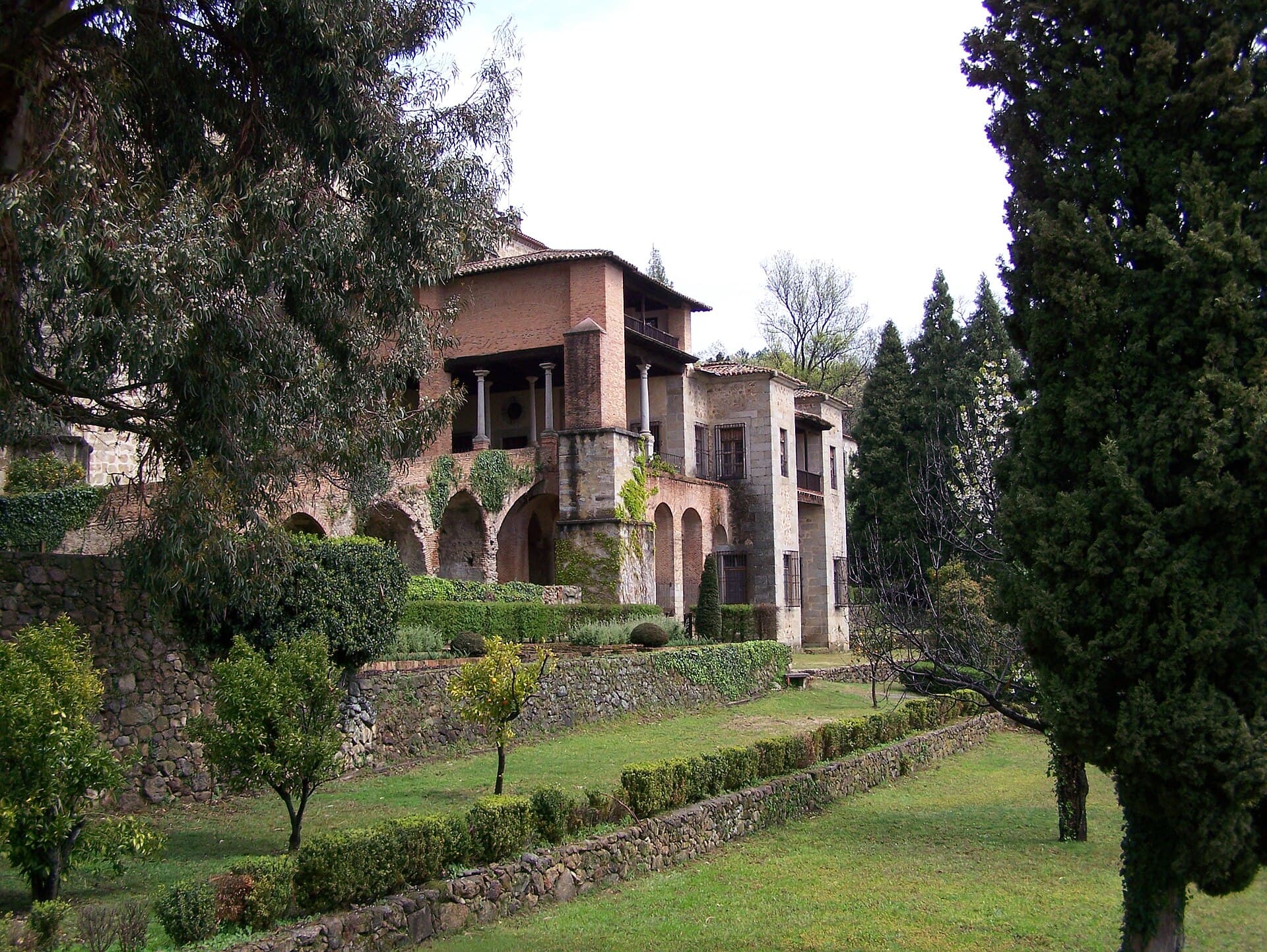
The primary point of interest in Cuacos de Yuste is the Monasterio de San Jerónimo de Yuste. This Hieronymite monastery, with its adjoining palace constructed for Emperor Charles V, offers a moving insight into the emperor's final retreat. Visitors can explore Charles V's austere chambers, the church, and the cloisters, gaining understanding into his daily routine and piety.

Within the village itself, the Plaza de España is an appealing central square with traditional architecture and arcades, a pleasant spot for a coffee. The Parish Church of Nuestra Señora de la Asunción displays a blend of Gothic and Renaissance elements.

A short distance from the village lies the Cementerio Alemán (German Cemetery), a meticulously maintained site where German soldiers from both World Wars are interred. It is a solemn but historically significant place, offering a distinct perspective on European history.

For those interested in local tastes, seek out shops selling paprika de la Vera, a celebrated smoked paprika produced in the region, and other local products like olive oil and cherries (when in season).

When to visit

The most favorable times to visit Cuacos de Yuste are spring (April to June) and autumn (September to October). During these months, the weather is mild and agreeable, perfect for exploring the monastery and the surrounding natural scenery. Spring brings blossoming cherry trees to the region, while autumn presents brilliant fall colors. Summers can be intensely hot, with temperatures frequently exceeding 30°C (86°F), while winters are generally cool and can be damp.

Practical

Cuacos de Yuste is reachable by car, which offers the most convenient way to explore the region. It is approximately a two-hour drive from Madrid. Bus services also connect the village to larger towns in Extremadura, though schedules may be infrequent. Within the village, walking is the ideal method of movement. The Monastery of Yuste is a short drive or a pleasant stroll from the village center. Modest attire is advised when visiting the monastery, as it is a religious site. Local cuisine features Extremaduran specialties, including migas, Iberian pork products, and dishes infused with pimentón de la Vera. Accommodation options include rural guesthouses and small hotels.

Good to know
What are the opening hours for the Monastery of Yuste?
The Monastery of Yuste typically opens from 10:00 AM to 1:30 PM and 3:30 PM to 6:30 PM, though hours can fluctuate by season and day of the week. It is advisable to consult the official Patrimonio Nacional website for the most current schedule before planning your visit.
Is there an entrance fee for the Monastery of Yuste?
Yes, there is an entrance fee to enter the Monastery of Yuste. Reduced rates are often available for students, seniors, and larger groups.
Can I take photos inside the Monastery of Yuste?
Photography guidelines can differ within various areas of the monastery. Generally, flash photography is prohibited, and in some sensitive areas, photography may not be permitted at all. It is best to observe posted signs or inquire with staff for guidance.
Are there guided tours available at the monastery?
Yes, guided tours are often offered at the Monastery of Yuste, providing deeper insights into its history and the life of Charles V. Audio guides may also be an option. Please check upon arrival or on the official website for specific details.
What local products should I look for in Cuacos de Yuste?
Cuacos de Yuste and the surrounding La Vera region are celebrated for 'Pimentón de la Vera' (smoked paprika), which holds a Protected Designation of Origin. You will also discover excellent olive oil, cherries (when in season), and local cured meats.
Is Cuacos de Yuste suitable for children?
While the historical importance of the monastery might engage older children interested in history, younger children might find it less captivating. The village itself provides a safe and pleasant environment, and the surrounding nature offers opportunities for gentle walks suitable for families.
On the map
Cuacos de Yuste
€9.90
No booking · activate anytime · 12h to walk it
Load on Wi-Fi, then walk offline — no roaming abroad
Get the key to Cuacos de Yuste