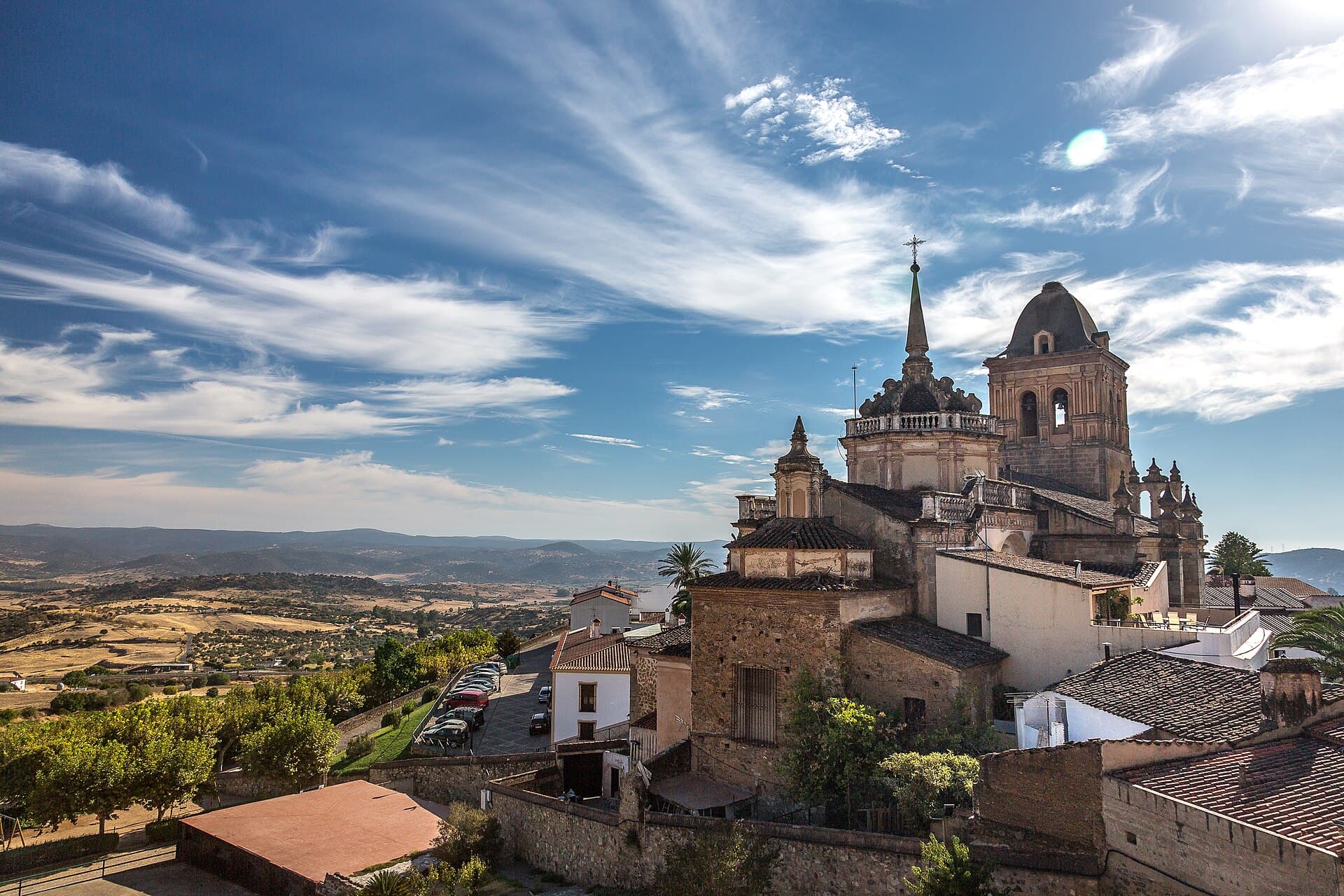
Torre Sangrienta (Bloody Tower)
The castle's most ominous tower holds a chilling secret about its final Templar defenders.
Full story unlocks in the tour
 Paulo Valdivieso from Lisboa, Portugal / CC BY-SA 2.0, via Wikimedia Commons
Self-guided audio walking tour of Jerez de los Caballeros — GPS route, offline playback, story-driven narration in 32 languages.
“Where Templar legends echo through sun-drenched streets.”
Not the postcards. The stories even locals don't know — whispered in your ear, right where they happened.
The castle's most ominous tower holds a chilling secret about its final Templar defenders.
Look closely at the altarpiece inside this lively church, and you'll find a poignant tribute.
The very name of this town, 'Jerez de los Caballeros,' isn't just a historical label.
Discover every secret of Jerez de los Caballeros
Every address, every reveal in full — in your ear, right where it happened.
You pick your stops. You walk. The voice reveals what the others miss.
Your self-guided audio tour of Jerez de los Caballeros is ready — pick your landmarks, choose your language, and start the moment you arrive.
BuyLume has a built-in augmented-reality guide. Hold your phone up and its camera shows the street ahead of you, with a glowing arrow laid over the real view that always points to your next stop — no map to puzzle over, no wrong turns. Like everything in Lume, it works fully offline.
Jerez de los Caballeros, a town in the Badajoz province of southwestern Spain, ascends from two hills, overseeing the River Ardila. Its old town, recognized as a Property of Cultural Interest, displays a blend of cultural influences spanning centuries. Known as the 'white village' of the region, it features whitewashed houses crowned with red roof tiles, and its narrow, stone-paved passages contribute to its allure.
This historic locale is deeply intertwined with the Knights Templar, who were granted the town in the 13th century and left an indelible mark on its defenses and character. Beyond its Templar legacy, Jerez de los Caballeros is also notable as the birthplace of several explorers of the Americas, including Vasco Núñez de Balboa, the first European to sight the Pacific Ocean. The town is surrounded by meadows, providing excellent pasture for livestock, which forms the basis of the local economy.
Jerez de los Caballeros offers a journey through time, from its ancient Phoenician origins to Roman villas, Visigothic remnants, and Arab influences. The town's monumental complex includes a citadel, the Templar Fortress, and numerous churches, convents, and stately homes, all contributing to its distinctive atmosphere.
The origins of Jerez de los Caballeros stretch back to the Phoenicians, who are believed to have named the area 'Ceret.' Evidence of even older habitation exists with the Dolmen at Granja de Torriñuelo, a Neolithic burial site declared a National Monument. Roman families later established properties here, leaving behind remnants such as the Roman bridge known as 'Pontón' and preserved mosaics.
Following the Roman era, Visigothic influences emerged, with a column inside the Santa María Church bearing a date from 556 AD as testament. The Moors then held sway, and elements like the small Muslim mosque, the Morabito, within the castle, and arches in the Moorish quarter are architectural survivors from this period.
Jerez de los Caballeros gained its defining identity during the Reconquista. Alfonso IX of Leon founded the town in 1229, and in 1232, his son Ferdinand III the Saint granted it to the Knights Templar. This act gave the town its name, meaning 'Jerez of the Knights,' and established it as a significant Templar stronghold. The Templars fortified the castle, constructed the surrounding wall, and built the Church of San Bartolomé. During this time, Jerez became the capital of a bayliato (a Templar administrative district), encompassing several surrounding towns.
However, the Templar Order faced dissolution in the early 14th century. In Jerez de los Caballeros, the last Templars in Extremadura made a final stand at the Torre Sangrienta (Bloody Tower) within the castle. After a fierce battle, they were defeated, captured, and beheaded, giving the tower its grim name. The town's historical significance continued through the era of exploration, as it was the birthplace of notable conquistadors like Vasco Núñez de Balboa and Hernando de Soto. The wealth brought back from the New World by these figures contributed to the construction of noble houses and mansions within the historic quarter. The castle itself underwent modifications in the 16th century to adapt to evolving military needs.
The Templar Fortress (Alcazaba) is a central feature, partly built on older Arab walls, with 18 of its original 26 towers still standing. Within the fortress, the Torre Sangrienta (Bloody Tower) is a poignant reminder of the Templars' final stand.
The town is dotted with religious architecture. The Church of San Miguel Arcángel is an imposing structure with a Baroque tower and a gold altarpiece. The Church of San Bartolomé, dedicated to the town's patron, is known for its colorful tower, adorned with polychrome plaster, glazed clay, and ceramics. The Church of Santa María de la Encarnación, located adjacent to the Templar Fortress, is the oldest church in Jerez. Other notable churches include La Encarnación (16th century) and Santa Catalina.
Explore the Plaza de Vasco Núñez de Balboa, dedicated to the explorer, near his ancestral home. The Museum of Sacred Art houses a significant collection of religious works from southern Extremadura. For a glimpse into prehistoric times, the Dolmen at Granja de Torriñuelo is a short distance outside the city.
For comfortable weather, consider visiting Jerez de los Caballeros in April, May, September, and October. During these months, daytime temperatures are pleasant for sightseeing. The town experiences very warm summers from June to September, with July being the warmest month, reaching average highs of 34°C (93°F). If you enjoy hot weather activities, late June to early September is ideal. Winters are mild, with January daytime highs around 14°C (57°F).
A significant event is the Templar Festival, held annually in July, which transforms the town into a medieval village with reenactments, parades, and cultural activities.
Jerez de los Caballeros is located in the province of Badajoz, in southwestern Spain, about 18 km east of the Portuguese border. The old town is encircled by a Moorish wall with six gates, with the Puerta de Burgos being a prominent entry point. The historic center, with its narrow, stone-paved passages, is accessible from the Plaza de Vasco Núñez de Balboa via Calle Corredera Hernando de Soto.
The town has been actively working on improving accessibility, with a plan implemented between 2018 and 2022 to enhance public spaces and buildings. This initiative includes accessible information points, a heritage guide, and a mobile application, all adapted for people with different abilities, offering content in easy-to-read formats, video, sign language, and Braille. The local economy is largely based on stockbreeding, particularly Iberian pigs, and the town is recognized as the "cradle of the Iberian pig." Local gastronomy includes Iberian ham, migas, and regional wines. Restaurants like La Ermita and Caeriana offer Mediterranean cuisine and local products.
Jerez de los Caballeros in Korean, in Chinese or in Hebrew — and 29 more languages, every stop narrated by a native voice. The widest language range of any self-guided audio tour.
Available in: