The Old Market (Palia Agora)
Komotini's Old Market is a winding path of small shops, yet a particular feature reveals a historical quirk in its urban planning.
Full story unlocks in the tour
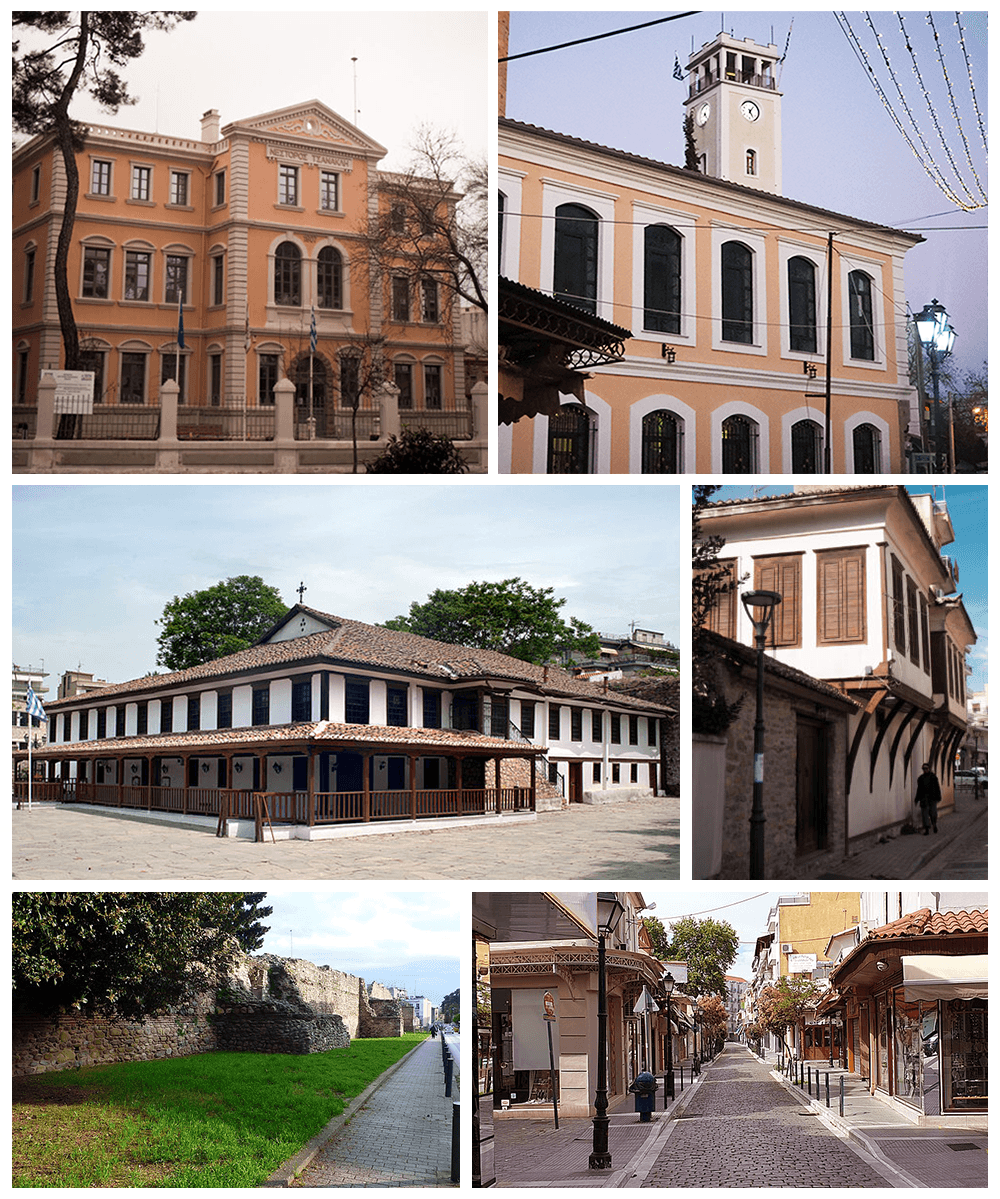 SilentResident (compilation, sources to attribute see above; if any of the sources used in the Montage are removed from Wikimedia Commons, or better ones are found, please inform its creator so that they can update it. You can contact the creator by leaving a message here: [1]) / CC BY-SA 3.0, via Wikimedia Commons
Self-guided audio walking tour of Komotini — GPS route, offline playback, story-driven narration in 32 languages.
“Where ancient echoes meet Ottoman elegance and university life flourishes.”
Not the postcards. The stories even locals don't know — whispered in your ear, right where they happened.
Komotini's Old Market is a winding path of small shops, yet a particular feature reveals a historical quirk in its urban planning.
This prominent mosque in the city center bears a name that might suggest it is Komotini's most ancient Islamic structure, but its history unfolds a different narrative.
The Clock Tower stands as a symbol of Komotini's past, its origins tied to a specific Ottoman Sultan and a broader movement of modernization.
Discover every secret of Komotini
Every address, every reveal in full — in your ear, right where it happened.
You pick your stops. You walk. The voice reveals what the others miss.


Your self-guided audio tour of Komotini is ready — pick your landmarks, choose your language, and start the moment you arrive.
BuyLume has a built-in augmented-reality guide. Hold your phone up and its camera shows the street ahead of you, with a glowing arrow laid over the real view that always points to your next stop — no map to puzzle over, no wrong turns. Like everything in Lume, it works fully offline.
Komotini, the capital of the Rhodope regional unit in northeastern Greece, is a city where diverse cultures intertwine, creating a distinct atmosphere. Situated on the Thracian plain at the base of the Rhodope Mountains, it offers a convergence of urban activity and natural landscapes. Home to the Democritus University of Thrace, Komotini pulses with youthful energy, contributing to its cosmopolitan feel.
The city's character is deeply rooted in its enduring story, displaying a graceful coexistence of Christian and Muslim communities. This multicultural heritage is evident in its architecture, daily rhythms, and gastronomy. From Byzantine remnants to Ottoman-era structures and modern Greek establishments, Komotini invites visitors to delve into its layered past and lively present.
Often called the "coffee city" of Greece, Komotini's animated central square and the stone-paved passages of the Old Market are favored gathering places for locals and students alike, where they savor aromatic coffee.
Komotini's origins trace back to a settlement in the 2nd century AD. Its strategic location along the Via Egnatia, a vital Roman road connecting Dyrrhachium with Constantinople, was crucial to its early development. The Roman Emperor Theodosius I fortified the area in the 4th century AD, constructing a small rectilinear fortress to protect this junction and the fertile Thracian plain from incursions. This Byzantine fortress formed the heart around which the city would later expand.
Komotini, then known as Komoutzina, began to take the shape of a town in the 14th century, particularly after people from the nearby Byzantine town of Mosynoupolis settled there following its destruction in 1206. The city came under the Ottoman Empire between 1361 and 1363, conquered by Gazi Evrenos Bey. Under Ottoman rule, the city, renamed Gümülcine, grew considerably, becoming an important trading center linking the capital with the European parts of the empire. This period saw the construction of many monuments, including the Imaret, an Ottoman-era poorhouse considered one of Europe's oldest surviving Ottoman structures, and the first mosques.
Komotini remained under Ottoman rule for centuries, until it was annexed by Greece in 1913 following the Balkan Wars. The Treaty of Lausanne in 1923 brought significant demographic shifts due to population exchange, though a sizable Muslim minority in Komotini was exempted and continues to be a part of the city's diverse cultural fabric. During World War II, Komotini was under German occupation. The founding of the Democritus University of Thrace in 1973 ushered in a new era for Komotini, injecting youthful energy and contributing to its expansion and development as an educational, cultural, and commercial center in Thrace.
Begin your exploration at the Byzantine Fortress walls, remnants of the 4th-century fortifications that once defended the city. Nearby, the distinctive Clock Tower, an Ottoman-era monument from 1884, stands beside the Yeni Mosque. The Yeni Mosque, built in 1585, is notable for being the only surviving structure in Greece with Iznik tiles from the 1580s. Take time to see the Eski Mosque, dating from 1608, which also reflects the city's Ottoman heritage.
Immerse yourself in history at the Archaeological Museum of Komotini, housed in a striking building designed by Aris Konstantinidis, displaying artifacts from the Neolithic to the Byzantine periods. For a glimpse into local traditions, visit the Folklore Museum, set in a 19th-century mansion. The central Eirini Square is the city's beating heart, encircled by cafes and shops, while the Old Market (Palia Agora) offers a labyrinth of narrow passages with traditional crafts, spices, and local sweets. For a tranquil escape, the Nymfaia forest, just 6 kilometers away, provides walking paths and sweeping views.
The most agreeable times to visit Komotini are during spring and autumn, specifically May, June, September, and October. During these months, temperatures are comfortable, ranging from 21°C to 28°C, ideal for exploring the city and its surroundings. Summers (July and August) are warm and dry, with average highs often exceeding 30°C, suitable for those who appreciate warm weather, though evenings bring a pleasant coolness. Winters (January and February) are cool and damp, with temperatures dropping to 1-2°C at night and more frequent precipitation, including the possibility of wet snow.
Komotini is generally a very secure city for travelers, with a low crime rate and a lively atmosphere, even at night, thanks to its university population. The official currency is the Euro (€). While credit cards are widely accepted in modern establishments, it is wise to carry cash for smaller purchases at traditional markets or kiosks. ATMs are readily available around the central square.
Greek is the official language, but English is commonly spoken and understood, especially in areas frequented by students and tourists. Komotini does not have its own airport; the closest options are Demokritos Airport (AXD) in Alexandroupoli (approximately 55 km away) and Kavala International Airport (KVA) (about 70 km away). The city itself is compact and best explored on foot, particularly the Old Market and central areas.
Komotini in Korean, in Chinese or in Hebrew — and 29 more languages, every stop narrated by a native voice. The widest language range of any self-guided audio tour.
Available in: