Local saying
Manciano has a centuries-old nickname that hints at something a little... otherworldly.
Full story unlocks in the tour
 LigaDue / CC BY 3.0, via Wikimedia Commons
Self-guided audio walking tour of Manciano — GPS route, offline playback, story-driven narration in 32 languages.
“Where ancient echoes meet wide Maremman horizons.”
Not the postcards. The stories even locals don't know — whispered in your ear, right where they happened.
Manciano has a centuries-old nickname that hints at something a little... otherworldly.
The main church in Manciano holds a tale of divine intervention and a patron saint's miraculous escape.
The ornate fountain in Piazza Garibaldi isn't just a pretty sight; its bas-reliefs tell a story of progress and a vital resource.
Discover every secret of Manciano
Every address, every reveal in full — in your ear, right where it happened.
You pick your stops. You walk. The voice reveals what the others miss.

Your self-guided audio tour of Manciano is ready — pick your landmarks, choose your language, and start the moment you arrive.
BuyLume has a built-in augmented-reality guide. Hold your phone up and its camera shows the street ahead of you, with a glowing arrow laid over the real view that always points to your next stop — no map to puzzle over, no wrong turns. Like everything in Lume, it works fully offline.
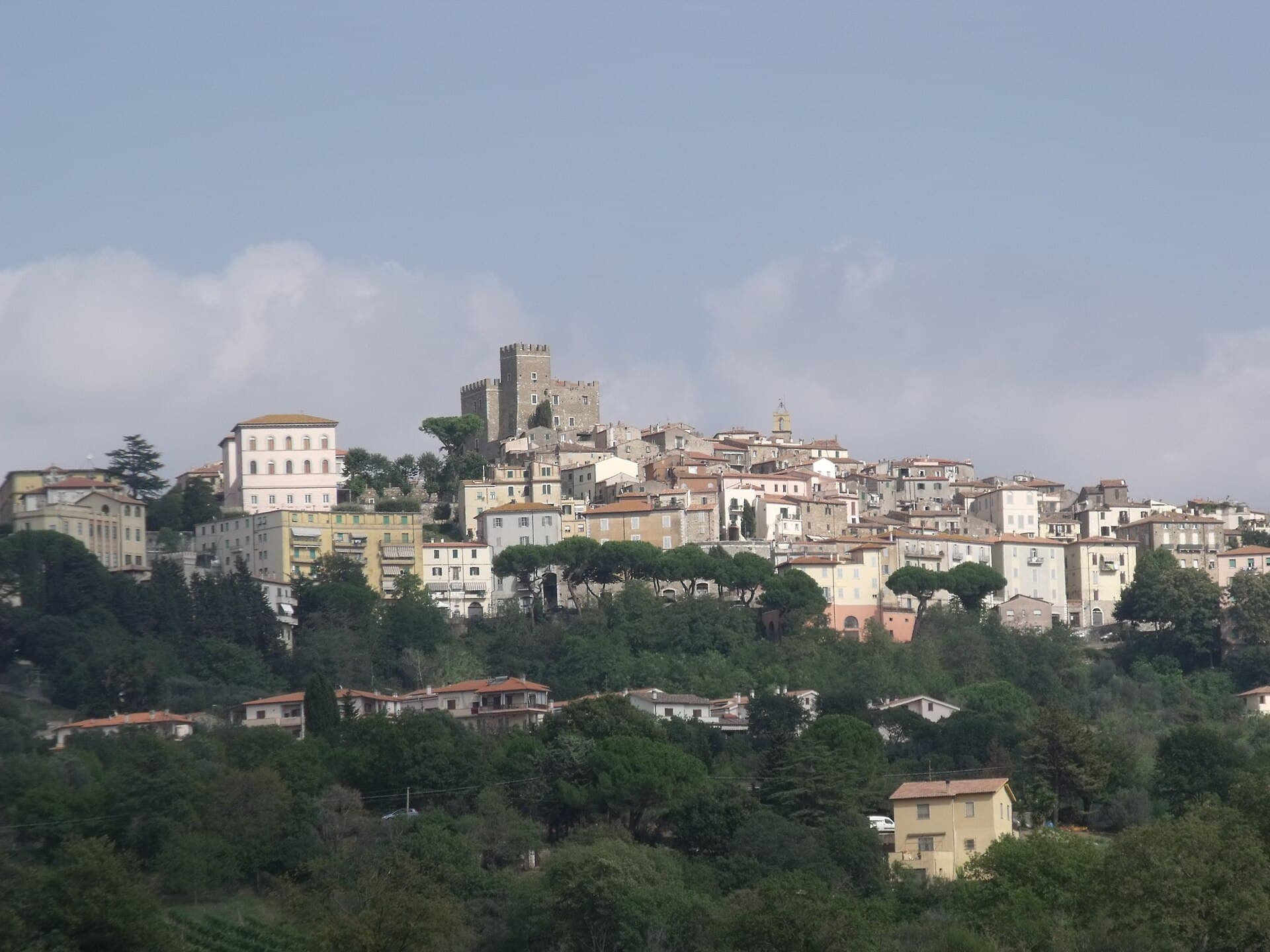
Situated on a hilltop in the core of Tuscany's Maremma region, Manciano affords expansive views that reach from Monte Amiata to the Argentario coast and even the islands of the Tuscan Archipelago. This commanding position earned it the moniker 'Spia della Maremma,' or 'Spy of the Maremma.' Far from the hurried crowds, Manciano offers a blend of enduring character, natural splendor, and authentic Tuscan living.
The town's well-preserved medieval core invites exploration, with narrow, curving passages revealing ancient walls, historic structures, and charming terraces. Beyond its captivating architecture, Manciano serves as a gateway to the region's celebrated thermal springs, profound Etruscan heritage, and a culinary tradition deeply rooted in local produce and flavors.
Manciano's story reaches back to prehistoric times, with archaeological discoveries from the Stone, Copper, and Bronze Ages confirming early human habitation in the hills between the town and Saturnia. The area formed a significant part of ancient Etruria, with numerous Etruscan burial grounds dotting the surrounding countryside.
The first documented mention of a castle in Manciano dates to 1188. Throughout the Middle Ages, Manciano's strategic location made it a sought-after possession, passing between powerful families and city-states. The Aldobrandeschi family, who controlled the hills in 1181, laid the foundation for its medieval prominence. They were succeeded by the Baschi family of Montemerano, and through marriage, the Orsini family of Pitigliano. A brief but influential occupation by Siena between 1419 and 1455 led to the construction of a formidable fortress around 1424. Later, Manciano came under the authority of the Grand Duchy of Tuscany and even the famed Florentine Medici family.
The town's varied past is evident in its mix of medieval and Renaissance architecture. Beyond its grand structures, Manciano's history is also marked by the endurance of its people. The elimination of malaria in the region played a pivotal role in shaping its modern agricultural landscape, transforming it into an area known for its arable pastures, wheat fields, and olive groves. In the 19th century, Manciano demonstrated its strong civic spirit by actively supporting Giuseppe Garibaldi's campaign for Italian unification. More recently, Manciano holds the distinction of being the first town in Tuscany liberated by the Allies in June 1944, and the site of Italy's first free elections after the Fascist period in February 1945. Today, Manciano stands as a testament to its rich and varied past, a town that has embraced its heritage while evolving into a delightful Tuscan destination.
Begin your exploration at the Cassero, the town's most prominent monument. This 12th-century fortress, now serving as the town hall, offers a sweeping view of the Maremma, extending to the Argentario coast and the Tuscan Archipelago. Walk down to Piazza Garibaldi, where an elegant Art Nouveau fountain from 1913 recounts the story of the Fiora Aqueduct. Nearby, the Church of San Leonardo, with its salmon-colored facade, is dedicated to Manciano's patron saint and displays works by Maremman painter Paride Pascucci.
Delve into the region's deep past at the Museo di Preistoria e Protostoria della Valle del Fiora, housed in Palazzo Nardelli. This interactive museum uses 3D reconstructions and augmented reality to bring prehistoric and protohistoric eras to life. Wander through Manciano's historic center, discovering its distinctive alleys, ancient walls, and the 15th-century Porta Fiorella.
Beyond the town center, the surrounding area offers much to discover. The celebrated Terme di Saturnia and the natural, free Cascate del Mulino hot springs are just a short drive away, providing a unique opportunity for relaxation in sulfurous waters. The nearby village of Montemerano, listed as one of Italy's most beautiful, captivates with its medieval character and Piazza del Castello. For a glimpse into Etruscan civilization, visit the Puntone Necropolis, with its approximately 40 tombs.
The ideal times to visit Manciano are during the spring (April to June) and fall (September to October). During these months, the weather is pleasant, and tourist numbers are smaller. Spring offers comfortably warm and breezy conditions, with temperatures ranging from 17-27°C (62-80°F), perfect for outdoor activities and enjoying the blooming Tuscan landscape. Fall also provides agreeable weather, with temperatures between 10-16°C (49-61°F), and is a great time for experiencing local festivals, truffle hunting, and wine tasting. Summers can be warm, with July being the warmest month, while winters are cooler and cloudier.
Manciano is best reached by car, offering the freedom to explore the surrounding Maremma region. The nearest major airport is Rome Fiumicino Airport (FCO). From there, you can rent a car or take a train to Orbetello-Monte Argentario, followed by a bus to Manciano. While English is not as widely spoken as in larger Italian cities, many in the tourism industry do speak it.
Accommodation options range from delightful agriturismos and bed & breakfasts to boutique hotels and vacation rentals. For dining, Manciano offers a variety of pizzerias, trattorias, and restaurants serving traditional Maremman cuisine, including local olive oil, red wines, and pecorino cheese. Comfortable walking shoes are recommended for navigating the town's stone pathways, and swimwear is essential for visiting the hot springs.
Manciano in Korean, in Chinese or in Hebrew — and 29 more languages, every stop narrated by a native voice. The widest language range of any self-guided audio tour.
Available in: