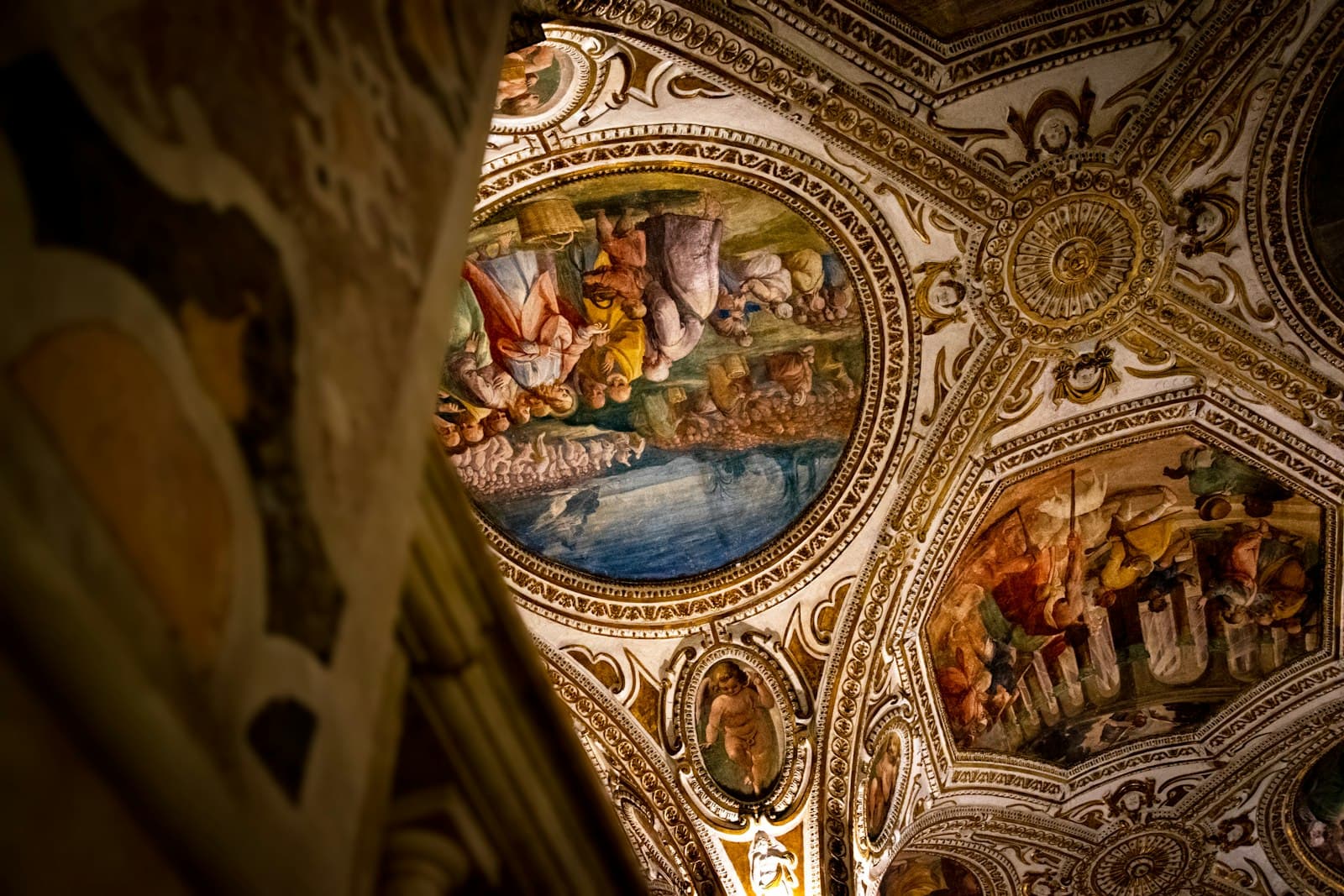
Salerno Cathedral Crypt
Beneath the main altar of Salerno's Duomo lies a space so unexpectedly opulent, it feels like stepping into a Baroque dream.
Full story unlocks in the tour
 Cabalist12 / CC BY-SA 4.0, via Wikimedia Commons
Self-guided audio walking tour of Salerno — GPS route, offline playback, story-driven narration in 32 languages.
“Where ancient knowledge converges with sun-drenched shores.”
Not the postcards. The stories even locals don't know — whispered in your ear, right where they happened.
Beneath the main altar of Salerno's Duomo lies a space so unexpectedly opulent, it feels like stepping into a Baroque dream.
On a hillside, this terraced garden isn't merely a beautiful space; it safeguards the botanical secrets of Europe's first medical school.
You might pass by it without notice, but portions of Salerno's ancient aqueduct still stand, hinting at a legendary, diabolical construction.
Discover every secret of Salerno
Every address, every reveal in full — in your ear, right where it happened.
You pick your stops. You walk. The voice reveals what the others miss.


Lume has a built-in augmented-reality guide. Hold your phone up and its camera shows the street ahead of you, with a glowing arrow laid over the real view that always points to your next stop — no map to puzzle over, no wrong turns. Like everything in Lume, it works fully offline.
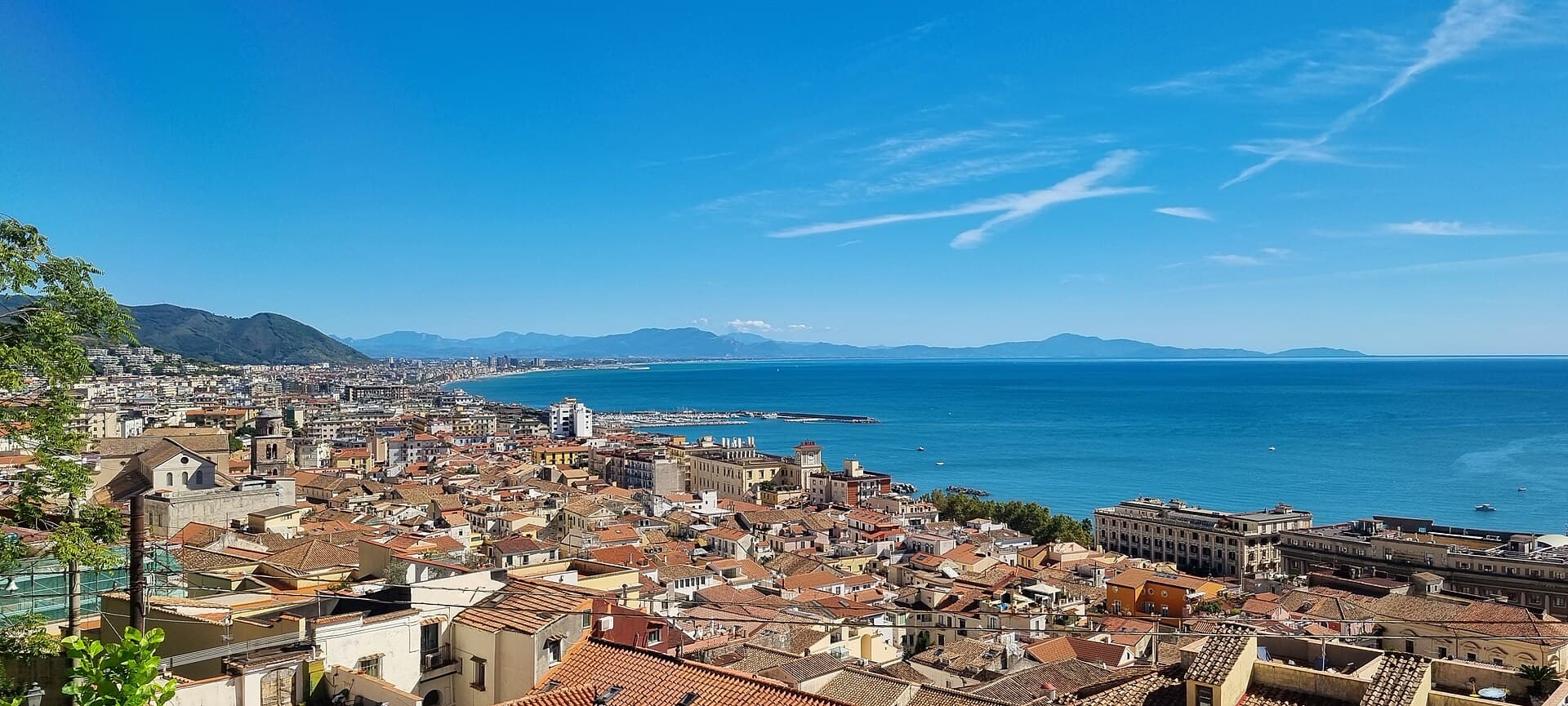
Salerno, a coastal city on the Tyrrhenian Sea, offers a compelling blend of age-old stories, cultural depth, and authentic Italian life. It often serves as a quieter alternative to its more celebrated Amalfi Coast neighbors. Its strategic position at the eastern edge of the Amalfi Coast makes it an ideal launchpad for exploring the region while experiencing a more local rhythm. The city presents a unique character, combining seaside allure with a profound historical narrative and a lively cultural scene.
From its tree-lined promenade, the Lungomare Trieste, offering vistas of the Gulf of Salerno, to its compact and atmospheric historic center, Salerno invites unhurried exploration. Wander through narrow streets where centuries-old buildings stand, revealing artisan shops, traditional bakeries, and small trattorias. Salerno's commitment to its authentic identity means it feels lived-in and real, rather than solely curated for tourism.
## From Etruscan Roots to a Medical Capital Salerno's origins are ancient, with evidence suggesting an Etruscan settlement around the 6th century BCE. It became a Roman colony in 197 BCE, known as Salernum. Following the fall of the Roman Empire, the city was successively conquered by the Goths, Byzantines, and Lombards. Under Lombard rule, Salerno flourished, becoming the capital of an independent Lombard principality in 839 CE, a period of significant wealth and magnificence.
In 1077, the Normans, led by Robert Guiscard, conquered Salerno, and it became his capital. This era saw the construction of the magnificent Duomo di San Matteo, an 11th-century cathedral reflecting Romanesque, Byzantine, and Baroque influences. However, Salerno's most enduring historical legacy is arguably the Schola Medica Salernitana, considered the first medical school in Europe. Active by the 9th century, it was a prestigious institution that integrated Arab, Greek, and Jewish learning, drawing students from across Europe, Asia, and North Africa. Notably, it was also one of the first medical schools to accept women as students and lecturers.
After the Norman period, Salerno passed through various ruling families, including the Angevins and the Sanseverino princes, before eventually reverting to the Kingdom of Naples. The city experienced a period of decline when the focus shifted to Naples. In the 19th century, Salerno was an active center for the Carbonari, supporting the unification of Italy. During World War II, Salerno played a crucial role, serving as the capital of Italy for five months from February to August 1944, following the Allied landings. Today, the city is divided into a medieval historic center, a 19th-century quarter, and more modern post-war districts.
## Architectural Echoes and Artistic Expressions Beyond the Duomo, the city's history is visible in structures like the Castello di Arechi, a medieval fortress on Mount Bonadies, offering expansive views of the city and the Gulf of Salerno. Originally a Byzantine fort, it was significantly enlarged by the Lombard Prince Arechi II. The city also features a medieval aqueduct, parts of which remain visible along Via Arce. The historic center itself is a testament to Salerno's past, with its narrow streets and old stone buildings. In the Fornelle neighborhood, an open-air art project known as the 'Muri d'Autore' features poetry written directly onto walls and arches, much of it by Salerno-born poet Alfonso Gatto, blending historical surroundings with contemporary artistic expression.
Begin your exploration in Salerno's Centro Storico, the historic heart of the city, where narrow streets and ancient buildings create a palpable sense of history. Wander through Via dei Mercanti, one of the oldest streets, lined with small shops and historic facades. A highlight is the Duomo di San Matteo, Salerno's Cathedral, an impressive 11th-century structure with Romanesque, Byzantine, and Baroque elements. Descend into its richly decorated crypt, the resting place of Saint Matthew the Apostle.
Ascend to the Giardino della Minerva, a terraced botanical garden that once served as an outdoor classroom for Europe's first medical school. It offers a peaceful retreat with diverse plant species and expansive views of the city and sea. For even grander panoramas, make your way to Castello di Arechi, a medieval fortress situated 300 meters above the city. The castle houses a museum with artifacts from the Lombard period.
Stroll along the Lungomare Trieste, Salerno's palm-lined seaside promenade, stretching over a mile and offering views of the Tyrrhenian Sea. You can also discover the Medieval Aqueduct, with its arches visible along Via Arce. For art enthusiasts, the Provincial Archaeological Museum displays archaeological finds from the region, including a bronze head of Apollo from the 1st century BCE. The Museo Diocesano San Matteo di Salerno also offers a glimpse into medieval and 18th-century art and history.
The most pleasant times to visit Salerno are during the shoulder seasons: late spring (May to early June) and early autumn (September to early October). During these months, the weather is agreeable with comfortable temperatures and ample sunshine, ideal for sightseeing and outdoor activities. There are also fewer crowds compared to the peak summer months. Summer (June to August) is warm and sunny, perfect for beach activities, though it brings higher prices and larger crowds. Winter (November to March) is mild and offers the fewest tourists and lowest prices, providing a more authentic local experience, though it can be cooler and rainy.
Salerno is well-connected and easily accessible. The closest international airport is Naples' Capodichino. From Naples, you can reach Salerno by train in about 35-50 minutes, with frequent services. The city is also a major sea terminal, with ferries connecting to other ports along the Amalfi Coast, including Amalfi, Positano, and Capri, particularly active from April to September. Buses also offer regular service to Naples and the towns of the Amalfi Coast.
Within Salerno, the city center is compact and best explored on foot, especially the historic district, which is pedestrian-only. Public buses serve the city, with the main bus stop located at the Salerno train station. Taxis are available for destinations outside the historic center. If you plan to explore the wider region, renting a car is an option, though traffic can be heavy, especially in summer. Many shops in Salerno close for a midday break, typically between 1 PM and 4 PM, so plan your browsing accordingly.
Salerno in Korean, in Chinese or in Hebrew — and 29 more languages, every stop narrated by a native voice. The widest language range of any self-guided audio tour.
Available in: