Maiori's Beach
Maiori presents the longest continuous beach on the Amalfi Coast, yet its current expanse is a relatively recent development.
Full story unlocks in the tour
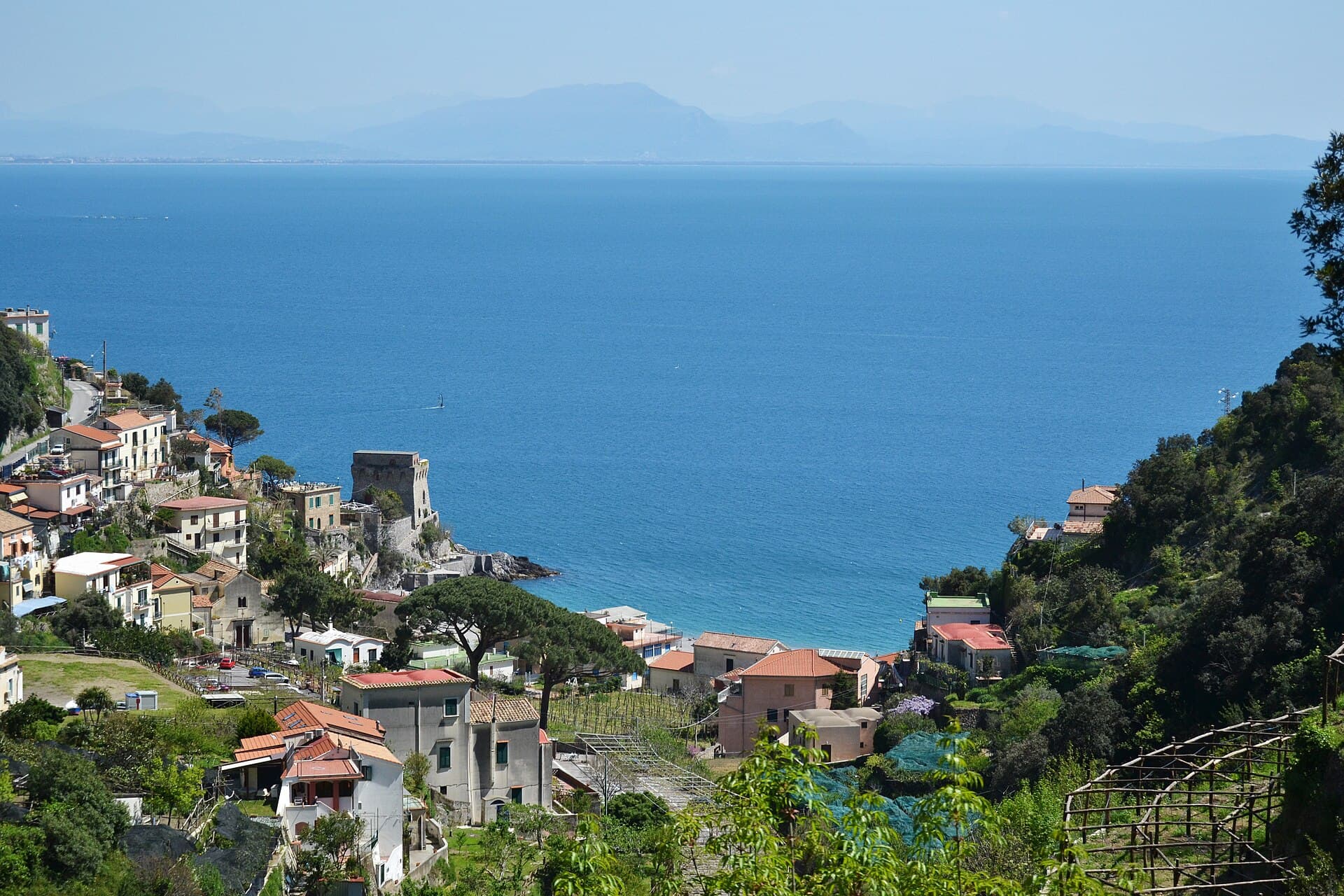 Francescorenna / CC BY-SA 4.0, via Wikimedia Commons
Self-guided audio walking tour of Maiori — GPS route, offline playback, story-driven narration in 32 languages.
“Beyond the longest beach, Maiori echoes with ancient Roman whispers, Saracen incursions, and cinematic dreams.”
Not the postcards. The stories even locals don't know — whispered in your ear, right where they happened.
Maiori presents the longest continuous beach on the Amalfi Coast, yet its current expanse is a relatively recent development.
The distinctive yellow and green majolica-tiled dome of Maiori's main church guards a surprising origin story.
These serene 19th-century gardens, open for quiet contemplation, conceal a unique architectural secret beneath their surface.
Discover every secret of Maiori
Every address, every reveal in full — in your ear, right where it happened.
You pick your stops. You walk. The voice reveals what the others miss.
Your self-guided audio tour of Maiori is ready — pick your landmarks, choose your language, and start the moment you arrive.
BuyLume has a built-in augmented-reality guide. Hold your phone up and its camera shows the street ahead of you, with a glowing arrow laid over the real view that always points to your next stop — no map to puzzle over, no wrong turns. Like everything in Lume, it works fully offline.
Maiori, a captivating town on Italy's celebrated Amalfi Coast, offers a distinct allure that sets it apart from its more cliff-clinging neighbors. Unlike many of the dramatic, vertically oriented villages, Maiori unfolds along a generous stretch of coastline, presenting the longest continuous sandy beach in the region. This expansive beachfront, complemented by a pleasant seaside promenade, makes it a favored destination for those seeking a more relaxed rhythm and a family-friendly environment.
Beyond its inviting shores, Maiori reveals layers of time, from its ancient Roman foundations to its strategic importance during the Amalfi Republic. The town's resilience is evident in its modern center, carefully rebuilt after a devastating flood in 1954, yet echoes of its medieval past and cultural heritage persist in its churches, watchtowers, and winding lanes. Maiori's unique blend of accessibility, historical intrigue, and natural splendor, framed by the dramatic coastal mountains, makes it a compelling stop on any Amalfi Coast journey.
## From Etruscan Outpost to Roman Retreat Maiori's story extends back millennia, with evidence suggesting Etruscan settlements in the area, possibly known as 'Cossa' or 'Bossa.' By the 3rd century A.D., the Romans had claimed the region, renaming the town 'Rheginna Maior' to distinguish it from its smaller neighbor, Minori, or 'Rheginna Minor.' During this Roman period, Maiori was already recognized as a destination for leisure, with a 1st-century A.D. villa discovered nearby, though it no longer stands.
## Medieval Maritime Power and Pisan Raids In the 9th century, Maiori was formally established by the Salernitan prince Sicard. It grew into an important center within the Duchy of Amalfi, an independent state that thrived as a maritime republic. The town's strategic position and flourishing merchant navy allowed it to construct large vessels on its extensive beach. However, this prosperity also invited conflict. Maiori resisted the Normans for a time but was plundered in 1268 by the Pisans, rivals of the Amalfi Republic.
## Disasters and Renewal Like many European towns, Maiori was severely impacted by the plague of 1656, which drastically reduced its population. A more recent and defining event in Maiori's chronology was the catastrophic flood of October 25, 1954. A massive storm triggered significant landslides, destroying much of the historic center, including many medieval structures, and claiming lives. The town was subsequently rebuilt, resulting in a more modern urban core, though some narrow medieval streets spared by the flood can still be found.
## Maiori Today: A Cinematic Legacy Despite the destruction, Maiori's enduring beauty continued to captivate. In the mid-20th century, it became a favored setting for Italian neorealist cinema. Renowned director Roberto Rossellini chose Maiori as the backdrop for several of his films, including 'Paisà,' 'The Miracle,' and 'Journey to Italy.' Today, Maiori remains a lively town, balancing its past with its present as a popular resort, known for its long beach, cultural festivals, and as a gateway to the wider Amalfi Coast.
Begin your exploration with a stroll along the Lungomare, Maiori's wide seaside promenade, offering expansive views of the Tyrrhenian Sea and the longest beach on the Amalfi Coast. Ascend the 108 steps to the Collegiate Church of Santa Maria a Mare, a 12th-century church with a distinctive majolica-tiled dome and a richly carved wooden ceiling. Its crypt houses the relics of St. Clement and a museum of sacred art. Nearby, the Palazzo Mezzacapo Gardens, adjacent to a 19th-century palace, offer a tranquil escape with their unique Maltese Cross-shaped underground pools.
For a glimpse into Maiori's defensive past, hike up to the Castello di San Nicola de Thoro-Plano, a 9th-century fortress offering panoramic views of the town and coastline. Do not miss the Abbey of Santa Maria de Olearia, a medieval monastic complex carved into the solid cliff face, featuring three rock-hewn churches with ancient frescoes. Consider a boat tour to explore the coastal caves, such as the Grotta Sulfurea with its therapeutic waters, or the larger Grotta di Pandora, known for its emerald reflections and stalactites. Finally, for a scenic walk, embark on the Sentiero dei Limoni (Path of the Lemons), a historic trail connecting Maiori to Minori through fragrant lemon groves.
Maiori experiences a Mediterranean climate with warm, dry summers and mild winters. The ideal time to visit for warm-weather activities and beach days is from late June to early September, with July and August being the warmest months, averaging around 30-33°C (86-91°F). For milder temperatures and fewer crowds, consider visiting in spring (April-May) or autumn (September-October), when temperatures are typically in the low to mid-20s°C (68-77°F). While Maiori is generally less crowded than other Amalfi Coast towns, July and August can still see significant tourist activity, particularly on public transport between towns.
Maiori is well-connected to other towns along the Amalfi Coast and beyond. You can reach Maiori by SITA bus, with lines connecting to Amalfi, Salerno, and Naples. Ferries also operate during the main tourist season, offering a scenic way to travel to destinations like Amalfi, Positano, and Capri. If driving, Maiori is located along the Strada Statale 163. For those arriving by air, Naples International Airport (Capodichino) is the closest, with bus services connecting to Maiori.
Within Maiori, the town is relatively flat and walkable, especially along the promenade. Renting a bike is also a convenient option for getting around. For longer distances or exploring the hills, local buses or taxis are available. Maiori offers a range of accommodation options, often more affordable than in more famous Amalfi Coast towns, with many hotels and apartments close to the coastline.
Maiori in Korean, in Chinese or in Hebrew — and 29 more languages, every stop narrated by a native voice. The widest language range of any self-guided audio tour.
Available in: