Fort Rousseau Causeway State Historical Park
The concrete causeway connecting a chain of islands near Sitka appears to be a natural land bridge, but its true purpose was far more strategic.
Full story unlocks in the tour
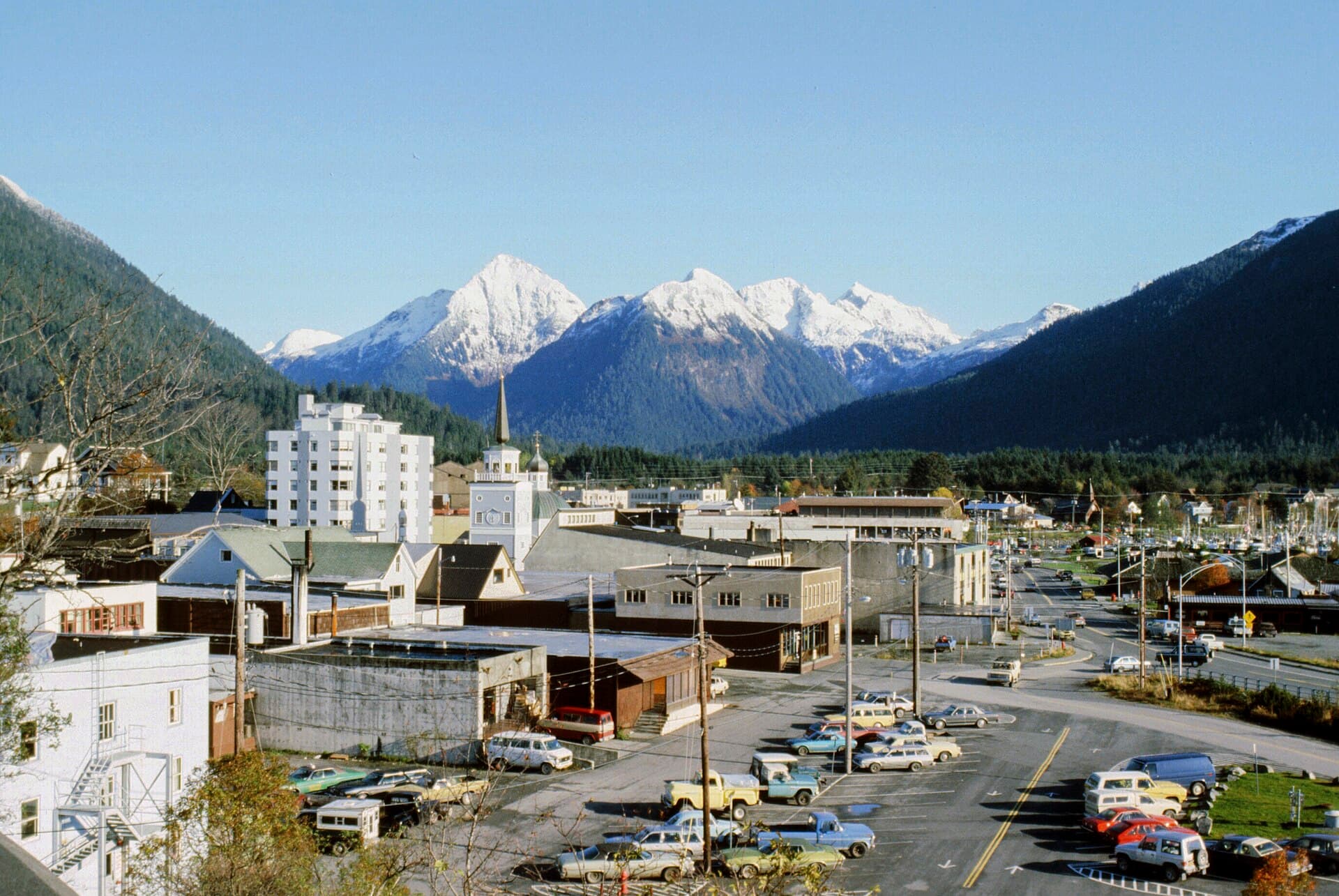 Gillfoto / CC BY-SA 4.0, via Wikimedia Commons
Self-guided audio walking tour of Sitka — GPS route, offline playback, story-driven narration in 32 languages.
“Where Tlingit heritage, Russian legacy, and wild Alaskan beauty converge.”
Not the postcards. The stories even locals don't know — whispered in your ear, right where they happened.
The concrete causeway connecting a chain of islands near Sitka appears to be a natural land bridge, but its true purpose was far more strategic.
Among the towering totem poles of Sitka National Historical Park, a subtle reminder persists of a pivotal battle that shaped the region.
This prominent hill, now a scenic viewpoint, was once the stage for a dramatic handover that changed the course of Alaskan history.
Discover every secret of Sitka
Every address, every reveal in full — in your ear, right where it happened.
You pick your stops. You walk. The voice reveals what the others miss.

Your self-guided audio tour of Sitka is ready — pick your landmarks, choose your language, and start the moment you arrive.
BuyLume has a built-in augmented-reality guide. Hold your phone up and its camera shows the street ahead of you, with a glowing arrow laid over the real view that always points to your next stop — no map to puzzle over, no wrong turns. Like everything in Lume, it works fully offline.
Sitka, a unified city-borough on Baranof Island in southeastern Alaska, is a place where the grandeur of the Pacific meets a profound human story. Unlike other Southeast Alaska ports, Sitka opens onto the Gulf of Alaska, offering dynamic feeding zones for marine wildlife like humpback whales, sea otters, and sea lions. Ringed by islands and watched over by the dormant volcano Mount Edgecumbe, Sitka presents a landscape of snow-dusted peaks and lush rainforest.
The city's compact downtown invites exploration on foot, with cafés, shops, and historical landmarks clustered near the waterfront. Sitka is accessible only by air or sea, with no roads connecting it to the Alaskan mainland. It's a destination that captivates nature lovers and those drawn to history, offering a blend of Tlingit heritage, Russian colonial history, and American influence.
Sitka continues to maintain a thoughtful balance, offering a small dock for cruise ship passengers rather than the massive berths found in other major Alaskan ports, ensuring a more intimate experience.
Sitka's history stretches back thousands of years, originally inhabited by the Tlingit people. In 1741, a Russian expedition explored the area, and in 1799, Aleksandr Baranov, the first Russian governor of Alaska, established Fort St. Michael, also known as Old Sitka. However, the Tlingit destroyed this fort in 1802.
Baranov returned in 1804, leading to the Battle of Sitka, a pivotal conflict where the Tlingit fiercely defended their land. Though nearly victorious, the Tlingit lost their gunpowder, leading to a Russian victory and the establishment of Novo Arkhangelsk (New Archangel), the new capital of Russian America. For 63 years, Sitka flourished as a major Russian fur-trading outpost, becoming the most sophisticated community north of San Francisco. The city saw the construction of Russian Orthodox churches, schools, and hospitals, drawing Russian Orthodox missionaries and other European settlers, including Finns.
In 1867, facing economic and political turmoil after the Crimean War, Russia sold Alaska to the United States for $7.2 million. The formal transfer ceremony took place in Sitka on October 18, 1867, at what is now Baranof Castle State Historical Site. Sitka then served as the territorial capital until 1906, when the seat of government moved to Juneau.
During World War II, Sitka played a crucial role in the defense of North America. In 1937, the U.S. Navy established Alaska's first seaplane base on Japonski Island. By December 7, 1941, it was the only major military base on the West Coast north of Puget Sound. Construction of Fort Ray, an army garrison, began in 1941 to protect the naval air station. The U.S. Army also built coastal defense batteries, including Fort Rousseau, which became the Army's headquarters in Sitka in 1943. These installations were part of a larger defense network, employing up to 40,000 military and civilian personnel. Although prepared for potential Japanese attacks, the Sitka harbor defenses never saw active combat. The naval station was deactivated in June 1944, and the army base was put into caretaker status at the end of the war.
Begin your exploration at the Sitka National Historical Park, where you can walk the Totem Trail and view a collection of intricately carved totem poles, while learning about the pivotal Battle of 1804 between the Tlingit and Russians. The park's Visitor Center offers exhibits on traditional Tlingit life and a film, "The Voices of Sitka."
Delve into Sitka's Russian past at St. Michael's Cathedral, a replica of the first Orthodox cathedral built in North America in 1848. Nearby, the Russian Bishop's House, a National Historic Landmark and one of only four surviving examples of Russian Colonial Style architecture in the Western Hemisphere, offers free tours from May to September.
For expansive views of downtown Sitka and the surrounding islands, ascend Baranof Castle State Historical Site (Castle Hill), the historic location of the Alaska transfer ceremony. Wildlife enthusiasts should visit the Alaska Raptor Center and Fortress of the Bear, both dedicated to the rehabilitation of local wildlife. Consider a wildlife boat tour to spot humpback whales, sea otters, and sea lions in their natural habitat.
Explore Fort Rousseau Causeway State Historical Park to discover remnants of WWII coastal defenses, including gun emplacements and ammunition magazines, accessible by boat or kayak.
The best time to visit Sitka for warm-weather activities is from mid-July to mid-August, when average daily high temperatures are above 58°F. The peak tourist season runs from May to September, offering the mildest weather, with temperatures ranging from the high 40s to mid-60s Fahrenheit, and long daylight hours. May and early June often bring clearer skies and fewer crowds. July and August are ideal for whale activity and lush scenery, while September offers cooler temperatures and fall colors. Sitka's winters are relatively mild compared to other parts of Alaska, with more rain than snow.
Sitka is only accessible by air or sea. Visitors can arrive via scheduled and charter air services, ferry, or cruise ships. If arriving by large cruise ship at the Old Sitka Dock, a free shuttle service is provided to and from downtown Sitka, a 10-15 minute ride. Once downtown, the harbor area is walkable, but taxis, ride services, and bike rentals are available for exploring further afield. Public bus service, 'The Ride,' operates Monday-Friday, 6:30 am-6:30 pm, with hourly routes covering various parts of Sitka.
Sitka is in the Alaska Standard Time zone (GMT -9) and observes Alaska Daylight Time (GMT -8) from March to November. The weather in Sitka, a temperate rainforest, can be unpredictable, so packing layers and waterproof clothing is highly recommended. While cell service is generally available, it can be spotty in certain remote areas. Public restrooms are available at Harrigan Centennial Hall.
Sitka in Korean, in Chinese or in Hebrew — and 29 more languages, every stop narrated by a native voice. The widest language range of any self-guided audio tour.
Available in: