Old Town Valdez Site
Valdez does not occupy its original footprint. The entire community relocated after a catastrophic event.
Full story unlocks in the tour
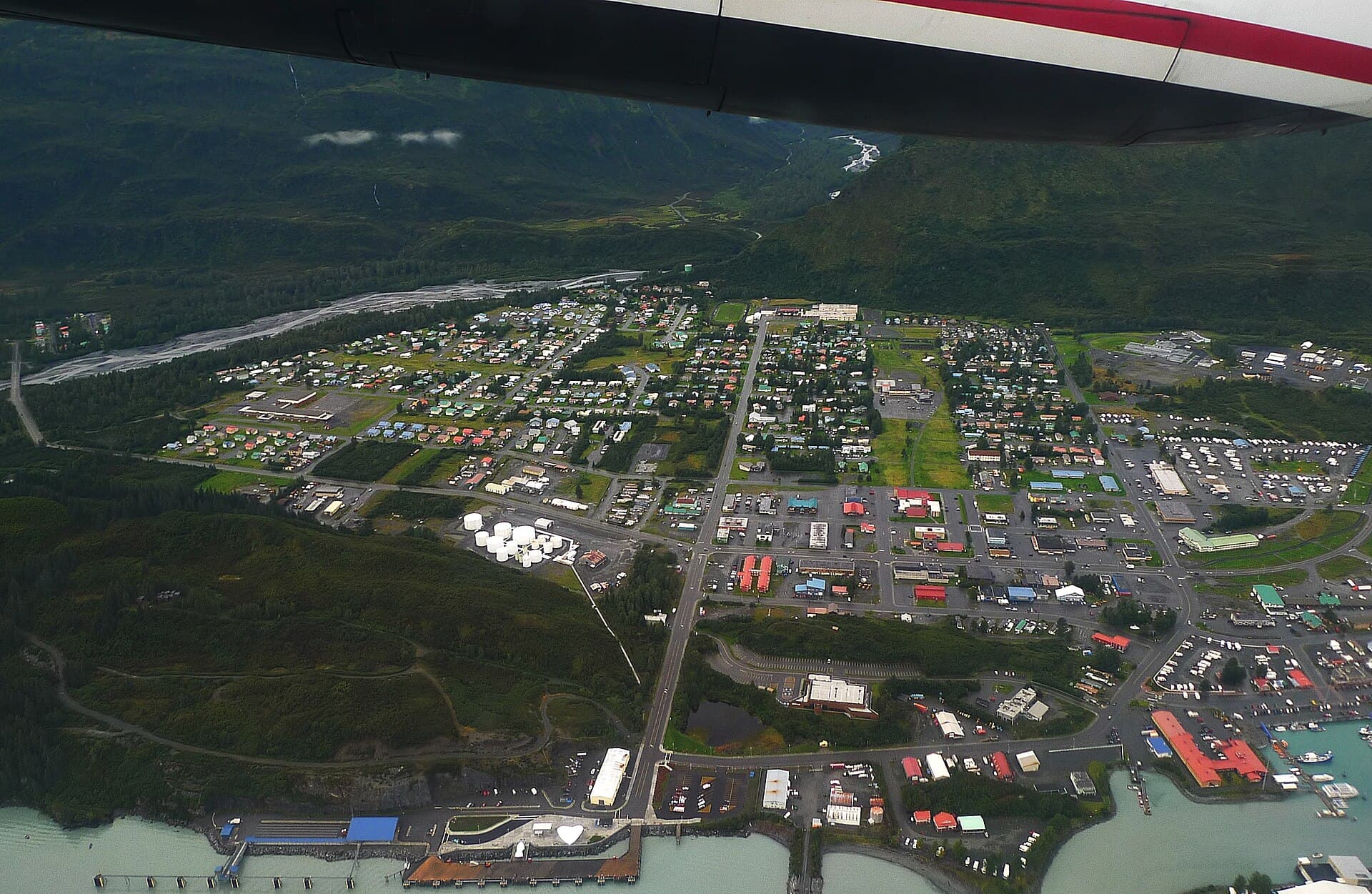 Joseph from Cabin On The Road, USA / CC BY-SA 2.0, via Wikimedia Commons
Self-guided audio walking tour of Valdez — GPS route, offline playback, story-driven narration in 32 languages.
“Where the sea meets mountains, and resilience forges a new path.”
Not the postcards. The stories even locals don't know — whispered in your ear, right where they happened.
Valdez does not occupy its original footprint. The entire community relocated after a catastrophic event.
During the gold rush, prospectors were enticed to Valdez by promises of an 'All-American Route' to the goldfields, yet what they encountered proved far more perilous than advertised.
The snowfall in Valdez is so immense that local vessels face an unusual annual peril.
Discover every secret of Valdez
Every address, every reveal in full — in your ear, right where it happened.
You pick your stops. You walk. The voice reveals what the others miss.


Your self-guided audio tour of Valdez is ready — pick your landmarks, choose your language, and start the moment you arrive.
BuyValdez, Alaska, rests at the head of a deep fjord on the northeastern edge of Prince William Sound, framed by the towering, glacier-clad peaks of the Chugach Mountains. Often likened to 'Little Switzerland' for its dramatic alpine scenery, this coastal community intertwines raw natural beauty with a history of remarkable resilience. It is a place where tidewater glaciers calve into icy waters, waterfalls descend sheer rock faces, and a thriving ecosystem supports marine and terrestrial wildlife.
More than a scenic port, Valdez serves as an outdoor recreation center, offering everything from world-class fishing and glacier cruises to challenging hiking trails and extreme winter sports. It marks the southern terminus of the Trans-Alaska Pipeline, an engineering marvel that underscores its strategic importance. Yet, despite its industrial role, Valdez maintains a welcoming, small-town character, inviting visitors to explore its unique blend of adventure, history, and Alaskan culture.
The Valdez area has been the traditional territory of the Sugpiaq people for over 7,500 years, alongside the Ahtna and Eyak, who utilized the region for fishing and trading. The Sugcestun word for Valdez, Suacit, means 'the people of the place that rises into view.' European exploration commenced in 1778 with Captain Cook, and in 1790, Spanish cartographer Lt. Salvador Fidalgo named the port after Antonio Valdez y Basan, a celebrated Spanish naval officer.
The city's modern story truly began with the Klondike Gold Rush in 1898. Prospectors, drawn by promises of an 'All-American Route' to the goldfields, found Valdez to be a formidable entry point. Many abandoned their arduous trek over the Valdez Glacier to establish a tent city at the head of the bay. Valdez was incorporated in 1901 and prospered further with the construction of a road link to Fairbanks in 1910, which became Alaska's first highway, the Richardson.
On March 27, 1964, a defining moment in Valdez's history occurred: the Good Friday Earthquake. Measuring 9.2 on the Moment Magnitude Scale, it was the second most powerful earthquake ever recorded. The quake triggered an underwater landslide and subsequent tsunami, devastating the Valdez waterfront and claiming 32 lives. The original townsite, built on unstable ground, was condemned. Rather than abandon their community, residents made the difficult decision to relocate the entire town four miles away to a more stable site. This 'new town' was established in 1967, with some buildings moved and others rebuilt.
In the 1970s, Valdez experienced rapid expansion as it became the southern terminus for the Trans-Alaska Pipeline, a critical link in the state's energy economy. The town's population swelled during the construction boom. However, on March 24, 1989, another Good Friday brought tragedy when the Exxon Valdez oil tanker struck Bligh Reef, causing the largest oil spill in North American history at the time. This event brought Valdez national attention and significantly impacted the Prince William Sound ecosystem. The community, once again, demonstrated its resilience, engaging in extensive cleanup efforts and continuing to evolve as a vital Alaskan port.
Valdez offers a wealth of sights, from dramatic natural wonders to historical landmarks. Begin with a glacier and wildlife cruise into Prince William Sound, a highlight for many visitors, to witness tidewater glaciers like Columbia Glacier or Meares Glacier, and observe marine wildlife such as sea otters, whales, and puffins.
Drive the scenic Richardson Highway through Keystone Canyon, admiring Bridal Veil Falls and Horsetail Falls. Continue to Worthington Glacier State Recreation Site for accessible views and trails to the glacier. Just beyond town, Valdez Glacier Lake offers striking views of icebergs.
Explore downtown Valdez, with its small boat harbor alive with fishing activity, shops, and restaurants. The Valdez Museum & Historical Archive provides insight into the city's past, including the gold rush, the 1964 earthquake, and the Trans-Alaska Pipeline. For wildlife observation, visit the Solomon Gulch Hatchery to see salmon, sea lions, seals, and potentially bears, or head to Allison Point. For an easy walk with harbor views, try the Dock Point Trail.
Do not overlook the opportunity to visit the site of Old Valdez, about four miles from the current city, which serves as a poignant memorial to the town destroyed by the 1964 earthquake.
The best time to visit Valdez for warm-weather activities and wildlife observation is during the summer months, from late June to late July or August. Temperatures are moderate, ranging from the 50s to low 70s, and outdoor activities like hiking, fishing, kayaking, and glacier cruises are in full swing. Rain is always a possibility, so be prepared.
Spring (May) and Fall (September-October) offer fewer crowds and moderate temperatures. Fall brings lively foliage and opportunities to see the last salmon runs. Winter transforms Valdez into a snowy paradise, ideal for heliskiing, snowmachining, ice climbing, and Northern Lights viewing, with average highs in the 20s and 30s.
Valdez is accessible by road via the scenic Richardson Highway, a 305-mile drive from Anchorage or 364 miles from Fairbanks. The Alaska Marine Highway ferry system also provides service from other coastal communities, and air taxi services are available. While cell service can be intermittent outside of town, AT&T generally performs best within Valdez.
Accommodations range from hotels and lodges to bed & breakfasts and numerous campgrounds, including options near town and more secluded sites. Dining options are varied, with local favorites like The Nat Shack food truck (seasonal), The Wheelhouse (year-round with harbor views), Old Town Burgers, and Fu Kung for Asian cuisine. There is no sales tax in Valdez, only a bed tax. The Valdez Visitor Center and the USFS Crooked Creek Information Site are excellent resources for local information and maps. For winter sports enthusiasts, the Alaska Avalanche Information Center provides crucial safety updates.
Valdez in Korean, in Chinese or in Hebrew — and 29 more languages, every stop narrated by a native voice. The widest language range of any self-guided audio tour.
Available in: