Church of San Mamiliano
Beneath a modest church in Sovana, a secret lay buried for centuries, far outstripping its humble appearance.
Full story unlocks in the tour
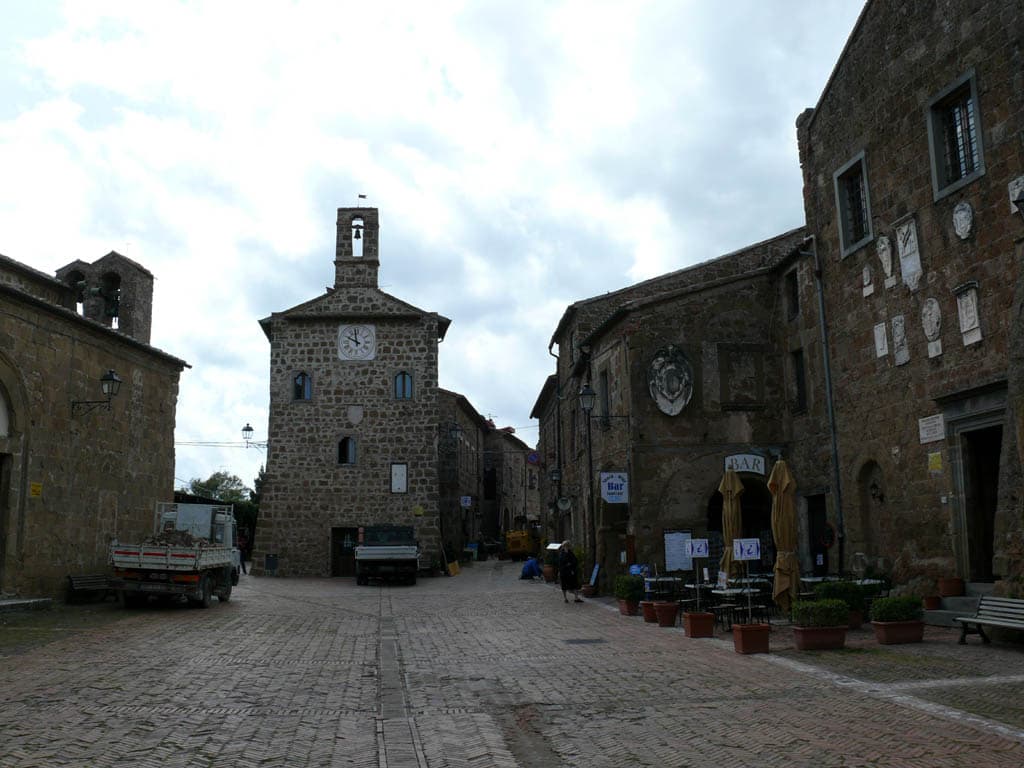 Zyance / CC BY-SA 3.0, via Wikimedia Commons
Self-guided audio walking tour of Sovana — GPS route, offline playback, story-driven narration in 32 languages.
“Where Etruscan echoes meet medieval whispers in a landscape carved from time.”
Not the postcards. The stories even locals don't know — whispered in your ear, right where they happened.
Beneath a modest church in Sovana, a secret lay buried for centuries, far outstripping its humble appearance.
The main cathedral in Sovana holds an ancient secret about its construction that defies typical medieval church architecture.
Beyond the well-known Etruscan tombs, a network of mysterious paths carved deep into the tufa rock holds an enigmatic purpose.
Discover every secret of Sovana
Every address, every reveal in full — in your ear, right where it happened.
You pick your stops. You walk. The voice reveals what the others miss.


Your self-guided audio tour of Sovana is ready — pick your landmarks, choose your language, and start the moment you arrive.
BuyLume has a built-in augmented-reality guide. Hold your phone up and its camera shows the street ahead of you, with a glowing arrow laid over the real view that always points to your next stop — no map to puzzle over, no wrong turns. Like everything in Lume, it works fully offline.
Sovana, a hamlet within the municipality of Sorano, is a captivating village carved from the distinctive tufa rock of southern Tuscany. Its origins stretch back to the 7th century BCE, when Etruscan farmers and shepherds first settled on the high plains above the Fiora River. Today, Sovana is recognized as one of Italy's most beautiful villages, a testament to its remarkably preserved medieval center and archaeological heritage.
The village offers a slower, deeper experience of Tuscany, far from the more crowded tourist routes. Its compact historic center is easily explored on foot, revealing layers of history from its Etruscan roots to its medieval prominence under the Aldobrandeschi family, and later, the Orsini and Medici families. Sovana's unique geology, characterized by the soft volcanic tufa, has shaped its architecture and the surrounding landscape, including the Etruscan necropolis and the fascinating vie cave.
Walking through Sovana feels like stepping back in time, with its main paved street, Via di Mezzo, leading visitors past ancient monuments and picturesque houses. It's a place where history isn't just in museums but etched into the very rock and fabric of the town, offering an evocative journey through millennia of Tuscan life.
## Etruscan Origins and Roman Influence Sovana's story begins around the 7th century BCE, with early Etruscan settlements on the tuff cliffs. Known then as Suana, it quickly grew into a significant Etruscan center, maintaining connections with powerful cities like Vulci. The most striking evidence of this period lies just outside the modern town: the vast Etruscan necropolis, a collection of hundreds of monumental tombs carved directly into the tufa rock. These tombs, some dating back to the 7th-6th century BCE, offer profound insights into Etruscan funerary practices and beliefs, with notable examples like the temple-shaped Ildebranda Tomb and the evocative Tomb of the Siren.
By the Roman period, Sovana had become a Municipium, maintaining many of its Etruscan traditions, including writing, for at least two more centuries. In the 5th century, it gained recognition as an Episcopal Seat, demonstrating its continued importance. This early Christian influence is still visible in the Church of San Mamiliano, which dates back to the 6th century and was the first episcopal seat of the diocese.
## Medieval Power and Papal Connections The 9th century marked the rise of the powerful Aldobrandeschi family, who chose Sovana as the capital of their county. They constructed the Rocca Aldobrandesca, an imposing fortress built on older Etruscan foundations, which served as a defensive stronghold. This era also saw the birth of one of history's most influential figures: Ildebrando di Soana, who would later become Pope Gregory VII (c. 1015 – 1085 AD). His papacy was marked by significant church reforms and conflicts with Emperor Henry IV, including the famous Walk to Canossa.
After the Aldobrandeschi family's decline in the 14th century, Sovana came under the control of the Orsini family, followed by the Sienese, and eventually the Medici, who incorporated it into the Grand Duchy of Tuscany. Despite these shifts in power, the town's medieval character, with its Romanesque and Gothic architecture, remained largely intact, avoiding the Baroque restyling seen in many other Tuscan towns.
## Decline, Rediscovery, and Modern Revival Sovana experienced a period of decline and near abandonment, partly due to plagues and the insidious effects of malaria from the surrounding swamp lands. However, the 20th century brought a renewed appreciation for its archaeological treasures, leading to its rediscovery and restoration. Today, Sovana stands as a meticulously preserved testament to its layered past, attracting visitors eager to explore its Etruscan necropolis, medieval architecture, and the quiet charm of a village that time almost forgot.
Begin your exploration at the Rocca Aldobrandesca, the imposing 11th-century fortress that guards the town's entrance, built on ancient Etruscan foundations. From here, stroll along the main paved street, Via di Mezzo, which leads directly to the heart of the historic center, Piazza del Pretorio. This charming square is flanked by several significant buildings: the Palazzo Pretorio, adorned with the coats of arms of past governors and housing the archaeological park's visitor center; the Palazzo dell'Archivio, with its distinctive bell tower; and the Loggia del Capitano, featuring a Medici coat of arms.
Also in Piazza del Pretorio is the Church of Santa Maria Maggiore, a Romanesque structure containing a rare pre-Romanesque ciborium. Adjacent to it, don't miss the Church of San Mamiliano, the oldest church in Sovana, now a museum housing the extraordinary "Treasure of Sovana" – a hoard of 498 5th-century gold coins discovered beneath its floor. Further along, slightly detached from the main village, stands the impressive Sovana Cathedral (Duomo di San Pietro), a Romanesque-Gothic masterpiece with a crypt, notable frescoes, and a unique astronomical alignment.
No visit to Sovana is complete without exploring the Etruscan Necropolis, located just outside the town. This archaeological park features hundreds of rock-cut tombs, including the grand Tomba Ildebranda, the Tomba della Sirena, and the Tomba del Tifone. Wander through the mysterious Vie Cave, ancient sunken roads carved deep into the tufa, which connect the various necropolises and offer a unique hiking experience.
The best time to visit Sovana is during the spring (April-May) and fall (September-October). These months offer mild temperatures, fewer crowds compared to the peak summer season, and lush, lively landscapes. While August can be very hot, with temperatures reaching 38°C (100°F) or more and limited air conditioning in older buildings, the rest of the summer (June and July) can also be enjoyable, though more crowded. Rainy days are possible in spring and fall, but they are often accompanied by longer daylight hours. Avoid Sundays in low season, as some kitchens may close early, and Mondays, when some museums are closed.
Sovana is a small town, easily explored in an hour or two, making it an ideal half-day trip, often combined with nearby Pitigliano and Sorano. While some buses serve the towns of Tuscany, the most convenient way to reach Sovana and explore the surrounding Maremma region is by car. If driving from Florence or Rome, take the Autostrada del Sole and exit at Chianciano Terme, then follow signs for San Casciano dei Bagni and Sovana. From Grosseto, head towards Terme di Saturnia and continue to Sovana.
Parking is available near the main square, Piazza del Pretorio, for a fee from 8 AM to 1 PM and 3 PM to 8 PM daily. The town itself is relatively flat, making it accessible for those with mobility concerns. For accommodation, consider staying overnight in Sovana's historic center for a quieter experience after day-trippers leave, or in a nearby agriturismo (farm stay). Pitigliano, just 5 km away, also offers more lodging options.
Sovana in Korean, in Chinese or in Hebrew — and 29 more languages, every stop narrated by a native voice. The widest language range of any self-guided audio tour.
Available in: