Tacna Cathedral
The grand Tacna Cathedral, a neo-Renaissance marvel, has a surprising connection to a world-renowned French engineer.
Full story unlocks in the tour
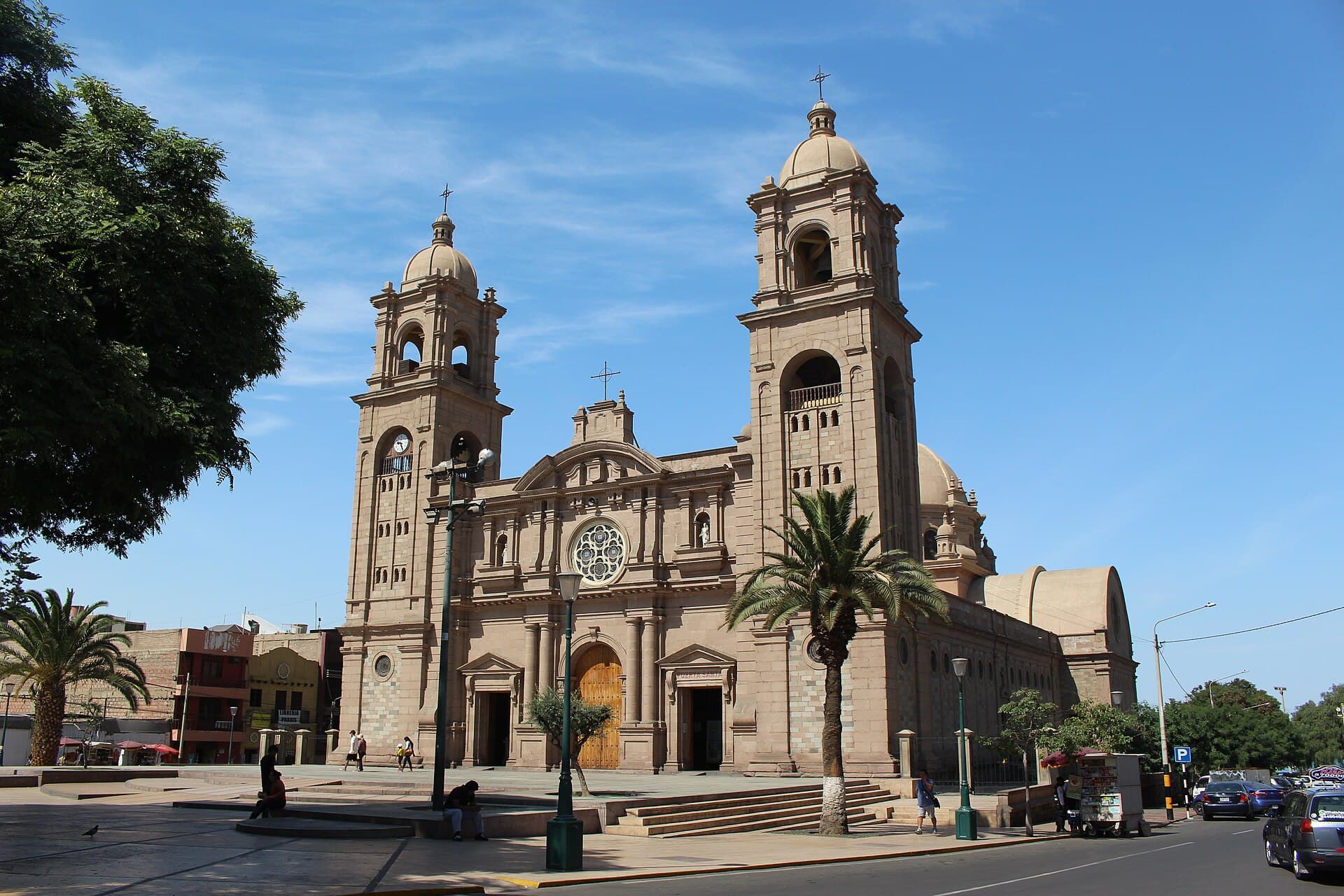 Marco Antonio Correa Flores / CC BY-SA 4.0, via Wikimedia Commons
Self-guided audio walking tour of Tacna — GPS route, offline playback, story-driven narration in 32 languages.
“Tacna: Where Peruvian pride echoes through sun-drenched streets.”
Not the postcards. The stories even locals don't know — whispered in your ear, right where they happened.
The grand Tacna Cathedral, a neo-Renaissance marvel, has a surprising connection to a world-renowned French engineer.
The central Civic Walkway of Tacna holds a silent testament to a long-standing national rivalry.
Deep within the region surrounding Tacna lies evidence of human artistry dating back millennia.
Discover every secret of Tacna
Every address, every reveal in full — in your ear, right where it happened.
You pick your stops. You walk. The voice reveals what the others miss.

Your self-guided audio tour of Tacna is ready — pick your landmarks, choose your language, and start the moment you arrive.
BuyLume has a built-in augmented-reality guide. Hold your phone up and its camera shows the street ahead of you, with a glowing arrow laid over the real view that always points to your next stop — no map to puzzle over, no wrong turns. Like everything in Lume, it works fully offline.
Tacna, known as the "Heroic City," stands in southern Peru, a short distance from the Chilean border. It's a place where a deep sense of national pride is palpable, etched into its monuments and celebrated in its traditions. With a population of approximately 286,240 residents, the city offers a lively yet welcoming atmosphere, characterized by its clean streets and well-kept gardens that thrive despite the surrounding arid landscape.
More than just a border city, Tacna is a commercial hub and a gateway to diverse landscapes, from arid deserts to fertile valleys and Andean foothills. Its strategic location historically made it a vital link between the Pacific coast and the silver mines of Potosí. Today, it continues to be an important economic center, drawing visitors with its unique blend of history, culture, and duty-free shopping.
For those willing to explore beyond its commercial appeal, Tacna reveals a compelling narrative of resilience and patriotism. It's a city that has witnessed pivotal moments in Peru's history, from the first cries for independence to its hard-won return to Peruvian sovereignty after decades of occupation. This past, combined with its natural wonders and burgeoning enological tourism, makes Tacna a captivating destination for the curious traveler.
The Caplina River valley, where Tacna is situated, has been inhabited by indigenous peoples since ancient times. Evidence of early hunter-gatherer settlements, dating back to approximately 7630 BC, can be found in the Toquepala Caves, showcasing millennia of human presence in the region. The Spanish established a settlement here in the 1570s, naming it San Pedro de Tacna. Its location as an oasis in the desert quickly made it a significant stop on colonial trade routes, linking the port of Arica with the silver mines of Potosí.
Tacna played a notable role in Peru's struggle for independence from Spain. On June 20, 1811, Francisco Antonio de Zela led the first armed uprising against Spanish rule, an event famously known as the "First Cry of Freedom." This bold act earned Tacna the honorary title of "Heroic City" (Ciudad Heroica) from the Peruvian Congress in 1828.
The 19th century brought significant challenges for Tacna, particularly during the War of the Pacific (1879-1884). In 1880, the Battle of Alto de la Alianza took place near the city, where Chilean forces defeated the Peruvian-Bolivian army, leading to the occupation of Tacna by Chile. Under the Treaty of Ancón in 1883, Tacna and Arica were placed under Chilean administration for ten years, with a plebiscite to determine their final nationality. However, Tacna remained under Chilean control for nearly 50 years. Despite efforts to instill Chilean identity, Peruvian nationalists persevered, and finally, in 1929, the Treaty of Lima secured Tacna's return to Peru, while Arica remained with Chile. This reincorporation is a source of immense national pride and is celebrated annually with the Paseo de la Bandera.
Following its return to Peru, Tacna underwent modernization and continued to develop as an agricultural processing center, with crops like tobacco, grapes, cotton, and sugarcane supporting industries such as wine making and liquor distilling. Today, Tacna is recognized for its strong patriotic identity, with numerous monuments and street names commemorating its heroes and pivotal historical events. The city's resilience and loyalty to the nation remain central to its cultural identity.
Tacna offers a compelling mix of historical sites, cultural experiences, and natural beauty. Begin your exploration at the Paseo Cívico, the city's main square, where you'll find the impressive Tacna Cathedral, designed by Gustave Eiffel's company, and the Arco Parabólico, a unique arch commemorating heroes of the War of the Pacific. Nearby, the Museo Ferroviario (Railway Museum) delves into Tacna's railway history, while the Museo Histórico showcases artifacts and stories from the city's past.
For a deeper dive into Peru's independence movement, visit the Casa de Zela, the former home of Francisco Antonio de Zela, who initiated the first uprising for freedom. Beyond the city center, consider a trip to the Miculla Petroglyphs, ancient rock carvings located about 30 minutes away, depicting human figures, animals, and celestial bodies from around 500 BC. Nature enthusiasts can explore the Ite Marshes, a significant wetland teeming with birdlife, or venture to the Valley of the Geysers of Candarave for a unique geothermal spectacle and therapeutic hot springs. For a relaxing day by the sea, Arena Blanca Beach offers calm waters and clear sands.
Tacna enjoys a mild desert climate, making it a pleasant destination year-round. The warmest period is from January to March, with average temperatures around 21°C (70°F) and highs reaching 25°C (77°F). The coolest months are from June to September, with average temperatures dropping to around 17°C (63°F) and lows of approximately 13.5°C (56°F). Rainfall is generally very low throughout the year. For warm-weather activities, the best times to visit are from late February to late May and from mid-October to early January. If you prefer milder temperatures and low rain chances, April, November, and December are also excellent choices.
The official currency in Tacna, and throughout Peru, is the Peruvian Sol (PEN). While US dollars are accepted in many tourist-oriented businesses, it's advisable to have soles for smaller purchases, markets, and local transportation. You can exchange currency at banks and exchange houses, and ATMs are widely available, allowing withdrawals in both soles and dollars.
Tacna is generally considered safe for tourists, but standard precautions apply. Be mindful of your belongings in crowded areas and avoid poorly lit streets at night. For getting around the city, taxis are the most convenient and affordable option. It's always best to agree on the fare before starting your journey, as meters are not commonly used. Ride-hailing apps like Uber are also available. Public buses are also an efficient and inexpensive way to travel within the city. Coronel FAP Carlos Ciriani Santa Rosa International Airport (TCQ) is located just 5 kilometers from the city center, with taxis readily available.
Tacna in Korean, in Chinese or in Hebrew — and 29 more languages, every stop narrated by a native voice. The widest language range of any self-guided audio tour.
Available in: