Big Tub Harbour
Tobermory's waters hold a secret that draws divers and curious onlookers alike, a silent testament to a bygone era.
Full story unlocks in the tour
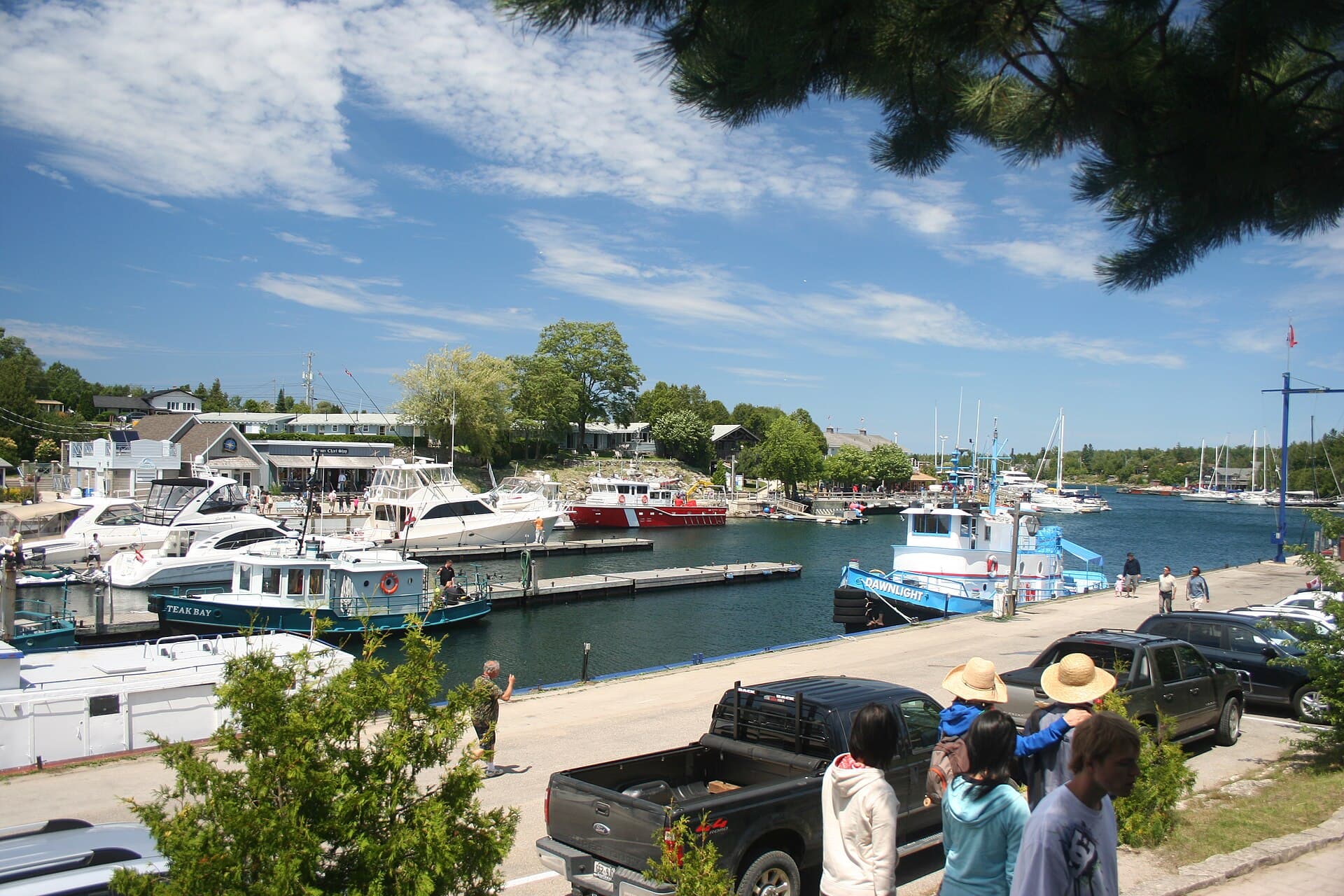 Robert Taylor from Stirling, ON, Canada / CC BY 2.0, via Wikimedia Commons
Self-guided audio walking tour of Tobermory — GPS route, offline playback, story-driven narration in 32 languages.
“Where the turquoise depths meet ancient cliffs and forgotten ships.”
Not the postcards. The stories even locals don't know — whispered in your ear, right where they happened.
Tobermory's waters hold a secret that draws divers and curious onlookers alike, a silent testament to a bygone era.
Beyond the well-trodden paths, the park guards a unique botanical secret that flourishes in its distinct environment.
This marine park, Canada's first, protects more than just shipwrecks; it preserves a geological rarity found in only two places on Earth.
Discover every secret of Tobermory
Every address, every reveal in full — in your ear, right where it happened.
You pick your stops. You walk. The voice reveals what the others miss.


Your self-guided audio tour of Tobermory is ready — pick your landmarks, choose your language, and start the moment you arrive.
BuyLume has a built-in augmented-reality guide. Hold your phone up and its camera shows the street ahead of you, with a glowing arrow laid over the real view that always points to your next stop — no map to puzzle over, no wrong turns. Like everything in Lume, it works fully offline.
Tobermory, a small community at the northern reach of Ontario's Bruce Peninsula, is where the clear waters of Lake Huron greet Georgian Bay. This harbor village, with fewer than 1,000 permanent residents, transforms into a lively destination, drawing approximately 750,000 visitors annually. It is a place where rugged limestone cliffs, ancient cedar forests, and diverse ecosystems converge, offering a singular blend of natural beauty and maritime history.
Known as the "freshwater SCUBA diving capital of the world," Tobermory's allure extends beneath the surface to its numerous well-preserved shipwrecks. The town serves as a gateway to both Bruce Peninsula National Park and Fathom Five National Marine Park, Canada's first national marine conservation area. Whether exploring dramatic lakeside caves, hiking along the Bruce Trail, or taking a scenic ferry ride, Tobermory offers a captivating escape for those who love nature and adventure.
Before European settlement, the area now known as Tobermory was the traditional home of the Saugeen Ojibway Nation, whose ancestors lived here as far back as 7,500 years ago. The region's dramatic landscape, shaped by the 400-million-year-old Niagara Escarpment, once resembled ancient coral reefs, later transforming into dolomite rock.
Naval surveyor Henry Bayfield initially named the port "Collins Harbour." However, in 1882, Scottish fishermen renamed it Tobermory, after the town on the Isle of Mull in Scotland, due to similar harbor conditions. The community was established in 1788.
In the late 1800s, fishermen began dropping nets into Tobermory's deep natural harbors, Big Tub and Little Tub. Big Tub Harbour is notably Canada's largest natural freshwater harbor. The early 1900s saw massive hauls of lumber, with the first sawmill opening in 1881. However, within 20 years, most valuable timber was depleted, and subsequent fires left the forests nearly bare by the 1920s. This decline led many settlers to leave, and the population decreased until the 1970s, when the area gained renewed interest from cottagers.
The treacherous waters at the meeting point of Georgian Bay and Lake Huron proved challenging for mariners, leading to numerous shipwrecks. These submerged vessels became a significant part of the region's identity. In the 1960s, as scuba diving gained popularity, the idea of an underwater park took hold. This led to the establishment of Fathom Five Provincial Park in 1972, later becoming Fathom Five National Marine Park in 1987, Canada's first national marine conservation area, protecting 22 known shipwrecks and several historic lighthouses.
Tobermory offers a range of experiences, from exploring underwater worlds to hiking dramatic landscapes. Take a glass-bottom boat tour to view the well-preserved shipwrecks in Fathom Five National Marine Park, such as the Sweepstakes schooner and the City of Grand Rapids steamer. For those seeking a closer look, Tobermory is known as a premier freshwater scuba diving destination, with over 20 shipwrecks at various depths.
Journey to Flowerpot Island, accessible only by boat, to witness its iconic sea stack rock formations, explore sea caves, and hike trails leading to a historic light station. On the mainland, Bruce Peninsula National Park offers dramatic cliffs, crystal-clear waters, and ancient forests. Hike the famous Bruce Trail, which has its northern terminus in Tobermory, to discover viewpoints like the Grotto, a sea cave with an underwater tunnel perfect for swimming and snorkeling. Visit the Big Tub Lighthouse, an iconic beacon operating since 1885, offering scenic harbor views.
For a different perspective, consider a scenic drive along the peninsula, stopping at places like Big Bay, known as the 'Stone Skipping Capital of Canada.' The MS Chi-Cheemaun ferry provides a scenic two-hour crossing to Manitoulin Island, offering wide views of Georgian Bay.
The best time to visit Tobermory for warm-weather activities is from early July to early September, when temperatures are comfortable, averaging around 18°C (64°F) and reaching highs of 23°C (73°F). This is also peak tourist season, so expect crowds and book accommodations and ferry tickets well in advance.
Spring (April to June) offers milder weather, fewer tourists, and blooming wildflowers, making it ideal for a quieter visit and birdwatching during migration. Fall (September to October) is considered a sweet spot, with thinning crowds after Labour Day, brilliant autumn foliage along the Bruce Trail, and still-swimmable waters in September. Many businesses operate from May until the Thanksgiving long weekend in October. While Tobermory remains open year-round, most park facilities and the Flowerpot Island ferry close after Thanksgiving, offering a serene winter experience with opportunities for snowy trail exploration.
Tobermory is approximately a 4.5-hour drive northwest of Toronto, and about 100 kilometers (62 miles) from Owen Sound, connected by Highway 6. Public transportation within Tobermory is limited; walking is recommended for downtown areas. A seasonal shuttle bus serves attractions like Bruce Peninsula National Park. Taxis and bicycle rentals are also available.
Reservations for camping and most parking at Bruce Peninsula National Park are required, especially for popular spots like the Grotto and Halfway Log Dump. It is advisable to book well in advance. The MS Chi-Cheemaun ferry, connecting Tobermory to Manitoulin Island, operates seasonally from early May to mid-October, and reservations are highly recommended, particularly for vehicles during peak summer.
When visiting Flowerpot Island, remember there are no garbage facilities, so all waste must be carried out. Bringing your own water and food is also strongly recommended, although a small shop may be available seasonally. Pets must be leashed, and drones are not permitted.
Tobermory in Korean, in Chinese or in Hebrew — and 29 more languages, every stop narrated by a native voice. The widest language range of any self-guided audio tour.
Available in: