Donglianhua Village
The grand courtyards of Donglianhua Village tell a story of wealth accumulated not from farming, but from an ancient, surprising trade route.
Full story unlocks in the tour
 Zhangmoon618 / CC BY-SA 3.0, via Wikimedia Commons
Self-guided audio walking tour of Weishan — GPS route, offline playback, story-driven narration in 32 languages.
“Where ancient echoes meet everyday life, undisturbed by time.”
Not the postcards. The stories even locals don't know — whispered in your ear, right where they happened.
The grand courtyards of Donglianhua Village tell a story of wealth accumulated not from farming, but from an ancient, surprising trade route.
The chessboard-like grid of Weishan's streets holds a subtle secret, designed not just for order, but for comfort against the elements.
A single bowl of noodles in Weishan can be a testament to incredible culinary skill and a symbol of good fortune.
Discover every secret of Weishan
Every address, every reveal in full — in your ear, right where it happened.
You pick your stops. You walk. The voice reveals what the others miss.


Your self-guided audio tour of Weishan is ready — pick your landmarks, choose your language, and start the moment you arrive.
BuyLume has a built-in augmented-reality guide. Hold your phone up and its camera shows the street ahead of you, with a glowing arrow laid over the real view that always points to your next stop — no map to puzzle over, no wrong turns. Like everything in Lume, it works fully offline.
Weishan, officially known as Weishan Yi and Hui Autonomous County, offers an authentic glimpse into China's past, distinct from its more commercialized counterparts. Situated in the western highlands of Yunnan Province, approximately 50 kilometers south of Dali Ancient City, Weishan is cradled at the foot of the Ailao Mountain range. This ancient city is recognized as the birthplace of the Nanzhao Kingdom, a powerful realm that once held sway over southwestern China for over two and a half centuries.
What truly sets Weishan apart is its remarkable state of preservation. The ancient city's layout, largely unchanged for over six hundred years, features well-preserved residential buildings from the Ming and Qing Dynasties. Its stone-paved streets still echo with the daily lives of locals, and food stalls continue to serve recipes passed down through generations. Weishan is a convergence of ethnic diversity, home to Yi, Hui, and Bai communities, whose cultures are expressed through festivals, handicrafts, and culinary traditions.
For those seeking a genuine cultural experience away from the usual tourist crowds, Weishan offers a profoundly historical and deeply personal journey. It's a place where ancient city walls still stand, and the rhythm of life feels connected to centuries of tradition.
Weishan's history stretches back over a thousand years, making it one of Yunnan Province's most historically significant regions. The story of Weishan is intertwined with the Nanzhao Kingdom, a powerful and influential realm that emerged in the 7th century. The area was originally inhabited by the Mengshe Tribe, one of six tribal groups known as the Six Zhao. In 737, with the support of the Tang Court, Pi Luoge, the chieftain of the Nanzhao Tribe, unified these tribes, establishing the Nanzhao Kingdom, which reigned from 738 to 937 AD.
While villages existed in the Weishan area as early as the Tang Dynasty, the city's formal establishment occurred during the Yuan Dynasty (1271-1368). It was later reconstructed as a fortified brick city during the Ming Dynasty (1368-1644). The city's layout, resembling a square seal with four gates at the cardinal directions, has remained largely intact for over six centuries. This grid-beam structure, with 25 streets and 18 lanes spanning 14 kilometers, is lined with well-preserved residential buildings from the Ming and Qing Dynasties.
Weishan also played a significant role as an important transportation hub on the Ancient Tea Horse Road during the Ming and Qing dynasties, earning it the moniker "city on horseback." This trade route brought prosperity and cultural exchange, evident in places like Donglianhua Village, a Hui Muslim settlement where descendants of caravan leaders built impressive courtyard houses. The region's diverse ethnic composition, including Yi, Hui, and Bai groups, reflects centuries of coexistence and cultural layering. Weishan's enduring architectural heritage and cultural traditions stand as a testament to its complex past.
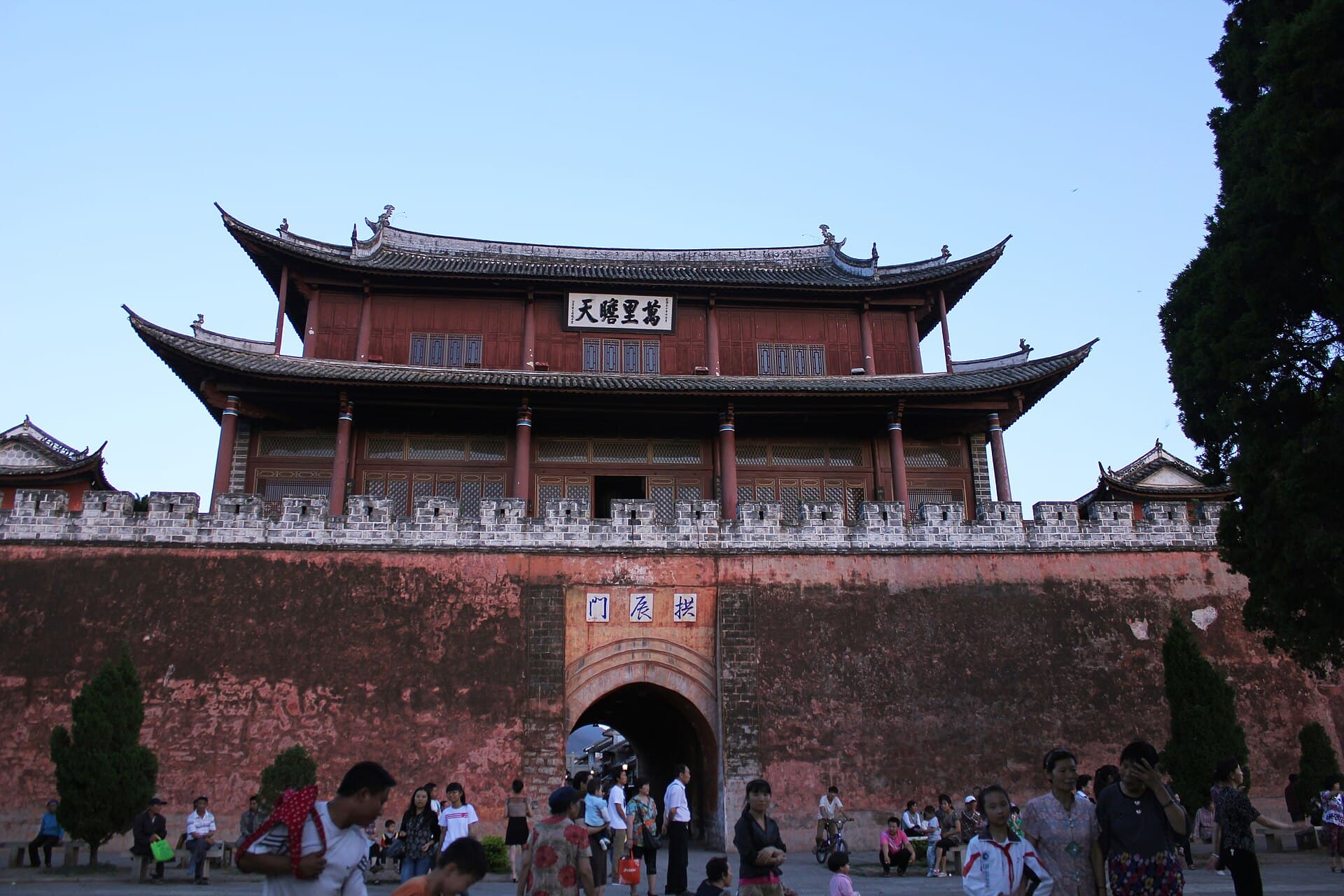
Weishan Ancient City offers a wealth of sights that invite leisurely exploration. The city's iconic landmarks are the Gongchen Tower and Xinggong Tower. Gongchen Tower, at the northern gate, stands 23.5 meters tall, supported by 28 large wooden pillars, and provides expansive views of the ancient city. Xinggong Tower, built in the city's center, is an 11-meter-high timberwork tower with a brick foundation.
The ancient streets of Weishan themselves are an attraction, a labyrinth of 25 streets and 18 lanes totaling 14 kilometers, lined with traditional Ming and Qing Dynasty residential buildings. The Nanzhao Ancient Street is a main thoroughfare where shops sell traditional handicrafts.
For a deeper dive into local culture, visit the Confucius Temple, considered the best-preserved Ming Dynasty Confucian temple in western Yunnan, featuring red walls, yellow tiles, and ancient cypresses. The Menghua Old House (Liu's Compound) is the largest and best-preserved ancient residential house in Weishan, showcasing a blend of central Chinese and local ethnic architectural styles.
Just outside the ancient city, Weibao Mountain is a significant attraction, recognized as one of China's famous Taoist mountains and a national forest park. It is home to over twenty Taoist temples, with some dating back to the Ming and Qing Dynasties, and is considered the spiritual birthplace of the Nanzhao Kingdom. Finally, a short drive away, Donglianhua Village offers a glimpse into Hui Muslim culture with its well-preserved mosque and historic courtyard houses, reflecting its past as a hub on the Ancient Tea Horse Road.
The most pleasant times to visit Weishan are during spring (March to May) and autumn (September to November). During these months, the weather is mild and comfortable, with temperatures ranging from 19°C to 26°C. March and April are particularly special, as the city comes alive with numerous festivals and cultural activities, including the Weibao Mountain Singing Festival. While winter remains comfortably cool, summer brings the rainy season, necessitating waterproof clothing.
Weishan Ancient City is approximately 50-75 kilometers south of Dali Ancient City. From Dali, you can take a bus from the Southwest bus station in Xiaguan; buses depart every 15 minutes, and the journey takes about an hour. Once at the Weishan bus station, a short tuk-tuk ride (around 5 RMB) will take you to the ancient town, often dropping you at the Gongchen Tower Gate. Direct high-speed trains from Kunming to Weishan are also available, with a journey time of about 2 hours and 37 minutes.
Entry to Weishan Ancient City itself is free, and the streets are open 24/7. Some smaller attractions, like the Confucius Temple and Xinggong Tower, have low ticket prices, with discounts for students and seniors. Weibao Mountain has an entrance fee of 40 RMB. The ancient town is small and walkable, but weather in the mountains can change quickly, so bringing a jacket is advisable. Travel insurance is also recommended, especially if you plan to hike Weibao Mountain.
Weishan in Korean, in Chinese or in Hebrew — and 29 more languages, every stop narrated by a native voice. The widest language range of any self-guided audio tour.
Available in: