Georgievskaya Gora (St. George's Hill)
Yuryevets began as a fortification, but its very first Kremlin served more than just defense.
Full story unlocks in the tour
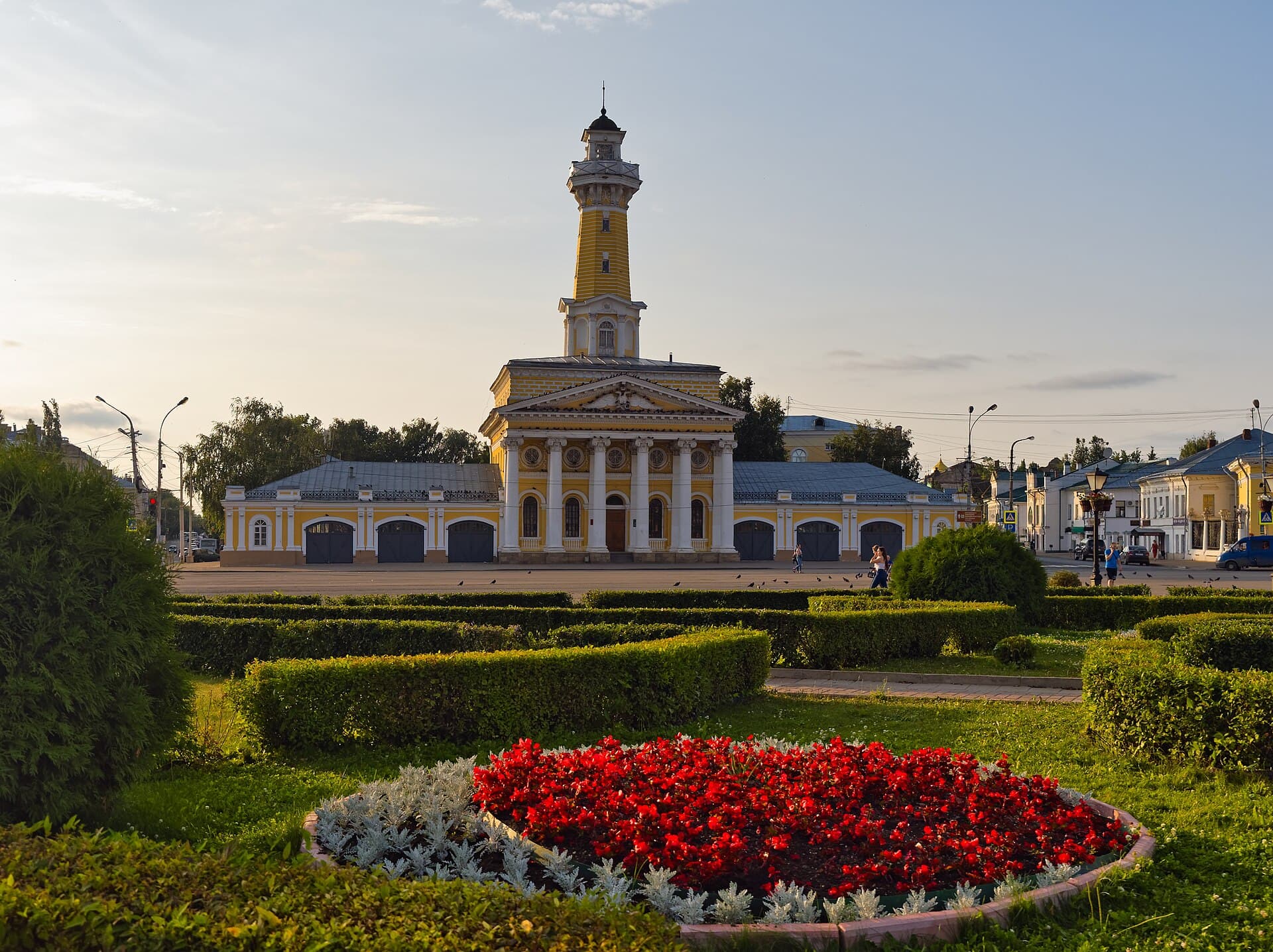 Photo of Kostroma, via Wikimedia Commons
Self-guided audio walking tour of Yuryevets — GPS route, offline playback, story-driven narration in 32 languages.
“Where the Volga expands, Yuryevets holds stories of princes, plagues, and cinematic visions.”
Not the postcards. The stories even locals don't know — whispered in your ear, right where they happened.
Yuryevets began as a fortification, but its very first Kremlin served more than just defense.
A grand stone kremlin was envisioned for Yuryevets, but shifting imperial priorities left it incomplete.
Yuryevets avoided the fate of many towns during the formation of the Gorky Reservoir.
Discover every secret of Yuryevets
Every address, every reveal in full — in your ear, right where it happened.
You pick your stops. You walk. The voice reveals what the others miss.

Your self-guided audio tour of Yuryevets is ready — pick your landmarks, choose your language, and start the moment you arrive.
BuyYuryevets, one of Ivanovo Oblast's most ancient towns, rests on the right bank of the expansive Volga River, where it dramatically widens into the Gorky Reservoir. Established in 1225 by Grand Prince Yuri II Vsevolodovich, the town was initially known as Yuryev-Povolsky, meaning 'Yury's town on the Volga.' Its strategic position at the confluence of the Unzha and Nyomda rivers has shaped its long and often turbulent narrative.
Today, Yuryevets offers a window into a Russia less explored, far from the bustling tourist circuits. It is a place where faded grandeur converges with the quiet rhythms of life by the great river. The town is most notably connected with the revered filmmaker Andrei Tarkovsky, who spent his childhood years here, and the pioneering Constructivist architects, the Vesnin brothers, who were born in Yuryevets.
While some of its historical structures bear the marks of age and neglect, Yuryevets retains a poignant allure, inviting those who seek authentic experiences and a connection to Russia's profound cultural and natural inheritance.
Yuryevets' origins trace back to 1225, when Grand Prince Yuri II Vsevolodovich established it as a fortification, Yuryev-Povolsky, to guard the eastern frontiers of North-Eastern Russia. The first Kremlin was constructed on Georgievskaya Gora, a site believed to be where an icon of Saint George the Victorious appeared to the Prince. However, this early settlement faced swift destruction in 1237 at the hands of Batu Khan's Mongol forces.
The town endured, with its soldiers participating in the pivotal Battle of Kulikovo in 1380. The 16th century saw Yuryevets grow into a significant administrative and economic center, even being assigned to Ivan the Terrible's oprichnina in 1556. A glimpse into its 16th-century life is preserved in the "Sotnaya Gramota of 1593/94," a unique census document.
The early 17th century brought further hardship, with the town experiencing an uprising against Polish-Lithuanian interventionists in 1609, followed by being burned and plundered. A new ostrog (fortress) was constructed on Predtechenskaya Gora, featuring 700-meter walls and two gates. The mid-17th century was marked by tragedy; a plague epidemic in 1655 claimed three-quarters of the population.
In 1661, Tsar Alexei Mikhailovich initiated the construction of a substantial stone kremlin, the "White Town," on Voskresenskaya Gora. However, this ambitious project was never completed, and its stones were repurposed for other constructions starting in 1780. Through the 18th and 19th centuries, Yuryevets' administrative status shifted between various governorates, reflecting the evolving political geography of the Russian Empire. Despite these changes, it developed a large cargo-passenger pier by the mid-19th century and saw the establishment of a flax-spinning factory, a brewery, and a district library.
The Soviet period brought its own transformations, with Soviet power established in 1917. Yuryevets continued as an administrative center, though its district boundaries and affiliations changed over the decades. One of the most significant modern changes was the creation of the Gorky Reservoir in the 1950s. While many towns were submerged, Yuryevets was deliberately preserved from flooding. Today, archaeological discoveries, such as an icon-medallion found in 2013, continue to illuminate the town's deep historical roots.
Yuryevets holds a special place in Russian culture as the childhood home of the acclaimed filmmaker Andrei Tarkovsky. Born nearby, Tarkovsky spent his formative years in Yuryevets, a period that undoubtedly influenced his cinematic vision, known for its spiritual themes and evocative landscapes. The town also produced the Vesnin brothers, pioneering figures in Constructivist architecture, whose innovative designs left a lasting mark on Soviet architecture. Their legacies are celebrated in local museums, offering visitors a deeper understanding of their contributions to art and cinema.
Begin your exploration in the central square, where three churches stand, including the classicist Assumption Cathedral (1825) and the actively repaired Old Cathedral of the Entrance to Jerusalem (1733). Observe the bell tower, which lost its cross to a hurricane in 2021. The familiar Lenin monument also graces the square.
Delve into the town's past at the Regional Museum, which encompasses four distinct museums: a historical and local lore museum, the house museum of the Vesnin brothers, the A. Tarkovsky museum center, and the Cherkasskiye House. The archaeological collection alone counts over 700 exhibits, including findings from ancient settlements like Pusharikha Hill and Georgievskaya Gora.
Stroll along the embankment, where a small park provides views of the expansive Gorky Reservoir. For a distinctive historical curiosity, seek out the former mechanized bakery on Sovetskaya Street, which was once the Temple of the Beheading of John the Baptist.
Those who appreciate nature should venture three kilometers from town to the 'Asafovy Gory' archipelago in the Gorky Reservoir, a protected natural area formed from a submerged hill. The town also borders a coniferous forest, "Nagornaya Dacha," offering opportunities for quiet walks, though it faces environmental challenges.
The most agreeable time to visit Yuryevets, like much of European Russia, is during the summer months from June to August. Temperatures are mild, typically between 20-25°C (68-77°F), making it ideal for exploring the town and its natural surroundings. The extended daylight hours of summer provide ample time for sightseeing.
Autumn, particularly September, also presents a good option. The crowds diminish, temperatures are comfortable for walking, and the changing foliage can be quite appealing. While winters are cold with snow, they offer a distinctive, stark beauty for those prepared for low temperatures.
Yuryevets is in the Moscow Time Zone (UTC+3). The town is located in Ivanovo Oblast, approximately 159 km northeast of the regional capital, Ivanovo, and 58 km from the Kineshma railway station. The town itself covers an area of 8 square kilometers.
Public transport options to Yuryevets may be limited, and unlike many Volga towns, it does not possess a marina for cruise ships, which contributes to a less developed tourism infrastructure. As of May 2022, decent accommodation options were noted as scarce. It is advisable to verify current travel and accommodation availability before planning your trip. The local currency is the Russian Ruble (RUB).
Yuryevets in Korean, in Chinese or in Hebrew — and 29 more languages, every stop narrated by a native voice. The widest language range of any self-guided audio tour.
Available in: