Imagine an island where wild horses roam freely, descendants of a herd brought there centuries ago by Indigenous peoples. You can visit, but no ferry connects to its shores.
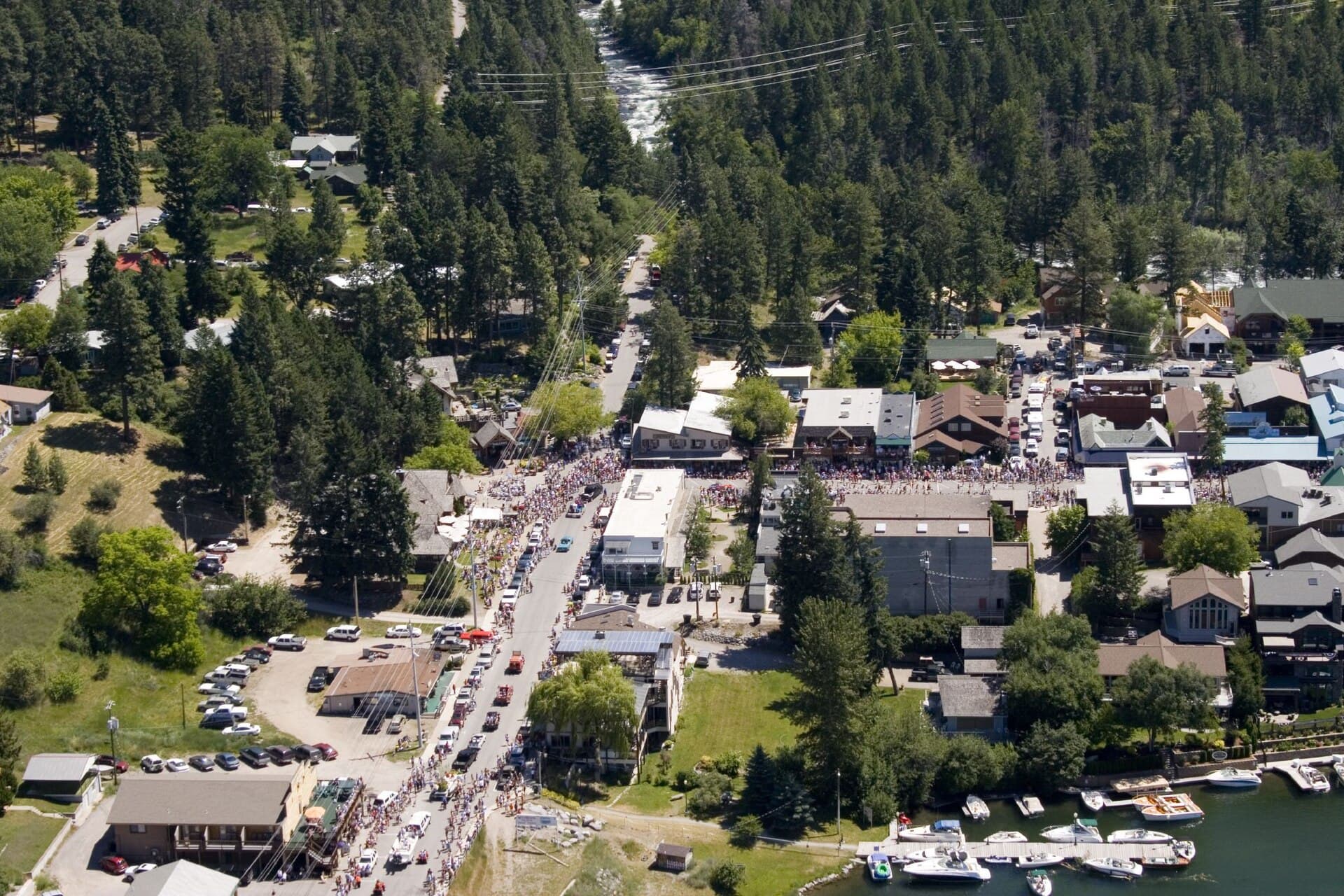
Katie Brady from Missoula, Montana, United States / CC BY-SA 2.0, via Wikimedia CommonsBigfork
Self-guided audio walking tour of Bigfork — GPS route, offline playback, story-driven narration in 32 languages.
“Where the Swan River meets Flathead Lake, an artistic pulse beats within Montana's wild embrace.”
Bigfork, as no one tells it.
Not the postcards. The stories even locals don't know — whispered in your ear, right where they happened.
Bigfork's main street carries a name that hints at a surprising early technological leap for a small mountain community.
This historic inn endured a devastating fire during the Great Depression, rebuilt with a vision that defied the era's hardships.
Discover every secret of Bigfork
Every address, every reveal in full — in your ear, right where it happened.
You pick your stops. You walk. The voice reveals what the others miss.

How long do you have in Bigfork?
Your self-guided audio tour of Bigfork is ready — pick your landmarks, choose your language, and start the moment you arrive.
BuyThe story of Bigfork
Bigfork, Montana, often called the 'Village by the Bay,' is a charming community situated at the northeastern tip of Flathead Lake, where the Swan River flows into its expansive waters. This picturesque setting, framed by the Swan and Mission Mountains, offers a unique blend of natural splendor, outdoor adventure, and a surprisingly sophisticated arts and culture scene. Recognized in publications like '100 Best Small Art Towns in America,' Bigfork attracts visitors seeking both tranquility and lively community life.
Beyond its striking scenery, Bigfork maintains a distinct local identity, free from large shopping malls or a heavy franchise presence. The town's dedication to supporting local artisans, galleries, and a professional summer playhouse gives it a refined yet authentic Montana character. Whether you are drawn by the allure of the largest natural freshwater lake west of the Mississippi, the challenging rapids of the Swan River, or the welcoming spirit of a small town, Bigfork offers a memorable experience.
## Early Settlement and Naming For thousands of years, the area around the north end of Flathead Lake, where the Swan River meets the lake, was crisscrossed with Indigenous trails and served as an exceptional fishing ground and source of food for the Kootenai, Salish, and Pend d'Oreilles tribes. In the early 19th century, French-Canadian fur trappers began visiting the region. The name 'Bigfork' itself is commonly believed to be derived from its geographical location at the 'big fork' where the Flathead and Swan Rivers converge into Flathead Lake. While some theories suggest a Salish origin or a connection to a Minnesota township, the confluence of the rivers remains the most widely accepted explanation.
## The Vision of Everit L. Sliter The modern history of Bigfork truly began with Everit L. Sliter, who arrived in the Flathead Valley in 1889 on a hunting and fishing trip. Legend has it that he was so captivated by the area's abundance, reportedly filling a canoe with trout in a matter of hours, that he decided to stay. Sliter purchased ranch land and by 1892, had planted 500 fruit trees, laying the groundwork for what would become a significant cherry-growing region. He became Bigfork's first postmaster in 1901 and officially platted the townsite in 1902, dividing it into 94 lots across 11 blocks. Sliter's vision extended beyond farming; he also built Bigfork's first hotel and general store, and even dedicated his own time and money to clear land for roads, effectively putting Bigfork on the map.
## Growth and Development Bigfork quickly saw significant advancements for its time. In 1901, a hydroelectric plant was built along the Swan River, providing electricity to Bigfork and other valley towns—a remarkable achievement when much of the nation still lacked power. The early 1900s also saw the establishment of the timber industry, with sawmills becoming the heartbeat of Bigfork's economy, producing hundreds of thousands of railroad ties annually. While the town has evolved, its rustic architecture and community storytelling still honor this industrious past.
## Community Spirit and Arts Despite never being formally incorporated, Bigfork developed into a proud and active community. The Bigfork Summer Playhouse, founded in 1960, quickly earned a reputation as 'Broadway in the Rockies,' drawing professional talent and audiences from far and wide. The town's lively arts scene, with numerous galleries and studios, has led to its recognition as one of the '100 Best Small Art Towns in America.' Community traditions like the annual Fourth of July Parade and the transformation of downtown into a 'Christmas Village' by the Bigfork Elves further underscore the town's strong civic spirit and welcoming atmosphere.
Begin your exploration of Bigfork with a stroll along Electric Avenue, the town's charming main street, where you will find a concentration of world-class art galleries, unique boutiques, and local artisan shops. Do not miss the Bigfork Summer Playhouse, known for its Broadway-caliber performances, offering live theater from May through September.
For outdoor enthusiasts, Bigfork is a gateway to abundant recreation. Flathead Lake, the largest natural freshwater lake west of the Mississippi, offers endless opportunities for boating, kayaking, paddleboarding, swimming, and fishing. Consider a visit to Wayfarers State Park on the lake's northeastern shore, featuring a beautiful beach, boat launch, and picnic areas. The Swan River Nature Trail provides an easy, scenic walk along the 'Wild Mile' of the Swan River, where you can watch kayakers navigate rapids. Just east of Bigfork, the Landmark Basin Hiking Area holds over 35 miles of trails and 27 alpine lakes, ideal for hikers and wildlife watchers.
Beyond the immediate village, consider a distinctive llama trek through wildflower meadows with Swan Mountain Llama Trekking, or a historical stagecoach ride on a working ranch. In winter, Bigfork transforms into a 'Christmas Village' and offers access to cross-country skiing, snowshoeing, and nearby downhill skiing at Blacktail Mountain.
The best time to visit Bigfork for warm-weather activities is from early July to mid-August, when temperatures are mild and precipitation is low. Summers are warm and partly cloudy, ideal for lake and trail activities. The comfortable weather window generally extends from mid-May to mid-September. Fall brings cooler weather, brilliant larch foliage, and fewer crowds, making it perfect for scenic drives and gallery browsing. Winters are cold and snowy, offering opportunities for cross-country skiing, snowshoeing, and a quieter, local pace. Spring is a transitional season with fresh mountain air and early hiking opportunities.
Bigfork is located in Flathead County, Montana, at an elevation of approximately 2,900 feet. The nearest major airport is Glacier Park International Airport (FCA) north of Kalispell, about a 30-minute drive away, offering direct flights to several major cities. Most residents and visitors rely on personal vehicles for transportation, as public transport is limited, though ride-sharing and local shuttle options are expanding. While Bigfork offers dining and shopping, many residents drive to Kalispell for larger retail and major medical services. Bigfork experiences a true four-season climate, with warm, dry summers and snowy, cold winters. There is no state sales tax in Montana.
- What is Bigfork known for?
- Bigfork is recognized for its picturesque location on Flathead Lake, its lively arts scene including the Bigfork Summer Playhouse, and abundant outdoor recreational opportunities.
- Is Bigfork a good place to live year-round?
- Yes, Bigfork offers year-round appeal with lake access, local trails, winter recreation, a stable residential base, and an active downtown culture.
- What is the population of Bigfork?
- As of the 2020 census, the population of Bigfork was 5,118.
- Are there hiking trails in Bigfork?
- Yes, Bigfork offers easy access to numerous hiking trails, including the Swan River Nature Trail, Landmark Basin Hiking Area, and trails in Flathead National Forest.
- What kind of cultural attractions does Bigfork offer?
- Bigfork is recognized for its world-class art galleries, studios, public art displays, and the professional live performances at the Bigfork Summer Playhouse.
- Is Bigfork close to Glacier National Park?
- Glacier National Park is approximately an hour's drive from Bigfork, making it a convenient base for exploring the park.