Tour de Guinette
The most striking remnant of Étampes' royal castle, the Tour de Guinette, holds a surprising secret about a queen's unexpected imprisonment.
Full story unlocks in the tour
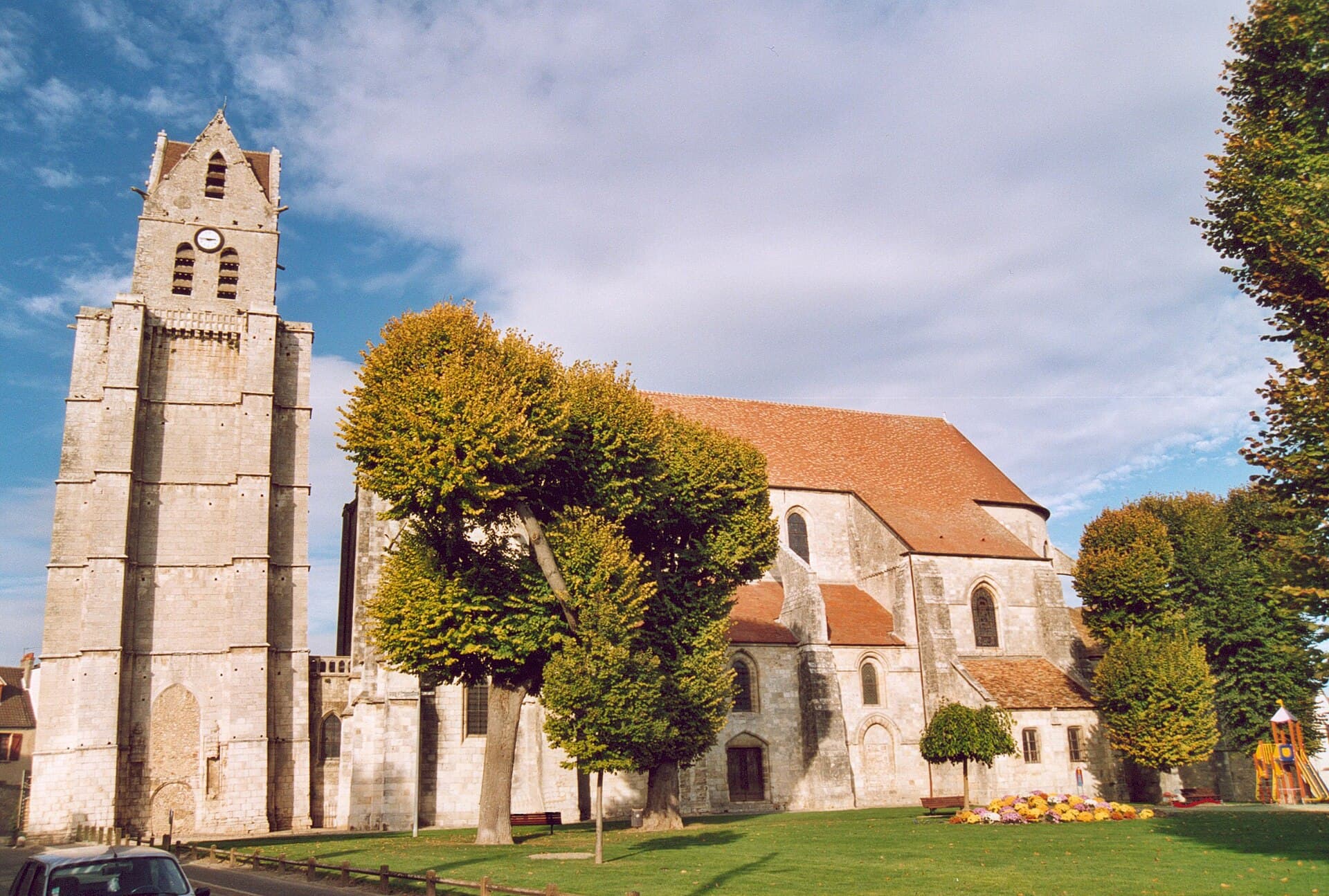 Unknown author / CC BY-SA 3.0, via Wikimedia Commons
Self-guided audio walking tour of Étampes — GPS route, offline playback, story-driven narration in 32 languages.
“Where royal history echoes in quatrefoil stone and quiet waterways.”
Not the postcards. The stories even locals don't know — whispered in your ear, right where they happened.
The most striking remnant of Étampes' royal castle, the Tour de Guinette, holds a surprising secret about a queen's unexpected imprisonment.
Étampes' town hall, with its neo-Gothic facade, conceals a detail that speaks to a forgotten, yet crucial, historical tax.
This collegiate church, a prominent landmark, features a unique artistic choice on its south portal that deviates from typical medieval iconography.
Discover every secret of Étampes
Every address, every reveal in full — in your ear, right where it happened.
You pick your stops. You walk. The voice reveals what the others miss.

Your self-guided audio tour of Étampes is ready — pick your landmarks, choose your language, and start the moment you arrive.
BuyLume has a built-in augmented-reality guide. Hold your phone up and its camera shows the street ahead of you, with a glowing arrow laid over the real view that always points to your next stop — no map to puzzle over, no wrong turns. Like everything in Lume, it works fully offline.
Étampes, a town in the Essonne department of France, lies approximately 48 kilometers (30 miles) southwest of Paris. It serves as the capital of southern Essonne and connects the Paris-Orléans and Chartres-Sens routes, forming a vital link between the Île-de-France regions. The town's history stretches back over a thousand years, with roots as a Roman settlement. Étampes is recognized as a City of Art and History, with over two dozen listed historical monuments.
The town's landscape is shaped by the Juine River and its tributary, the Chalouette, which flow through the area. This setting, combined with its historical architecture, offers a blend of cultural heritage and natural beauty. Étampes maintains a population of around 23,000 people and is known for its peaceful suburban atmosphere, offering a quieter pace than the bustling capital while remaining easily accessible.
Visitors to Étampes can explore its medieval streets, discover its architectural wonders, and enjoy the surrounding green fields and waterways. The town's historical significance and its proximity to Paris make it a compelling destination for those interested in exploring beyond the immediate Parisian metropolitan area.
The origins of Étampes trace back over a millennium, beginning as a Roman settlement. Its name is thought to derive from the Proto-Germanic word stampōną, meaning 'to squeeze or compress'. By the early 7th century, Étampes was established and became part of the royal domain during the early Middle Ages.
In the 11th century, Étampes emerged as a royal city, highly favored by French kings. Robert the Pious, King of France, founded the Collégiale Notre-Dame-du-Fort around 1022, establishing one of his residences in Étampes. The town's prominence grew significantly in the 12th century, when a council held there recognized Innocent II as the legitimate pope. Kings Louis VI and Louis VII particularly favored Étampes during this period.
The Château d'Étampes, originally an early 10th-century stronghold, was significantly developed between 1130 and 1150 with the construction of a new castle overlooking the valley, featuring the strong keep known today as the Tour de Guinette. This keep, built by Louis VII around 1150, has a distinctive quatrefoil (four-leaf clover) plan, a result of tactical experimentation in medieval defense. The castle was expanded under later kings, including Philip II, and played a crucial role in controlling the vital Paris-Orléans route.
Étampes endured several sieges during the Hundred Years' War. In 1589, after years of incessant conflict, King Henry IV ordered the destruction of the castle at the request of the inhabitants, leaving only the Tour de Guinette. The town also saw the establishment of mansions in the 16th century, such as those of Anne de Pisseleu and Diane de Poitiers.
The French Revolution brought its own challenges to Étampes. In March 1792, the mayor, Jacques Guillaume Simoneau, was killed for refusing to lower the price of wheat and bread during a famine. The 19th century saw the arrival of the railway in 1843, connecting Étampes to Paris and Orléans, and the enlargement and remodeling of the Hôtel de Ville in a neo-Gothic style between 1851 and 1853. In the early 20th century, Étampes became a significant site for aviation, with Louis Blériot and Henri Farman founding France's first flight school here in 1910.
Today, Étampes continues to evolve, focusing on maintaining its human-scale character, preserving green spaces, and fostering economic development. It remains a town with many historical monuments, reflecting its long and varied past.
Étampes offers a range of historical sites and natural spaces to explore. The Tour de Guinette, the striking quatrefoil-shaped keep, is the most prominent remnant of the former royal Château d'Étampes. Visitors can view the exterior of this 12th-century structure, which once served as a royal prison.
The Collégiale Notre-Dame-du-Fort, founded around 1022 by King Robert the Pious, showcases a blend of Romanesque and Gothic architecture. Key features include its 12th-century royal door, impressive stained glass windows, and a unique south portal. Another significant religious edifice is the Church of St. Martin, known for its leaning tower.
The Hôtel de Ville, or town hall, is a neo-Gothic building from the mid-19th century that was designated a monument historique in 1982. The House of Pillars stands as the oldest house in the town. For those interested in local history and art, the Étampes Museum, located in the right wing of the town hall, houses collections spanning palaeontology, archaeology, fine arts, and contemporary art.
Beyond the historical structures, Étampes provides opportunities for outdoor enjoyment. The regional leisure center offers activities such as a wave pool, pony club, skate park, climbing wall, and canoeing. The Juine River meanders through the town, with peaceful walking paths along its banks, and the Jardins des Prés provide a green space for relaxation.
The most pleasant times to visit Étampes are typically from May through September, when the weather is generally comfortable for exploring. Summers, particularly July and August, bring warm temperatures, with daytime highs reaching around 26°C (79°F), ideal for outdoor activities and enjoying the town's historical sites. June and July also offer the most sunshine.
Spring (April-May) and Fall (September-October) offer mild weather and fewer crowds, making them good choices for a relaxed visit. Winters are cold, with daytime highs around 8°C (46°F) in January, and can be cloudier, though indoor attractions remain accessible.
Étampes is conveniently located about 50 kilometers (31 miles) southwest of Paris, making it an accessible day trip destination. The easiest way to reach Étampes from Paris is by direct train, specifically the RER C line from Gare d'Austerlitz, with a journey time of approximately one hour. Train tickets within the Île-de-France region are capped at €5 each way. Once in Étampes, the best way to navigate the town is on foot.
For those driving, Étampes is well-connected to major roads. The town has a weekly market held on Tuesdays and Saturdays, offering local goods. Étampes is part of the Essonne department and uses the Euro (€) as its currency. French is the primary language, though English may be spoken in tourist-oriented areas.
Étampes in Korean, in Chinese or in Hebrew — and 29 more languages, every stop narrated by a native voice. The widest language range of any self-guided audio tour.
Available in: