Nanhu Lake
The 'Red Boat' on Nanhu Lake stands as a national emblem, its preservation involving a surprising yearly custom.
Full story unlocks in the tour
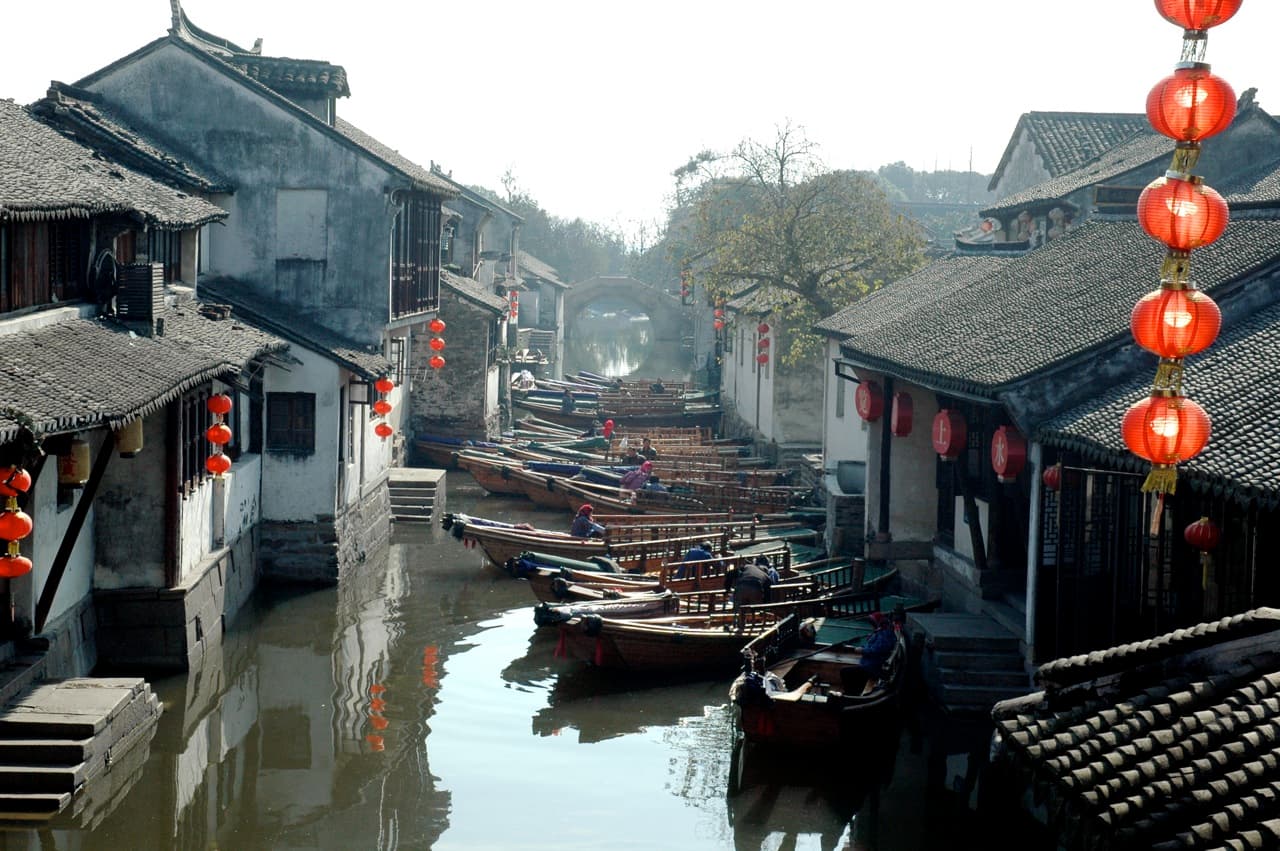 Photo of Zhouzhuang, via Wikimedia Commons
Self-guided audio walking tour of Jiaxing (Nanhu) — GPS route, offline playback, story-driven narration in 32 languages.
“Where revolutionary history converges with serene waters and enduring culture.”
Not the postcards. The stories even locals don't know — whispered in your ear, right where they happened.
The 'Red Boat' on Nanhu Lake stands as a national emblem, its preservation involving a surprising yearly custom.
Beyond its historical weight, Nanhu Lake conceals a culinary delight that thrives beneath its surface.
The narratives of the Red Boat are animated by a family whose generations share a singular connection to the memorial.
Discover every secret of Jiaxing (Nanhu)
Every address, every reveal in full — in your ear, right where it happened.
You pick your stops. You walk. The voice reveals what the others miss.
Your self-guided audio tour of Jiaxing (Nanhu) is ready — pick your landmarks, choose your language, and start the moment you arrive.
BuyLume has a built-in augmented-reality guide. Hold your phone up and its camera shows the street ahead of you, with a glowing arrow laid over the real view that always points to your next stop — no map to puzzle over, no wrong turns. Like everything in Lume, it works fully offline.
Jiaxing, a city in China's Zhejiang Province, presents a landscape where quiet natural splendor intertwines with pivotal moments in modern history. At its core lies Nanhu Lake, or South Lake, a expansive body of water covering 5.86 square kilometers, recognized as a National 5A Level scenic spot. Often mentioned alongside Hangzhou's West Lake and Nanjing's Xuanwu Lake, Nanhu forms a significant part of the cultural and historical fabric of the Yangtze River region. Its calm waters, framed by weeping willows and venerable pavilions, offer a peaceful escape, while its historical resonance adds a profound layer of meaning to any visit.
The city of Jiaxing itself, with Nanhu District as its central downtown area, melds a storied past with contemporary development. It is acknowledged as a foundational site of Majiabang culture, a Neolithic civilization, and a Confucian business tradition. Beyond Nanhu Lake, Jiaxing offers a network of picturesque waterways, historic thoroughfares like Yuehe, and a culinary heritage celebrated for its Zongzi (rice dumplings). For travelers seeking a combination of historical contemplation, cultural immersion, and natural beauty, Jiaxing offers a compelling destination within the broader Yangtze River Delta.
## The Origins of Majiabang Culture Jiaxing's history extends back 7,000 years, establishing it as a significant location for understanding ancient Chinese civilization. It is recognized as the birthplace of the Majiabang culture, a Neolithic civilization, and a Confucian business tradition. During the Spring and Autumn Period (770-476 BC), the area was identified as Changshui and Zuili, a region where the states of Wu and Yue contended for influence. The Qin Dynasty (221-206 BC) established Youquan and Haiyan counties, which were subordinate to Kuaiji county. By the Western and Eastern Han dynasties (206 BC-220 AD), Jiaxing had become known for its salt and grains.
## From Hexing to Jiaxing The city's name evolved across centuries. In 231 AD, Sun Quan, emperor of the Wu State, renamed Youquan to Hexing, signifying 'flourishing crops.' It was later renamed Jiaxing, meaning 'auspicious and flourishing,' in 242 AD. During the Five Dynasties and Ten Kingdoms period (907-960 AD), Jiaxing was designated a city-level regime for the first time with the establishment of Kaiyuan city, governing Jiaxing, Haiyan, and Huating counties.
## The Red Boat and a New Era The most pivotal moment in Jiaxing's modern history occurred in July 1921. The First National Congress of the Communist Party of China (CPC), initially convened in Shanghai, was disrupted by French police. The assembly was then relocated to a boat on Nanhu Lake in Jiaxing, where the congress concluded and the founding of the CPC was declared. This 'Red Boat' became an enduring emblem of the Party's pioneering spirit and its dedication to the people. The Nanhu Revolutionary Memorial Hall, established in 1959 and expanded in 2011, safeguards over 10,000 historical artifacts related to the CPC's early development, offering visitors a detailed account of this momentous event.
## A City of Culture and Commerce Jiaxing has also served as a historical center for silk production, earning it recognition as one of China's 'origins of silk.' Its extensive network of waterways facilitated trade and shaped the city's distinctive appearance, often leading to comparisons with the 'Venice of the East.' Over the centuries, this cultural and economic prosperity drew notable figures such as painters Wu Zhen and Pu Hua, scholar Shen Zengzhi, and mathematician Chen Xingshen, all of whom studied or resided in Jiaxing. Today, Jiaxing continues to develop, blending its profound heritage with contemporary advancements in scientific and technological innovation, and a focus on liveability and shared progress.
The primary point of interest in Jiaxing is Nanhu Lake, a National 5A Level scenic spot. A boat journey on the lake is necessary to reach Huxin Island, where a replica of the historic Red Boat is moored near Yanyu Tower. While photography is not permitted on the boat itself, you can capture silhouette photos from the shoreline. Yanyu Tower, originally constructed during the Five Dynasties period, affords expansive views of Nanhu Lake from its second-floor terrace. The Nanhu Revolutionary Memorial Hall, a brief walk from the lakeside, offers a thorough examination of the founding of the Communist Party of China through its extensive collection of artifacts and exhibits.
Beyond the lake, explore the Yuehe Historic District, a traditional water town area with ancient thoroughfares and canals that provide a glimpse into old Jiaxing. The Zicheng Ruins Park and Jiaxing Catholic Church are also easily accessible, connected by a pleasant walking route. For a taste of local culture, consider a visit to the Zongzi Museum to learn about Jiaxing's celebrated rice dumplings. Other notable attractions in the Nanhu District include Meihuazhou Scenic Area and the Jiaxing Museum.
The most agreeable times to visit Jiaxing are during spring (March to May) and autumn (September to November), when the weather remains mild and comfortable for walking and exploration. Spring brings verdant landscapes and crisp air, though it can be damp with occasional rain, which often enhances the atmosphere of the Jiangnan water towns. Autumn offers gentle light and a soft breeze, ideal for photography and outdoor activities. Summers (June to August) are hot, wet, and humid, with temperatures often surpassing 25°C, and can approach 30°C in July and August. If visiting in summer, it is advisable to explore before 9 AM or after 4 PM. Winters (December to February) are cool and generally drier, with average temperatures around 5-7°C, providing a quieter experience for those who prefer tranquility.
Jiaxing is well-connected by China's high-speed rail network, with Jiaxing South Railway Station serving as the primary arrival point. From there, a taxi ride to the city center typically takes about 30 minutes, or you can take Tram Line 1 directly to key areas like Fangong Road Nanxi West Road Station, which is a 600-meter walk from the Nanhu Scenic Area. Jiaxing Nanhu Airport (JNH), a dual-use civilian and military airport, commenced operations in December 2025, offering domestic passenger flights and functioning as a cargo hub. Taxis and ride-hailing applications like Didi or Gaode are recommended for navigating the city. Public buses and tourist buses (such as routes 1 or 8) also provide good value for reaching attractions.
The mainland sections of the Nanhu Scenic Area are free to enter. A round-trip boat ticket to Huxin Island costs 20 RMB. The Nanhu Revolutionary Memorial Hall is free but requires a reservation, which can be made in advance via their official WeChat account. Comfortable walking shoes are essential, particularly when exploring the historic districts and water towns. Light-colored clothing is often suggested for better photographs against the scenic background. During warmer months, insect repellent and sun protection are advisable. It is important to note that international mapping applications may not be accurate in mainland China; local applications such as Gaode Map or Baidu Map are recommended.
Jiaxing (Nanhu) in Korean, in Chinese or in Hebrew — and 29 more languages, every stop narrated by a native voice. The widest language range of any self-guided audio tour.
Available in: