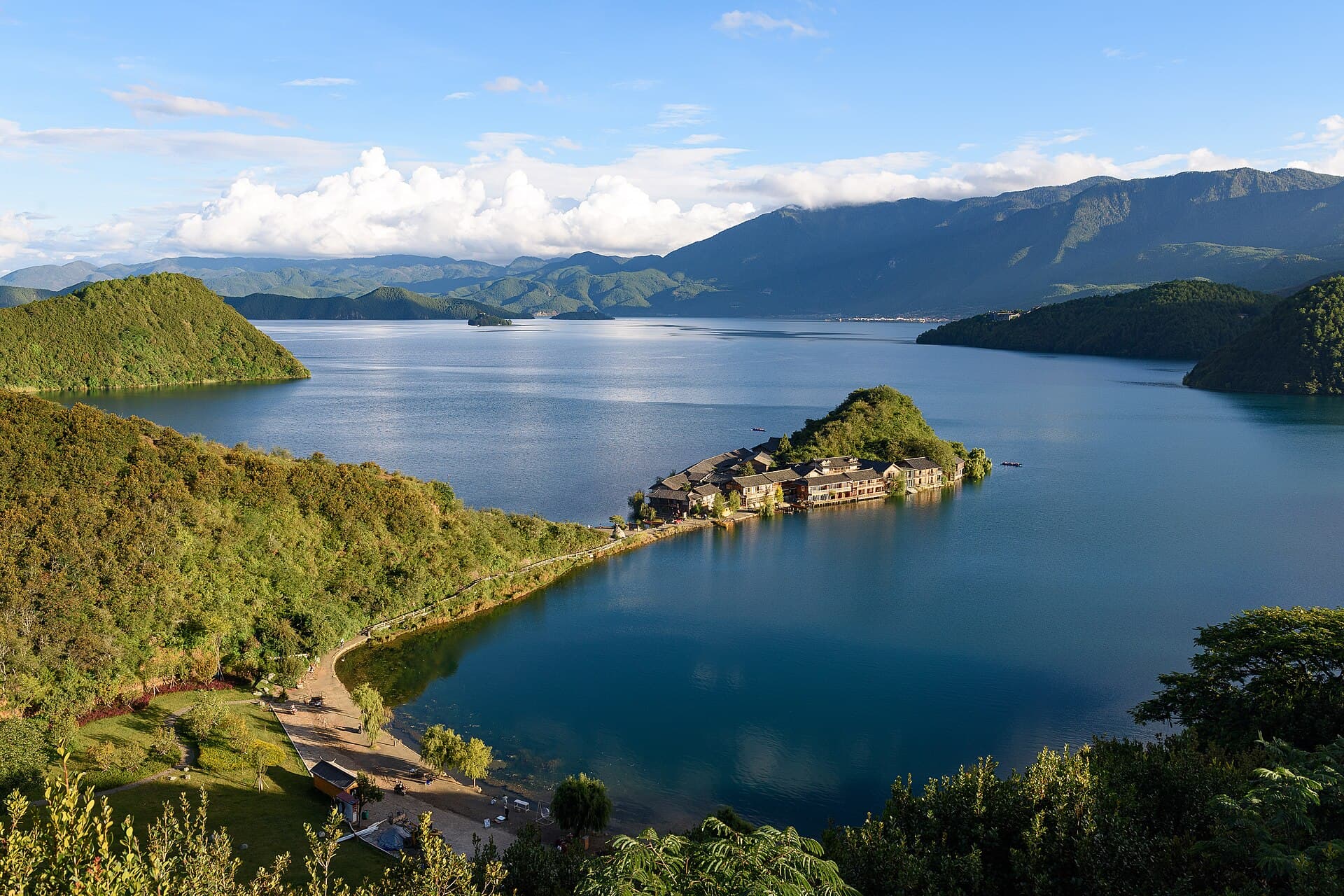
Point de vue de la presqu'île de Lige
D'en haut, le lac Lugu révèle une forme particulière.
L'histoire complète se débloque dans le tour
 N509FZ / CC BY-SA 4.0, via Wikimedia Commons
Visite audio autoguidée de Lugu — parcours GPS à pied, lecture hors ligne, narration en 32 langues.
“Là où les eaux reflètent des traditions ancestrales et les femmes mènent la danse de la vie.”
Pas les cartes postales. Les histoires que même les habitants ignorent — soufflées à l'oreille, là où elles se sont passées.
D'en haut, le lac Lugu révèle une forme particulière.
Le peuple Mosuo aborde les relations d'une manière distincte, souvent appelée 'mariage marché'.
Ce pic sacré recèle un secret dans ses profondeurs, au-delà des vues imprenables.
Découvrez tous les secrets de Lugu
Chaque adresse, chaque révélation en entier — dans ton oreille, là où elle s'est passée.
Tu choisis tes lieux. Tu marches. La voix te révèle ce que les autres ignorent.


Votre visite audioguidée de Lugu vous attend — choisissez vos lieux, votre langue, et lancez-vous dès votre arrivée.
AcheterLume intègre un guide en réalité augmentée. Levez votre téléphone : sa caméra montre la rue devant vous, avec une flèche lumineuse posée sur l'image réelle qui pointe toujours vers votre prochain arrêt — aucune carte à déchiffrer, aucun mauvais virage. Comme tout dans Lume, ça fonctionne entièrement hors-ligne.
Le lac Lugu, connu sous le nom de 'Lac Mère' par le peuple Mosuo local, est un lac alpin niché à une altitude de 2 685 mètres (8 809 pieds) à la frontière des provinces du Yunnan et du Sichuan en Chine. Cette étendue d'eau tranquille, avec ses profondeurs turquoise claires et ses montagnes environnantes, offre une évasion sereine. Il se classe parmi les lacs d'eau douce les plus profonds de Chine.
L'attrait singulier du lac s'étend au-delà de sa splendeur naturelle à la culture durable du peuple Mosuo. Souvent appelé 'Le Royaume des Femmes' ou 'Foyer de la Tribu Matriarcale', le lac Lugu présente un rare exemple de société matriarcale où les femmes occupent des rôles centraux dans la vie familiale et communautaire. Leurs traditions distinctives, y compris la pratique du 'mariage marché', ont captivé chercheurs et voyageurs.
La formation géologique du lac Lugu remonte à une faille de l'ère Cénozoïque tardive, façonnant un lac alpin niché par les montagnes. Le lac possède un long passé, avec des découvertes archéologiques indiquant d'anciens établissements Mosuo le long de ses rives. Les légendes locales décrivent souvent la genèse du lac comme les larmes d'une déesse, contribuant à la révérence avec laquelle la communauté le considère.
Depuis près de 2 000 ans, le peuple Mosuo habite cette région, préservant ses traditions matriarcales et matrilinéaires uniques. Leur société est caractérisée par des femmes dirigeant les foyers, héritant des biens et transmettant les noms de famille à leurs enfants. La grand-mère sert généralement de matriarche familiale, guidant les décisions du foyer depuis la maison ancestrale. Les hommes restent dans leurs foyers maternels, et les oncles maternels jouent un rôle important dans l'éducation des enfants de leurs sœurs.
L'un des aspects les plus distinctifs de la culture Mosuo est le 'mariage marché' (localement connu sous le nom de zouhun ou axia marriage). Dans ce système, les partenaires romantiques se rendent visite la nuit mais continuent de vivre dans leurs foyers maternels respectifs. Les relations sont fondées sur l'affection mutuelle, sans les concepts conventionnels de prix de la mariée, de dot ou de fusion des biens. Les enfants nés de ces unions sont élevés par la mère et sa famille. Bien que certaines jeunes générations adoptent des mariages plus conventionnels, la forte atmosphère culturelle matrilinéaire perdure.
Historiquement, l'emplacement isolé des Mosuo, à une altitude de 2 685 mètres, a contribué à sauvegarder leur mode de vie distinct, avec une influence extérieure substantielle ne commençant qu'à partir des années 1970. La religion traditionnelle Mosuo vénère la nature, le lac Lugu étant vénéré comme la Déesse Mère et la montagne Gemu comme la Déesse de l'Amour. Ils intègrent également le lamaïsme, une forme de bouddhisme tibétain, dans leurs pratiques spirituelles.
Le lac Lugu présente une fusion de beauté naturelle et d'immersion culturelle. Le Point de vue de la presqu'île de Lige offre une perspective emblématique en forme de cœur du lac, particulièrement saisissante dans la brume matinale. Pour une vue étendue, montez la Montagne de la Déesse Gemu en téléphérique, suivi d'une courte randonnée jusqu'à la plate-forme d'observation la plus élevée. La montagne abrite également la Grotte de la Déesse, avec ses formations de stalactites distinctives.
Explorez la paisible Mer d'Herbe, un paysage de prairies humides traversé par le Pont du Mariage Marché. Cette zone est vitale pour maintenir la clarté du lac et offre des vues aériennes photographiques depuis une passerelle sur la colline opposée. Une promenade en bateau dans un 'bateau-auge à porcs' traditionnel Mosuo est un moyen classique de découvrir les eaux calmes et de visiter des îles comme l'île de Liwubi, connue pour son monastère paisible et ses couchers de soleil. Visiter un village Mosuo local, tel que Xiaoluoshui ou Lige, permet d'avoir un aperçu de la vie quotidienne et de la structure unique du foyer matrilinéaire. Le Musée Mosuo offre un aperçu plus approfondi de leur histoire et de leurs coutumes.
Les périodes les plus agréables pour visiter le lac Lugu sont le printemps (mars à mai) et l'automne (septembre à novembre). Pendant ces saisons, le temps reste stable, avec des journées claires et des températures confortables allant de 18°C à 25°C (64°F à 77°F), idéales pour apprécier les eaux d'un bleu profond du lac et s'adonner à des activités de plein air. L'été (juin à août) est également agréable avec des températures fraîches (15-25°C/59-77°F), bien que ce soit la saison des pluies. L'hiver apporte moins de visiteurs, des journées claires et des opportunités d'observer la brume matinale et les mouettes, avec des températures diurnes autour de 10-15°C (50-59°F).
Le lac Lugu se situe à une altitude de 2 685 mètres (8 809 pieds), les visiteurs peuvent donc ressentir un léger mal d'altitude, surtout en montant la Montagne de la Déesse Gemu. Il est conseillé d'emporter des collations riches en calories et d'envisager une bouteille d'oxygène portable si vous êtes sensible à l'altitude. Le droit d'entrée pour le lac Lugu est de 80 yuans. La plupart des visiteurs estiment qu'un séjour d'au moins deux nuits est recommandé pour profiter pleinement de la région. Bien que la sécurité soit généralement bonne, il est judicieux d'avoir suffisamment d'argent liquide car les distributeurs automatiques de billets se trouvent principalement dans le village de Daluoshui et le comté de Lugu Lake, et non dans le village de Lige.
Le transport vers le lac Lugu est possible par la route depuis Lijiang dans le Yunnan et Xichang dans le Sichuan, les trajets prenant généralement 4 à 7 heures. Les options incluent les navettes ou les voitures affrétées. Une fois sur place, vous pouvez vous déplacer en affrétant une voiture pour un tour du lac, en faisant du vélo ou en prenant des bateaux traditionnels. Le respect des coutumes et traditions locales Mosuo est primordial.
Lugu en coréen, en chinois ou en hébreu — et dans 29 autres langues, chaque étape narrée par une voix native. La plus large gamme de langues de tous les audioguides autoguidés.
Disponible en :