Porte de la Saunerie
This formidable medieval gate once served a curious, less-than-sweet purpose for the town's economy.
Full story unlocks in the tour
 civodule / CC BY-SA 3.0, via Wikimedia Commons
Self-guided audio walking tour of Manosque — GPS route, offline playback, story-driven narration in 32 languages.
“Where the perfume of lavender drifts through ancient stone, carrying literary echoes.”
Not the postcards. The stories even locals don't know — whispered in your ear, right where they happened.
This formidable medieval gate once served a curious, less-than-sweet purpose for the town's economy.
Manosque, a seemingly tranquil Provençal town, once harbored a clandestine training ground for a notorious criminal enterprise.
The scenic Mont d'Or hill, offering sweeping views, preserves the last remnant of a once-grand medieval complex that served a powerful figure.
Discover every secret of Manosque
Every address, every reveal in full — in your ear, right where it happened.
You pick your stops. You walk. The voice reveals what the others miss.


Your self-guided audio tour of Manosque is ready — pick your landmarks, choose your language, and start the moment you arrive.
BuyLume has a built-in augmented-reality guide. Hold your phone up and its camera shows the street ahead of you, with a glowing arrow laid over the real view that always points to your next stop — no map to puzzle over, no wrong turns. Like everything in Lume, it works fully offline.
Manosque, the largest town in the Alpes-de-Haute-Provence, offers an authentic Provençal encounter, far from the coastal glitz. Situated in the Durance valley, at the edge of the Luberon and the Valensole plateau, it is a town where ancient stone architecture meets a landscape dotted with olive groves and, in season, expansive lavender fields. The historic center, largely free of vehicle traffic, invites leisurely exploration of its well-preserved lanes, charming squares, and ancient gates. Manosque serves as an excellent starting point for discovering the broader region, from hilltop villages to the Gorges du Verdon.
The town's identity is deeply intertwined with its cultural and natural inheritance. It is the birthplace of the acclaimed writer Jean Giono, whose enduring legacy is honored through a cultural center and various events. Beyond its literary connections, Manosque is recognized for its ancient olive-growing traditions, home to one of France's largest olive oil producers, Le Moulin de l'Olivette. The surrounding natural environment, with its walking paths and expansive views from Mont d'Or, further enhances its allure.
## From Roman Market to Medieval Stronghold Manosque's origins precede 966, with its name possibly stemming from a Celto-Ligurian term meaning 'inhabitant of the hills.' While precise details before the Roman era are scarce, the town functioned as a regional market during the Roman Empire. Archaeological discoveries, such as a potter's workshop producing wine amphorae, suggest Manosque was closely integrated into the Roman Empire due to its proximity to the Via Domitia.
Around 900 AD, Manosque suffered destruction by the Saracens, but it began to regain prominence in the 13th century. It became a favored residence of the Counts of Forcalquier, who co-owned the town with Saint-Victor de Marseille. During this period, the town's population swelled to 10,000, prompting the construction of city walls for defense against roving 'Great Companies' that devastated Provence between 1355 and 1385. These fortifications included monumental gates like the Porte de la Saunerie, completed in 1382, and the Porte Soubeyran, dating from the 14th century.
## Plagues, Resilience, and Modern Growth The town confronted significant adversities in later centuries, particularly from plagues in 1720 and 1834, which severely impacted the populace. A major earthquake in 1708 also damaged many structures, including the hospital, which was subsequently rebuilt outside the fortified walls in the mid-18th century. Despite these setbacks, Manosque endured. Between 1950 and 1970, the town experienced a substantial population surge, tripling its inhabitants, a trend observed in other areas south of the Luberon.
Today, Manosque is the most populated town in Haute Provence, known for its preserved historic center and its strong connection to literature, particularly through the life and works of Jean Giono, a native son. The town continues to honor its enduring past through its architecture, cultural events, and the lasting traditions of olive growing and winemaking.
Manosque's historic center, shaped like a pear, is best explored on foot. Begin your journey at one of the surviving medieval gates, such as the Porte de la Saunerie, built in 1382, or the Porte Soubeyran, with its 18th-century clock tower and 1830 campanile. Wander through narrow lanes to discover charming squares adorned with fountains and café terraces. Notable religious sites include the Romanesque church of Notre-Dame-de-Romigier, said to shelter one of France's oldest Virgin statues, and the Romanesque-Gothic church of Saint-Sauveur, featuring 17th-century Baroque organs.
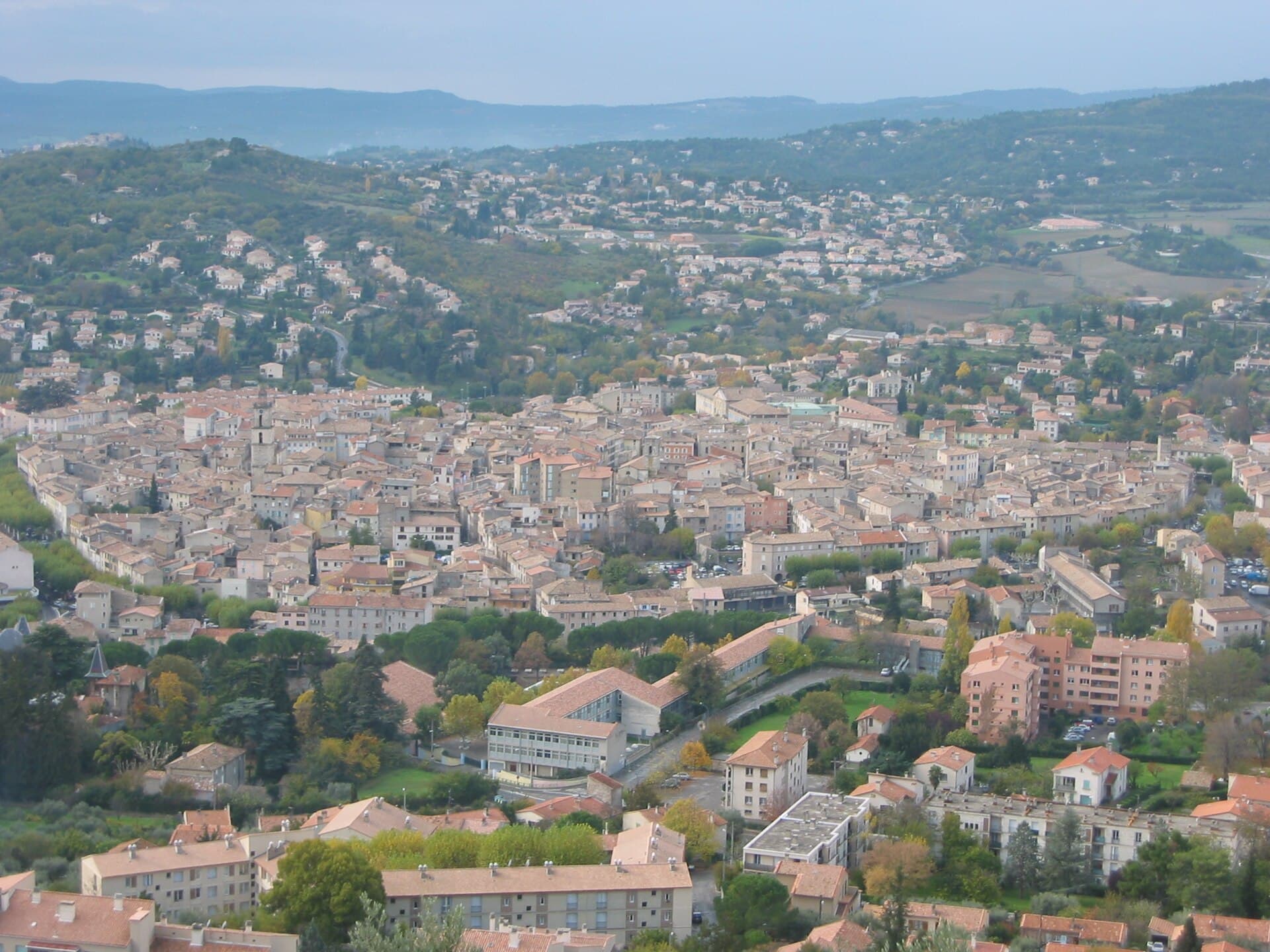
For a broader perspective, ascend Mont d'Or hill, where the last remnant of a medieval castle provides expansive views of the old town, the Durance valley, and the surrounding countryside, including the Luberon and even the pre-Alpine peaks. Literature enthusiasts can visit the Centre Jean Giono, dedicated to the Manosque-born writer, and his former home, Le Paraïs, which features his personal library of over 8,500 works and a garden overlooking the historic center. A short drive away, the L'Occitane en Provence factory offers guided sensory tours, a Mediterranean garden, and a boutique.
Manosque enjoys a Mediterranean climate with hot, dry summers and cooler winters. The ideal time to visit depends on your preferences. For comfortable weather and blooming landscapes, spring (April to June) offers mild temperatures (15–25°C). Summer (July to August) is the busiest season, with temperatures between 25–35°C, perfect for experiencing the lavender fields of the Valensole Plateau. For lavender, aim for late June to early July. Autumn (September to October) remains sunny and warm (18–28°C), with fewer crowds and the harvest season for olives and grapes. The driest month is July, while October sees the most precipitation.
Manosque is well-connected and accessible. By car, it sits just off the A51 motorway, making it easy to reach from Aix-en-Provence or Gap. The nearest major airport is Marseille Provence Airport, approximately an hour's drive away. Manosque-Gréoux-les-Bains has a regional train station with connections from Marseille, Aix-en-Provence, or Gap. While public transport within the region can be limited, urban bus lines operate in Manosque and its surroundings.
The town center is largely pedestrian-friendly. For those exploring the wider Provençal countryside, a car is highly recommended. Manosque offers a range of accommodations, dining establishments, and essential services like grocery stores and pharmacies. The local tourism office can provide guidance on activities, local products, and accommodation.
Manosque in Korean, in Chinese or in Hebrew — and 29 more languages, every stop narrated by a native voice. The widest language range of any self-guided audio tour.
Available in: