Prada Marfa
An iconic luxury boutique stands alone in the vast West Texas desert, yet you can't buy a single item inside.
Full story unlocks in the tour
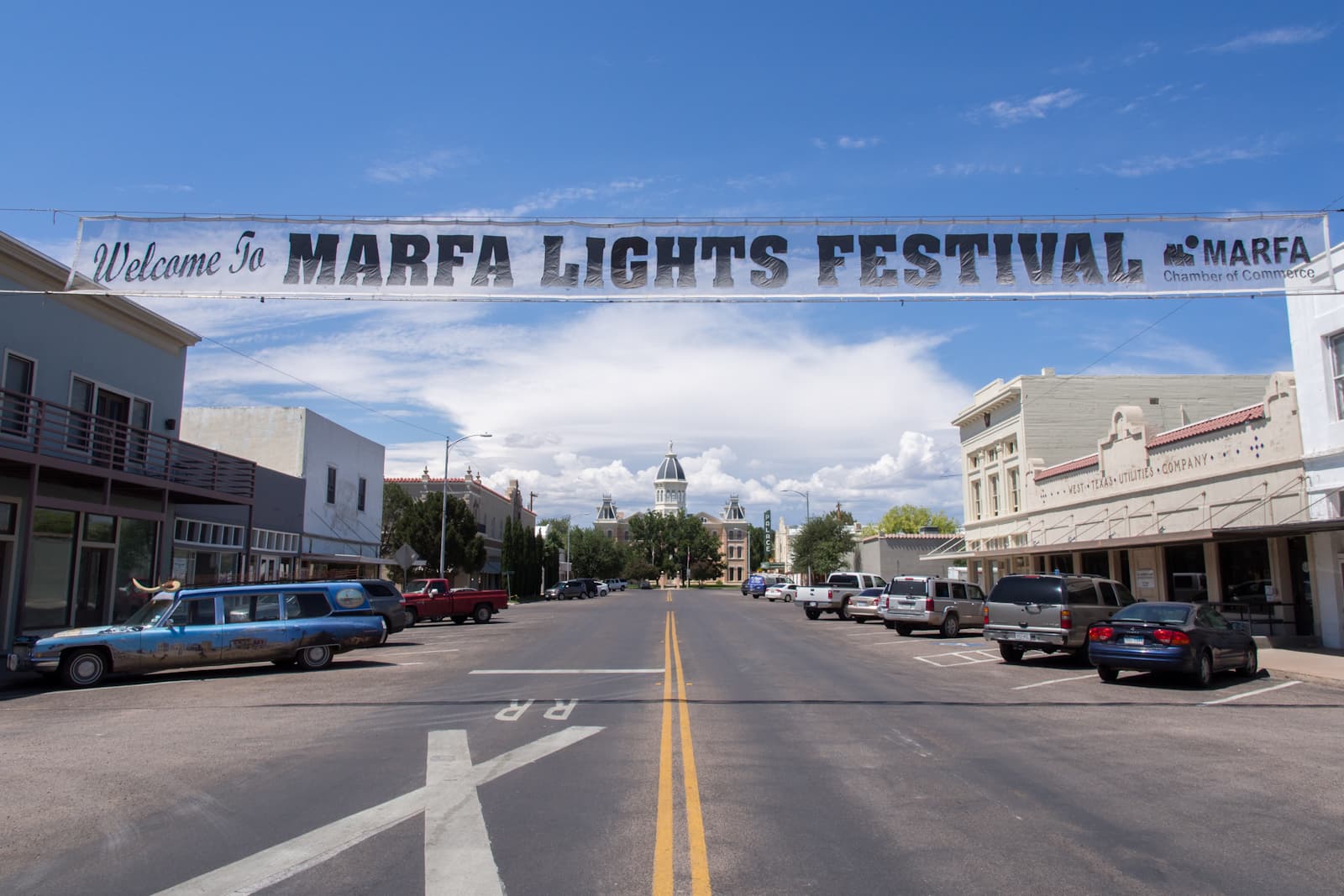 Mathieu Lebreton from Paris, France / CC BY 2.0, via Wikimedia Commons
Self-guided audio walking tour of Marfa — GPS route, offline playback, story-driven narration in 32 languages.
“Where the high desert meets high art, and the unexplained.”
Not the postcards. The stories even locals don't know — whispered in your ear, right where they happened.
An iconic luxury boutique stands alone in the vast West Texas desert, yet you can't buy a single item inside.
For over a century, mysterious, glowing orbs have appeared in the desert sky near Marfa, baffling scientists and drawing curious onlookers.
This historic hotel in downtown Marfa once hosted Hollywood legends during the filming of a classic epic, becoming a temporary home for a star-studded cast.
Discover every secret of Marfa
Every address, every reveal in full — in your ear, right where it happened.
You pick your stops. You walk. The voice reveals what the others miss.

Your self-guided audio tour of Marfa is ready — pick your landmarks, choose your language, and start the moment you arrive.
BuyLume has a built-in augmented-reality guide. Hold your phone up and its camera shows the street ahead of you, with a glowing arrow laid over the real view that always points to your next stop — no map to puzzle over, no wrong turns. Like everything in Lume, it works fully offline.
Marfa, a small city in the high desert of West Texas, serves as an unlikely cultural oasis. With a population just under 1,800 people, it has garnered international recognition as a center for minimalist art, drawing artists, art enthusiasts, and curious travelers from around the globe. Situated between the Davis Mountains and Big Bend National Park, Marfa offers a distinctive blend of expansive desert landscapes, quirky roadside attractions, and sophisticated contemporary art.
The town's remote location contributes to its allure, requiring a deliberate journey that deepens its mystique. Visitors often find themselves immersed in a slower pace of life, where the vastness of the Chihuahuan Desert provides a dramatic backdrop for artistic expression and quiet contemplation. Marfa's charm resides in its contradictions: world-class art in a remote setting, fine dining alongside casual eateries, and modern design contrasting with historic architecture.
Marfa was established in the early 1880s as a railroad water stop for the Galveston, Harrisburg, and San Antonio Railway. The name "Marfa" is said to have been suggested by the wife of a railroad executive, inspired by a character in Jules Verne's novel Michael Strogoff. The town quickly expanded, serving as a freight headquarters and a vital link in West Texas's economic and military history.
During the 1920s, Marfa experienced significant growth, and by 1930, its population reached 3,909 residents. The 1940s brought a military presence with the Marfa Army Air Field, an advanced flight-training base during World War II, and a training ground for chemical mortar battalions. A prisoner of war camp was also constructed nearby. However, these military installations closed in 1945 and 1946, leading to economic challenges for the town, exacerbated by drought affecting agricultural output.
Marfa's trajectory shifted dramatically in 1971 when renowned minimalist artist Donald Judd moved to the town from New York City. His intention was to permanently install his large-scale art, acquiring and renovating properties to house his work and that of other artists. This move marked the beginning of Marfa's transformation into an international art destination. The Chinati Foundation, established by Judd in 1986 on a former military base, became a cornerstone of Marfa's art scene, displaying permanent installations designed specifically for the space. Judd's vision attracted other artists and art patrons, solidifying Marfa's reputation as a singular cultural center in the high desert.
Begin your exploration at The Chinati Foundation, established by Donald Judd, which presents large-scale, permanent installations by Judd and other artists across a former military base. Guided tours are recommended and require reservations. The Judd Foundation also maintains Judd's former studios and homes, offering further insight into his work.
Do not overlook Prada Marfa, a permanent art installation resembling a Prada boutique, located about 30 miles west of town near Valentine. For contemporary art beyond Judd's legacy, visit Ballroom Marfa, a converted dance hall hosting diverse exhibitions. The Marfa and Presidio County Museum, housed in an 1880s-era building, offers a glimpse into the region's history, including ranching, military, and local culture.
As night falls, head to the Marfa Lights Viewing Area, nine miles east of town, for a chance to observe the mysterious Marfa Lights. While their origin is unknown, the experience under Marfa's dark skies is memorable. For stargazing, the McDonald Observatory, about 40 miles away in Fort Davis, hosts public star parties.
The most pleasant times to visit Marfa are during the spring (March to May) or fall (September to November). During these seasons, the weather is agreeable for outdoor activities and exploring the art installations, avoiding the extreme heat of summer and the cold winter nights. Many art events and festivals also take place in the spring and fall, such as the Chinati Foundation's open house in October. Weekends, particularly Friday and Saturday, are when most shops, galleries, and restaurants are open and active.
Marfa is remote, and a car is essential for reaching it and exploring the surrounding area. The closest major airports are El Paso International Airport (ELP) and Midland International Air & Space Port (MAF), both approximately a three-hour drive away. Be aware that some businesses in Marfa operate with limited or unpredictable hours, so it is advisable to check ahead for opening times, especially for restaurants. There are no large chain stores in Marfa, so plan accordingly for any specific needs.
Pack layers of clothing, as desert temperatures can fluctuate significantly between day and night. Sunscreen, a hat, and a reusable water bottle are also recommended due to the intense sun and dry climate. Consider bringing allergy medication, lip balm, and eyedrops. While some central areas are walkable, a car is necessary to reach attractions like Prada Marfa and the Marfa Lights Viewing Area.
Marfa in Korean, in Chinese or in Hebrew — and 29 more languages, every stop narrated by a native voice. The widest language range of any self-guided audio tour.
Available in: