Church of the Transfiguration
The current church occupies the footprint of an earlier fortification, yet a particular detail speaks of its defensive origins.
Full story unlocks in the tour
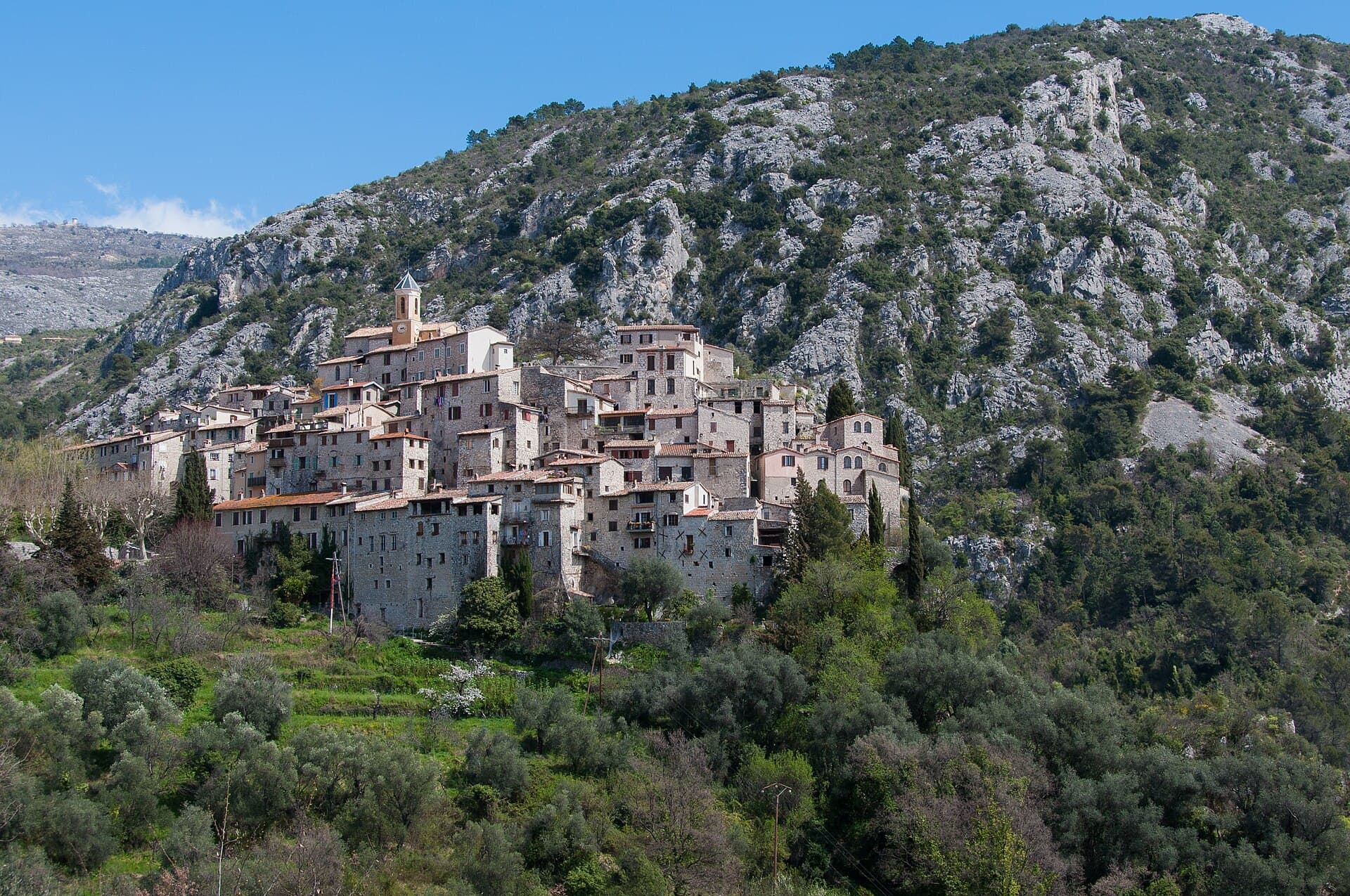 Mark Fischer / CC BY-SA 2.0, via Wikimedia Commons
Self-guided audio walking tour of Peillon — GPS route, offline playback, story-driven narration in 32 languages.
“Peillon: Where time folds in on itself, and stone recounts ancient lives.”
Not the postcards. The stories even locals don't know — whispered in your ear, right where they happened.
The current church occupies the footprint of an earlier fortification, yet a particular detail speaks of its defensive origins.
To fully appreciate the chapel's acclaimed 15th-century frescoes, a small contribution might be helpful.
This hotel, one of the few accommodations in the village, embraces an aesthetic that distinguishes it from contemporary trends.
Discover every secret of Peillon
Every address, every reveal in full — in your ear, right where it happened.
You pick your stops. You walk. The voice reveals what the others miss.

Your self-guided audio tour of Peillon is ready — pick your landmarks, choose your language, and start the moment you arrive.
BuyLume has a built-in augmented-reality guide. Hold your phone up and its camera shows the street ahead of you, with a glowing arrow laid over the real view that always points to your next stop — no map to puzzle over, no wrong turns. Like everything in Lume, it works fully offline.
Peillon, a medieval village set upon a rocky spur, offers a journey back in time, merely 20 kilometers north of Nice in France’s Alpes-Maritimes department. This car-free village, often likened to an 'eagle's aerie,' surveys the Paillon de l'Escarène valley, affording expansive views of the surrounding mountains and valleys. Its architecture, defined by narrow, winding pathways, vaulted passages, and closely built stone houses, cultivates a singular atmosphere that feels untouched by contemporary tourism.
Peillon distinguishes itself among the hilltop villages of the French Riviera through its authentic and preserved character. Unlike more commercialized destinations, one will not find an abundance of souvenir shops or bustling cafes here. Instead, visitors can immerse themselves in the quietude of its ancient thoroughfares, uncover its historical treasures, and appreciate the peaceful rhythm of village life. It is a place where the past feels tangible, inviting exploration on foot through its intricate network of paths and staircases.
The area of Peillon has been inhabited since prehistoric times, with evidence of human presence dating to the Iron Age. The village’s strategic hilltop location, approximately 376 meters above sea level, was chosen for defensive reasons, providing natural protection against invasions and plunder during the Middle Ages. The initial fortified settlement began to take shape around 980 AD.
Peillon was first documented in 1150 under the name 'Guauceranus de Pellom,' with its name derived from Latin and Occitan roots signifying 'rock' or 'height.' The village’s medieval core, originating in the 12th century, exemplifies Provençal architecture adapted for defense. Houses were constructed in close proximity, forming a natural rampart around the central castle that once dominated the settlement. Until 1235, Peillon belonged to the neighboring village of Peille’s territory.
In 1388, Peillon came under the authority of the House of Savoy. It briefly became French during the French Revolution and Napoleonic era but reverted to the Kingdom of Sardinia after 1815. Following a regional referendum in 1860, Peillon, along with the County of Nice, was definitively annexed to France, solidifying its place within French territory.
The 20th century brought administrative alterations, with the hamlet of Sainte-Thècle, situated in the valley below, becoming the official administrative center in 1948, housing the town hall, post office, and railway station. Despite these changes, the old village of Peillon has remarkably maintained its medieval atmosphere and heritage. Today, its ancient structures, narrow pathways, and fortified gates continue to narrate the story of its long and varied past.
Begin your exploration in Place Arnulf, where an 1800 fountain, now a listed historic monument, stands beneath the shade of venerable plane trees. From here, wander through the intricate network of narrow, winding pathways, many of which are staircases crossed by vaulted passages, or pountins, that give the village its distinctive character. These passages often form tunnels over other paths, offering unique architectural details.
Ascend to the village's summit to visit the Church of Saint-Sauveur, also known as the Church of the Transfiguration. This 17th-century Baroque church, with its neo-classical façade from 1772, was constructed on the site of a former fortified castle; its 12th-century keep now serves as the bell tower. Inside, admire the rustic Baroque influences, including twisted columns and trompe l'oeil windows. Just below the village, the Chapel of the White Penitents (Chapelle Notre-Dame des Sept Douleurs) is a significant sight, housing magnificent 15th-century frescoes by Jean Canavesio depicting the Passion of Christ. A small contribution illuminates these detailed paintings.
For expansive views, seek out the Saint Roch Church Viewpoint, a short walk from the parking area, providing a striking perspective of Peillon and the valley below. The village also features several oratories and calvaries, small chapels housing saint statues, which can be discovered on walks around the village's periphery.
The most agreeable times to visit Peillon are generally spring (March to May) and autumn (September to November), when the weather is pleasant and crowds are fewer. Autumn, in particular, is recommended for appreciating the village's picturesque setting. Summers (early July to late August) are warm and dry, suitable for outdoor activities, though temperatures can be high. Winters (November to March) are cooler and partly cloudy, with January being the coldest month. Rainfall is highest in October and lowest in July.
Peillon is a car-free village, meaning visitors will need to park at the designated lot near the Auberge de la Madone and explore the village on foot. While driving is the simplest way to reach Peillon, public transportation can be somewhat challenging. From Nice, one can take the TER train (Tende line) to the Peillon-Sainte-Thècle stop, followed by a 42-minute uphill walk to the village. Alternatively, a taxi from the train station is advisable if carrying luggage. Limited bus services operate from Nice, so checking schedules in advance is essential.
Within the village, one will find a tranquil atmosphere with only two restaurants and one hotel, the Auberge de la Madone. There are no grocery stores or souvenir shops, so it is wise to bring water and snacks. The Peillon Tourist Office, located at 4 Carriera Centrale, can provide information on accommodations, activities, and local heritage. They can be reached at +33 (0)6 24 97 42 25.
Peillon in Korean, in Chinese or in Hebrew — and 29 more languages, every stop narrated by a native voice. The widest language range of any self-guided audio tour.
Available in: