The narrow, winding roads to Saorge
The drive into Saorge can prove an exhilarating experience, particularly when approaching from the Italian border.
Full story unlocks in the tour
 Patrick Rouzet / CC BY-SA 3.0, via Wikimedia Commons
Self-guided audio walking tour of Saorge — GPS route, offline playback, story-driven narration in 32 languages.
“Where ancient stone clings to mountainsides and echoes of history resonate through the very air.”
Not the postcards. The stories even locals don't know — whispered in your ear, right where they happened.
The drive into Saorge can prove an exhilarating experience, particularly when approaching from the Italian border.
Despite its captivating beauty, Saorge's population has significantly diminished over the centuries.
The tranquil Franciscan Monastery of Saorge, once a spiritual sanctuary, now welcomes a different kind of contemplative inhabitant.
Discover every secret of Saorge
Every address, every reveal in full — in your ear, right where it happened.
You pick your stops. You walk. The voice reveals what the others miss.


Your self-guided audio tour of Saorge is ready — pick your landmarks, choose your language, and start the moment you arrive.
BuyLume has a built-in augmented-reality guide. Hold your phone up and its camera shows the street ahead of you, with a glowing arrow laid over the real view that always points to your next stop — no map to puzzle over, no wrong turns. Like everything in Lume, it works fully offline.
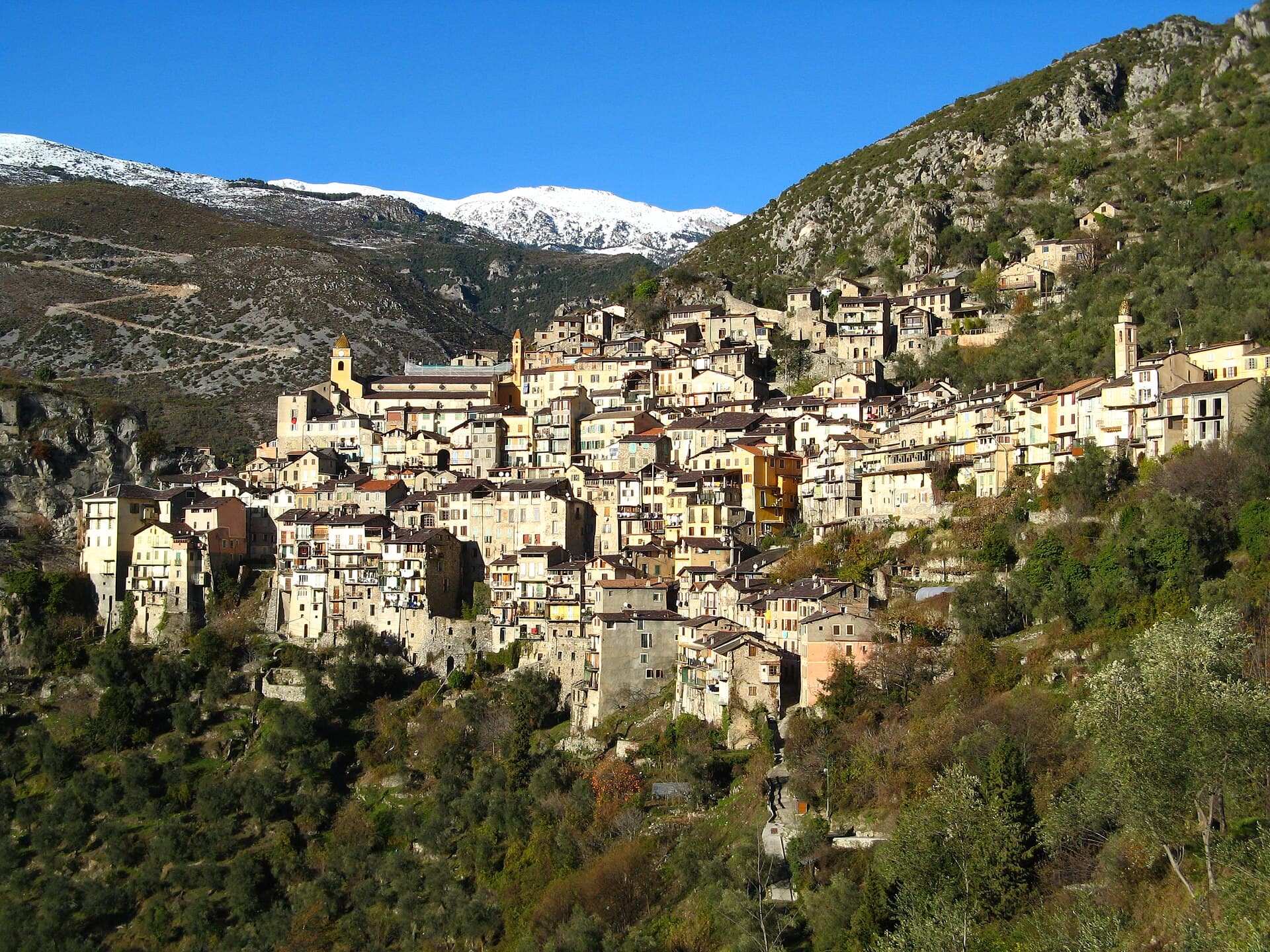
Saorge, often likened to a "Tibetan village" or an "eagle's aerie," is a medieval settlement in the Alpes-Maritimes department of southeastern France. It adheres to a steep mountainside, forming a natural amphitheater above the Roya Gorges. This distinctive architectural style, characterized by its tall, five-story residences and narrow, stepped thoroughfares, creates a labyrinthine allure that encourages discovery.
Recognized as one of France's "Plus Beaux Villages" (most beautiful villages), Saorge presents a fusion of historical legacy and dramatic natural surroundings. The village's ochre and blue-stone houses, topped with dark-red slate roofs, blend into the landscape, affording expansive views of snow-capped peaks and the deep gorge below. Its strategic placement, which once guarded the salt route between Nice and Turin, has shaped its identity and left a heritage of venerable churches, chapels, and vaulted passages.
## From Roman Outpost to Medieval Stronghold Saorge's origins extend beyond Roman times, with its initial recorded mention as "Saurgio" in the 10th century. Roman inscriptions remain visible on some of the village's structures, including the Church of St. Michel. Its strategic vantage point overlooking the Roya Valley, controlling the crucial road between Nice and Turin via the Col de Tende mountain pass, rendered it a significant fortification throughout its existence.
During the medieval period, Saorge formed part of the County of Ventimiglia until 1258, when it was ceded to Provence. Subsequently, it fell under the dominion of the House of Savoy, serving as a fortified town considered impenetrable and known as "the lock of la Roya." The village was once defended by three castles, though today only remnants endure, such as those of Château de Malmort.
## Religious Life and Shifting Allegiances The 17th century witnessed the establishment of the Franciscan Monastery by Recollect friars in 1633. The local community contributed to its construction, providing financial support for the church, dedicated to Notre-Dame-des-Miracles, which was finished around 1662. The monastery, a remarkable instance of Baroque monastic architecture, retains its original structure and painted decoration, including 18th-century frescoes depicting the life of Saint Francis of Assisi in the cloister.
Saorge endured periods of upheaval, particularly during the French Revolution. In 1794, French soldiers expelled the friars and occupied the monastery, which then functioned as a communal hospice for thirty years. It was returned to the Franciscans in 1824 but was again relinquished in 1903 due to new laws concerning religious congregations. The monastery later served various purposes, including youth summer camps, and was occupied by Italian and German soldiers during World War II. In 1967, it became state property, undergoing restoration before briefly housing Franciscans again between 1969 and 1988.
## Modern Day Saorge In 1860, Saorge became part of France after a referendum, though it was occupied by Italy during WWII before its final annexation to France in 1947. Today, the village maintains its medieval character, with a population of approximately 400. The Franciscan Monastery, now a classified Historic Monument, has discovered a new purpose as a residence for writers and artists, providing a serene setting for creative endeavors.
Begin your exploration in the pedestrianized old village, a labyrinth of slender streets, vaulted passages, and steep steps. Marvel at the tall, ancient houses (some five stories high) dating from the 15th to 17th centuries, with their ochre and blue stone facades and dark-red slate roofs. Seek out intricate details like carved lintels, sundials, and painted murals.
The Franciscan Monastery of Saorge stands above the village. This 17th-century Baroque edifice features a cloister adorned with 18th-century frescoes illustrating the life of Saint Francis of Assisi, a refectory displaying 17th-century allegorical frescoes, and an exceptional array of nine sundials. The monastery also preserves original church furnishings and magnificent wood carvings. The terraced gardens, encompassing an orchard and vegetable garden, offer glimpses into the friars' self-sufficient existence.
Visit the Saint-Sauveur Church, a Baroque masterpiece with Romanesque origins. Its interior features 17th and 18th-century altarpieces and a high altar crafted from marble inlay in 1732. The Italian-made organ, transported to Saorge by mules in 1847, continues to be played at concerts and religious ceremonies. Do not overlook the 11th-century Madona del Poggio with its Romanesque bell tower, situated below the village. Saorge also forms part of the "Route of the Baroque and Historic Organs of the Roya Valley."
Beyond the village, the Mercantour National Park provides extensive opportunities for hiking and outdoor pursuits, including canyoning in Bendola, the largest canyon in the Alpes-Maritimes.
Saorge welcomes visitors throughout the year, with each season presenting a distinct experience. Summer brings warm and sunny weather, ideal for exploring the village and its natural surroundings. Spring and autumn also offer agreeable temperatures for outdoor activities. For those drawn to winter sports, the colder months provide opportunities in the nearby Alpes-Maritimes mountains. The monastery is open from February to October, with specific hours varying seasonally, and closes annually from November 1st to January 31st, and on May 1st.
Saorge is entirely pedestrianized, so plan to leave your vehicle in one of the free parking areas at the village's entry points, such as Place Biancheri (except Tuesday mornings, market day) or near the train station, and walk the remaining kilometer into the village. Sturdy walking shoes are essential for navigating the steep, stone-paved streets. The most pleasant way to arrive in Saorge is by taking the picturesque Train des Merveilles from Nice to Cuneo, which stops at Fontan-Saorge, approximately 1 km downhill from the village. Alternatively, you can drive from Nice via the A8 motorway to Ventimiglia, then follow signs for Breil-sur-Roya and Saorge. There are no cash dispensers in Saorge, so it is wise to carry cash. The village offers a few accommodations, including apartments and a small hotel, and one bar.
Saorge in Korean, in Chinese or in Hebrew — and 29 more languages, every stop narrated by a native voice. The widest language range of any self-guided audio tour.
Available in: