Pont-Vieux (Old Bridge)
This enduring stone bridge holds a secret about its true age.
Full story unlocks in the tour
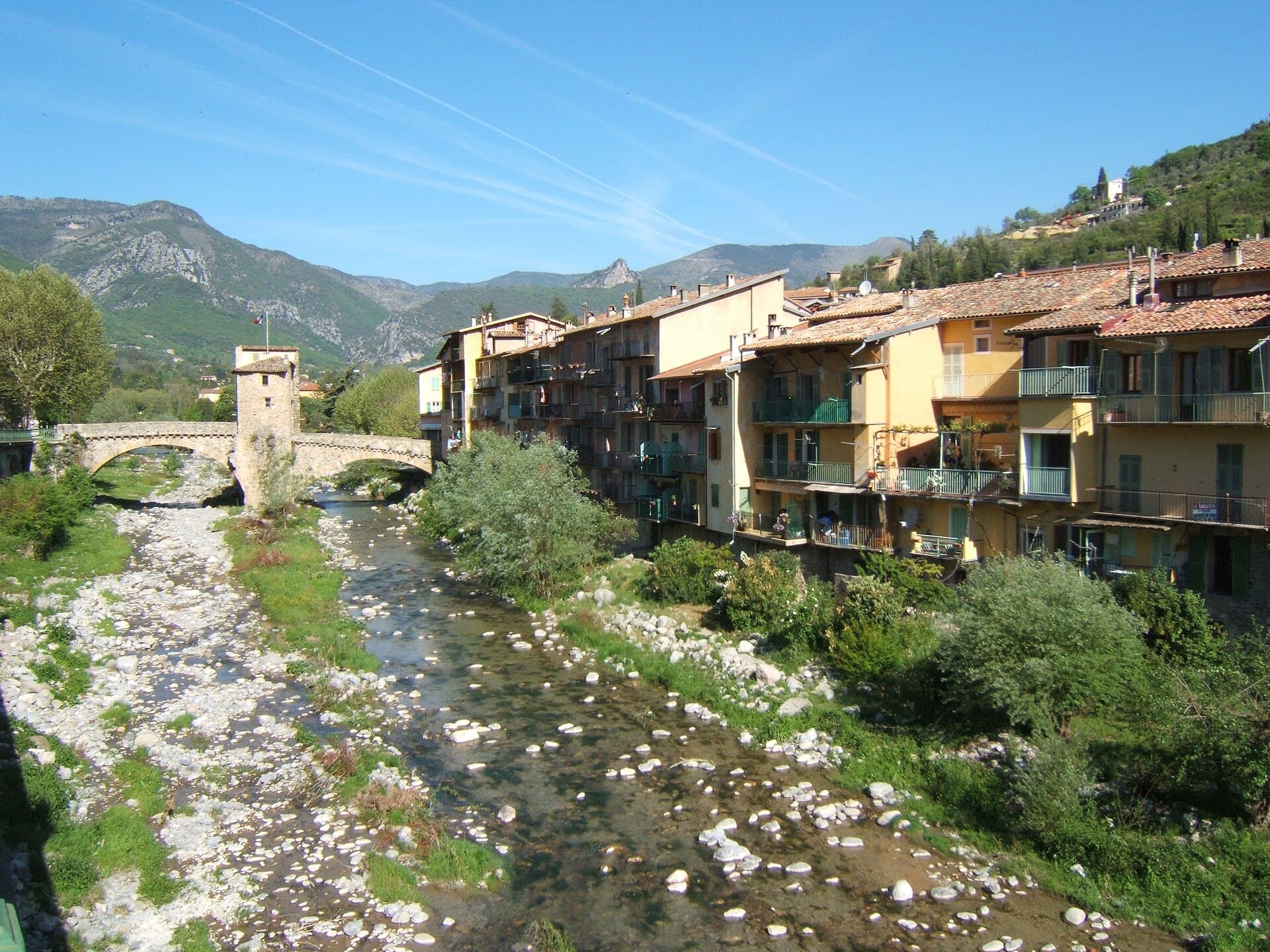 Rundvald / Public domain, via Wikimedia Commons
Self-guided audio walking tour of Sospel — GPS route, offline playback, story-driven narration in 32 languages.
“Where ancient stones meet mountain air.”
Not the postcards. The stories even locals don't know — whispered in your ear, right where they happened.
This enduring stone bridge holds a secret about its true age.
This quiet lane once pulsed with a very different kind of energy.
Some of the charming facades lining the river are not quite as they first appear.
Discover every secret of Sospel
Every address, every reveal in full — in your ear, right where it happened.
You pick your stops. You walk. The voice reveals what the others miss.


Your self-guided audio tour of Sospel is ready — pick your landmarks, choose your language, and start the moment you arrive.
BuyLume has a built-in augmented-reality guide. Hold your phone up and its camera shows the street ahead of you, with a glowing arrow laid over the real view that always points to your next stop — no map to puzzle over, no wrong turns. Like everything in Lume, it works fully offline.
Sospel, a medieval mountain town in the Alpes-Maritimes department of southeastern France, offers a unique blend of enduring landmarks and natural splendor. It stands at an altitude of 354 meters, within the southern reaches of Mercantour National Park, close to the Italian border. The Bévéra river flows through its heart, gracefully dividing the old town into two distinct halves.
Sospel's strategic location at the confluence of the Bévéra and Merlanson rivers historically positioned it as a vital waystation on the old Salt Road and the Royal Road connecting Nice to Turin. This past has profoundly shaped its architecture and character, lending it an almost Italianate feel in certain areas. Today, Sospel draws those seeking outdoor pursuits like hiking and cycling, as well as visitors eager to explore its carefully preserved heritage.
The town maintains a lively community spirit, balancing the safekeeping of its traditional elements with contemporary needs. Its narrow passageways, towering buildings, and Piedmontese-influenced architecture contribute to a distinct medieval atmosphere.
## From Roman Outpost to Salt Road Crossroads Sospel's origins can be traced to the 5th century, when it served as a crucial staging post on the royal road between Nice and Turin. However, evidence of prehistoric habitation in nearby grottos suggests human presence much earlier. The Romans annexed the region around 14 BC, establishing Sospel as an important military position.
Throughout the medieval period, Sospel fell under the dominion of various powers, including the Vintimille, the Counts of Provence (from 1258), and eventually the Counts of Savoy. Its prosperity grew significantly in the 13th century due to its position on a major salt trading route. The fortified Pont-Vieux, a toll bridge spanning the Bévéra river, became central to this trade, collecting fees from mule caravans transporting salt. In 1370, Sospel made the notable decision to align itself with the Pope of Avignon against the Anti-Pope in Rome, leading to its church being elevated to a cathedral.
## Wartime Endurance and Modern Renewal Sospel's strategic position near the French-Italian border also made it a significant location during periods of conflict. The town saw extensive fortification efforts, including the construction of three Maginot Line forts—Saint-Roch, Barbonnet, and Agaisen—in the 1930s as part of France's eastern border defenses. During World War II, Sospel endured considerable damage, with parts of the town, including the Pont-Vieux, being bombed by German forces in 1944. However, the town, including its enduring bridge, was rebuilt using original stones, safeguarding its historical essence.
In the 20th century, Sospel also experienced a brief period with a narrow-gauge tramway system from Menton, operating from 1912 to 1932. Today, Sospel continues to honor its past, with annual events like the BaroQuiales festival celebrating its Baroque heritage through concerts held within the cathedral.
Begin your exploration at the Pont-Vieux (Old Bridge), Sospel's enduring fortified stone bridge, complete with a central guard tower. While a bridge has existed here since the 13th century, much of what stands today was reconstructed after World War II. The tower once functioned as a toll gate for the salt trade.
Cross the bridge to discover the Cathédrale Saint-Michel, an impressive example of Baroque architecture constructed between 1641 and 1762. Its 13th-century Romanesque bell tower represents the oldest part of the structure. The cathedral faces an inviting square lined with arcaded and pastel-painted houses.
Explore the narrow, medieval passageways of the old town, where you will find many attractive houses, some adorned with decorative painted facades, including trompe l'oeil effects. Seek out the Chapel des Pénitents Blancs (Chapel Sainte-Croix), a 16th-century chapel with an unassuming exterior that conceals a rich interior of paintings and frescoes. Wander through squares like Place Saint-Nicolas, recognized for its traditional stone fountain, and Place Garibaldi, which features a traditional washhouse.
For those interested in military history, the Maginot Line forts—Fort Saint Roch, Barbonnet, and Agaisen—are located just beyond the town and are open to visitors.
Sospel experiences warm summers and cold winters. The most comfortable weather for a visit typically occurs from June to September. July and August offer the warmest temperatures and most sunshine, making them ideal for outdoor activities. For those seeking pleasant weather with fewer crowds, May and October are also good choices, with comfortably warm afternoons.
Sospel is situated approximately 15 km inland from Menton and 40 km from Nice. You can reach Sospel by taking the scenic Train des Merveilles from Nice, or by bus from Menton. If driving, take the A8 then the D2566 from Menton, or the A8 and D2204 from Nice.
Parking is available at the Maulandi parking lot at the entrance to the village, which includes an electric charging terminal. There are also free public parking options near shops and the train station, and blue zone parking near the main town hall. Sospel hosts a large market every Thursday morning in Place des Platanes, offering local produce, plants, and clothing. A farmers' market is held on Sunday mornings in Place du Marché. The Tourist Office of Sospel, located at 1 Place Saint-Pierre, can provide further information and assistance.
Sospel in Korean, in Chinese or in Hebrew — and 29 more languages, every stop narrated by a native voice. The widest language range of any self-guided audio tour.
Available in: