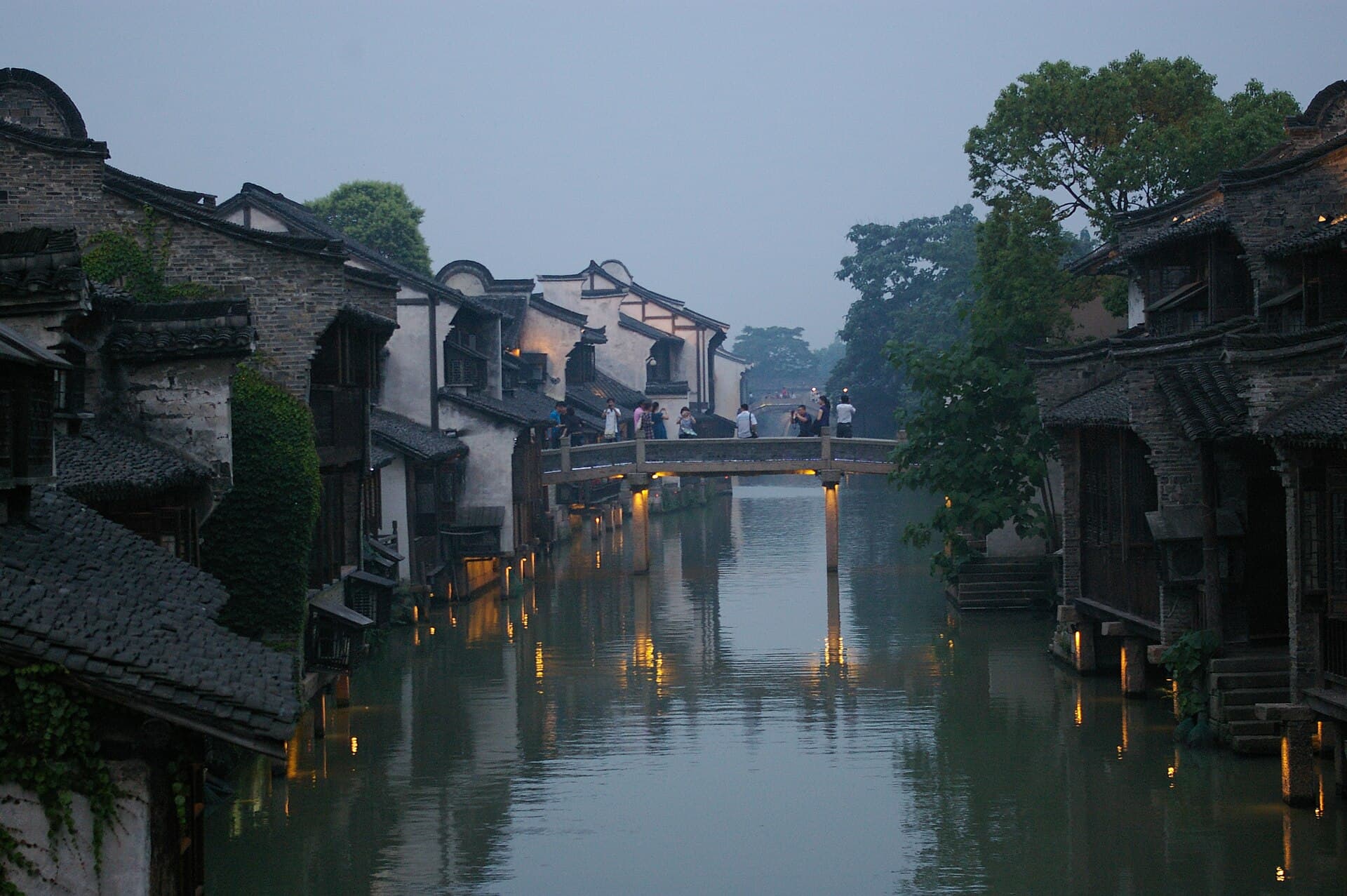
Wuzhen is often called the 'Venice of the East', but one architectural feature here goes beyond picturesque canals to reveal a clever solution for daily life.
杨志强Zhiqiang / CC BY-SA 3.0, via Wikimedia CommonsTongxiang
Self-guided audio walking tour of Tongxiang — GPS route, offline playback, story-driven narration in 32 languages.
“Where ancient waterways meet modern innovation, a city of silk and stories.”
Tongxiang, as no one tells it.
Not the postcards. The stories even locals don't know — whispered in your ear, right where they happened.
This ancient town, known for its silk, holds a unique blend of enduring heritage and contemporary fashion.
The local 'Hangbaiju' chrysanthemum tea is renowned, but its cultivation includes a particular detail that elevates its value.
Discover every secret of Tongxiang
Every address, every reveal in full — in your ear, right where it happened.
You pick your stops. You walk. The voice reveals what the others miss.
How long do you have in Tongxiang?
Your self-guided audio tour of Tongxiang is ready — pick your landmarks, choose your language, and start the moment you arrive.
BuyThe story of Tongxiang
Tongxiang, a county-level city within Jiaxing in northern Zhejiang Province, China, extends a captivating blend of historical charm and modern dynamism. It serves as a crucial link within the 'Golden Triangle' formed by Shanghai, Hangzhou, and Suzhou, making it an accessible and intriguing destination. The city is particularly celebrated for its exquisitely preserved water towns, with Wuzhen being the most famous, often likened to the 'Venice of the East' due to its intricate canal systems, traditional bridges, and ancient houses.
Beyond its scenic waterways, Tongxiang is a region deeply rooted in culture and industry. It is the birthplace of notable literary figures like Mao Dun and Feng Zikai, and it is a significant center for textile manufacturing, particularly woolen sweaters. The city's commitment to preserving its heritage while embracing innovation is evident in its revitalized ancient towns and its role as the permanent site for the World Internet Conference in Wuzhen. Whether exploring ancient alleys or experiencing cutting-edge technology, Tongxiang provides a unique glimpse into China's past and future.
Tracing Tongxiang's Deep Roots
The history of Tongxiang stretches back millennia, with evidence of early human settlement dating to the New Stone Age, approximately 7,000 years ago, at the Tanjiawan site in Wuzhen. The region's strategic location on the Hangzhou-Jiaxing-Huzhou Alluvial Plain, crisscrossed by rivers and adjacent to the Beijing-Hangzhou Grand Canal, played a pivotal role in its development. The Grand Canal, a UNESCO World Heritage Site, facilitated trade and cultural exchange between northern and southern China for over a thousand years, contributing significantly to Wuzhen's prosperity as a regional trading center.
Wuzhen itself was established in 872 A.D. during the Tang Dynasty and has remarkably retained its original name, water system, and lifestyle for over a millennium. Its traditional buildings, many dating back to the Ming and Qing dynasties, were constructed along the riverbanks, with markets near bridges, reflecting a long-standing way of life centered on the waterways. By the end of the Song Dynasty, Wuzhen had flourished into a prominent hub.
While Wuzhen underwent an extensive renovation project beginning in 1999 to restore its ancient appearance, other areas within Tongxiang also hold deep histories. Puyuan Ancient Town, for instance, has a history spanning nearly a thousand years, developing its silk industry since the Southern Song Dynasty and becoming a renowned silk distribution center during the Ming and Qing dynasties. Tongxiang is also the birthplace of influential 20th-century literary figures like Mao Dun and Feng Zikai, whose legacies are preserved in sites like Mao Dun's Former Residence.
The city's cultural heritage extends to its unique agricultural products, such as Hángbáijú, a variety of chrysanthemum flower tea that originates from Tongxiang and has been cultivated for hundreds of years. Today, Tongxiang continues to balance its deep historical roots with modern advancements, evident in its thriving logistics industry and its role as a host for international events like the World Internet Conference.
Tongxiang offers a diverse range of attractions, primarily centered around its historic water towns. The most famous is Wuzhen Water Town, divided into the East Scenic Area (Dongzha) and West Scenic Area (Xizha). Dongzha provides a glimpse into the original water town lifestyle with traditional craft workshops and local food. Xizha, while reconstructed, beautifully reproduces the ancient appearance with Ming and Qing dynasty architecture, and it truly comes alive at night with illuminated canals and bustling stalls. A boat ride through Wuzhen's canals is a quintessential experience.
Another significant water town is Puyuan Ancient Town, a newly restored Ming-Qing dynasty town that offers a quieter, less crowded alternative to Wuzhen. Puyuan is known for its well-preserved canals, stone bridges, courtyard mansions, and its history as a silk and wool trading hub. Visitors can explore historical sites like Tongji Bridge, Fushan Temple, and Xiangyun Temple.
For those interested in local history and culture, the Tongxiang Museum displays artifacts, artworks, and traditional handicrafts. The Former Residence of Mao Dun in Wuzhen's Dongzha scenic area provides insight into the life of the renowned modern Chinese writer. Additionally, Fengxiang Lake Park in central Tongxiang offers walking paths, pavilions, and gardens for leisurely strolls.
The most pleasant times to visit Tongxiang are during the spring (April to May) and autumn (September to November) months. During these periods, the weather is mild, with temperatures generally ranging between 19°C and 30°C (66°F and 86°F), making it ideal for outdoor activities and exploring the water towns. Spring brings blossoming fruit trees and budding plants, creating a picturesque natural backdrop. Autumn offers comfortable temperatures and fewer crowds. Summers (June to September) in Tongxiang are hot, humid, and wet, with average daily highs above 83°F (28°C) and significant rainfall, especially in June and July. Winters (December to March) are very cold, with average lows around 34°F (1°C) in January.
Tongxiang is well-connected, making it accessible from major cities. High-speed trains serve Tongxiang Railway Station, linking it to Shanghai (30-60 minutes away), Hangzhou, and Beijing. From Tongxiang Railway Station, you can reach Wuzhen Water Town by taking bus line K282 to Wuzhen Coach Station, then transferring to bus line K350 or a taxi. Direct buses to Wuzhen are also available from Hangzhou and Shanghai. The main Tongxiang Bus Station offers services to various destinations, including direct routes to Wuzhen.
Within the water towns like Wuzhen and Puyuan, walking is the primary way to explore the narrow lanes and bridges. Boat rides are also a popular and scenic mode of transport on the canals. Mandarin Chinese is the official language. Accommodations range from boutique hotels in ancient towns to modern options in central Tongxiang. Local cuisine includes traditional Tongxiang noodles, Hangzhou-style dishes, river fish, Puyuan rice cakes, and lamb noodles.
- What is Tongxiang best known for?
- Tongxiang is best known for its historic water towns, particularly Wuzhen, which is celebrated for its well-preserved traditional architecture, canals, and stone bridges. It is also a significant center for silk and wool production, and the birthplace of renowned writer Mao Dun.
- How do I get to Tongxiang?
- You can reach Tongxiang by high-speed train to Tongxiang Railway Station, which connects to cities like Shanghai and Hangzhou. From there, local buses or taxis can take you to attractions like Wuzhen Water Town.
- What is the best time of year to visit Tongxiang?
- The best time to visit Tongxiang for pleasant weather and fewer crowds is during the spring (April to May) and autumn (September to November) months.
- Can I take a boat ride in the water towns?
- Yes, boat rides through the canals are a highly recommended and popular activity in both Wuzhen and Puyuan water towns, offering a unique perspective of the ancient architecture.
- What local products are famous in Tongxiang?
- Tongxiang is famous for its silk products, particularly from Puyuan, and for Hángbáijú (Tongxiang white chrysanthemum) tea, known for its delicate floral aroma and refreshing taste.
- Is Tongxiang suitable for a day trip?
- While Wuzhen can be visited as part of a day trip from nearby cities like Shanghai or Hangzhou, staying overnight is often recommended to fully experience the serene atmosphere and illuminated nightscapes of the water towns.