Notre-Dame Church
A significant Avignon School painting, 'The Crucifixion' (1498), embarked on an unexpected journey before returning to its rightful sanctuary.
Full story unlocks in the tour
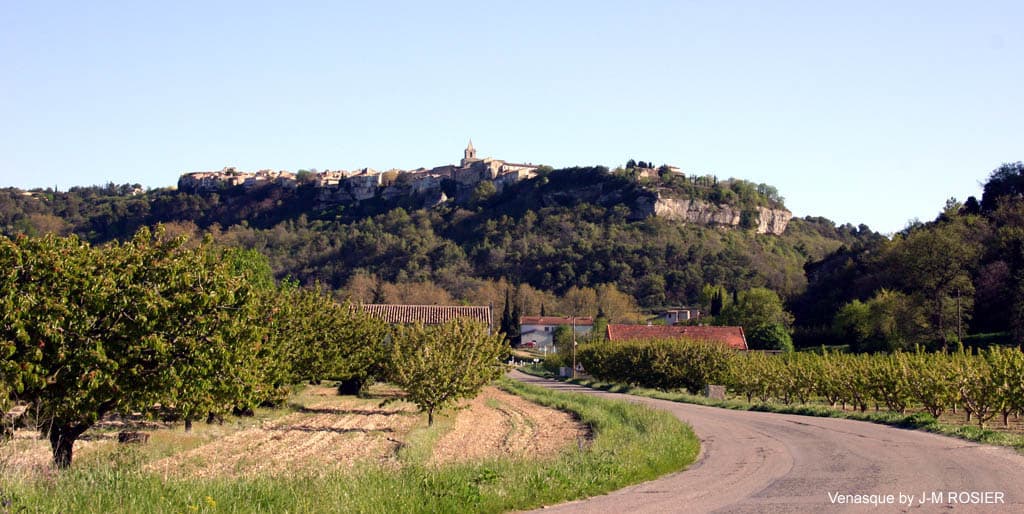 Jean-Marc Rosier (de/from http://www.cjrosier.com + http://www.gordes-immobilier.com) / CC BY-SA 3.0, via Wikimedia Commons
Self-guided audio walking tour of Venasque — GPS route, offline playback, story-driven narration in 32 languages.
“Where ancient stones recount Provençal journeys.”
Not the postcards. The stories even locals don't know — whispered in your ear, right where they happened.
A significant Avignon School painting, 'The Crucifixion' (1498), embarked on an unexpected journey before returning to its rightful sanctuary.
This ancient religious structure, dating from the 6th century, once hosted a distinctive baptismal ceremony.
Provence’s 'red diamonds' possess a special designation that speaks to their quality and origin.
Discover every secret of Venasque
Every address, every reveal in full — in your ear, right where it happened.
You pick your stops. You walk. The voice reveals what the others miss.


Your self-guided audio tour of Venasque is ready — pick your landmarks, choose your language, and start the moment you arrive.
BuyLume has a built-in augmented-reality guide. Hold your phone up and its camera shows the street ahead of you, with a glowing arrow laid over the real view that always points to your next stop — no map to puzzle over, no wrong turns. Like everything in Lume, it works fully offline.
Venasque, a designated 'Most Beautiful Village of France,' ascends dramatically from a rocky prominence in the heart of the Vaucluse, offering expansive vistas across the Nesque valley, the Dentelles de Montmirail, and Mont Ventoux. This medieval village, just 11 kilometers from Carpentras, provides a tranquil respite from more frequented Provençal towns. Its narrow, winding passages of golden stone invite unhurried exploration.
The village’s allure resides in its authenticity and preserved legacy, where ancient ramparts and historic structures narrate a long and storied past. Venasque's serene atmosphere is complemented by a thriving artistic community, with local painters, ceramists, and potters welcoming visitors into their studios. Beyond its historical appeal, Venasque is encircled by vineyards, fragrant garrigue, and extensive cherry orchards, making it a picturesque destination throughout the year.
The site of Venasque has been continuously settled since prehistoric times, with evidence of early human presence discovered in the caves of the Nesque valley. During the Roman era, the village, then a territory of a Gallic tribe centered in Carpentras, reinforced its natural defenses with a wall flanked by three semi-circular towers. These defensive structures, including the impressive 18-meter-high Saracen Towers, stand among the best-preserved Romanesque fortifications in southern France, dating back to the 4th century.
Under the Merovingian dynasty, the bishopric of Carpentras relocated to Venasque due to regional unrest. Saint-Siffredus, a bishop of this period, is credited with the construction of an early cathedral and a church. In the Middle Ages, Venasque became the property of the Counts of Toulouse before being ceded to the popes in 1219, remaining under pontifical authority until 1791. During this time, Venasque served as the capital of the Comtat Venaissin until 1320 when Carpentras assumed its place. Despite being besieged twice during the Wars of Religion, Venasque was never conquered.
The 19th century witnessed a decline in Venasque's population as many agricultural workers moved to the plains closer to their fields. However, a reversal began in the 1960s, as newcomers from France and other European countries started restoring abandoned houses, either for year-round living or as holiday homes. This revitalization brought a fresh wave of artists and artisans, further enriching the village's cultural landscape.
Begin your exploration at the Baptistery of Venasque, one of France's oldest religious buildings, dating to the 6th century. Its distinctive quatrefoil layout and preserved interior, with blind arcades and capitals, offer a glimpse into early Christian architecture. Adjacent to it stands the Notre-Dame Church, a 12th-century Romanesque structure housing a significant 17th-century altarpiece and 'The Crucifixion,' a 1498 painting from the Avignon School.
Walk along the ancient ramparts and discover the three imposing Saracen Towers, remnants of 4th-century Gallo-Roman fortifications that once guarded the village. From the Esplanade, near the towers, absorb panoramic views of the Monts de Vaucluse, the Dentelles de Montmirail, and Mont Ventoux. Wander through the village's narrow, winding passages, admiring the golden-stone houses, fountains, and vaulted archways. Seek out local art studios showcasing the work of ceramists, potters, and painters. For those interested in local produce, Venasque is celebrated for its 'Monts de Venasque' cherries, especially honored during the Cherry Festival in June.
The most pleasant times to visit Venasque are during spring (May and June) or early autumn (September and October). In May and June, the weather is agreeable for outdoor activities, and the cherry orchards are in bloom, with the Cherry Festival typically held in early June. September offers warm, sunny weather with fewer visitors than the peak summer months. While July and August are warm, with average highs around 85°F (29°C), they are popular for warm-weather pursuits. Winters are cool and partly cloudy, with temperatures descending to an average low of 32°F (0°C) in January.
Venasque is situated 11 kilometers southeast of Carpentras and approximately 45 minutes east of Avignon. The most convenient way to arrive at the village is by car, with several complimentary parking areas available, including a large one near the Saracen Towers. While public transportation is limited, a bus line connects Carpentras to Venasque with a few daily services. A visit to the village typically requires 2 to 3 hours to explore the main monuments, but a full half-day allows for a more relaxed pace, including time to appreciate the views and local atmosphere. For photographers, the morning or late afternoon light is particularly appealing. The Tourist Office, located at 61 Grand'rue, provides information on the village and surrounding area.
Venasque in Korean, in Chinese or in Hebrew — and 29 more languages, every stop narrated by a native voice. The widest language range of any self-guided audio tour.
Available in: