Cruz Cubierta (Croix Couverte)
L'identité même d'Aínsa, et sa place dans l'histoire aragonaise, sont liées à une apparition miraculeuse lors d'une bataille décisive.
L'histoire complète se débloque dans le tour
 Heparina1985 / CC BY-SA 4.0, via Wikimedia Commons
Visite audio autoguidée de Aínsa — parcours GPS à pied, lecture hors ligne, narration en 32 langues.
“Là où les légendes de croix enflammées rencontrent la pierre médiévale.”
Pas les cartes postales. Les histoires que même les habitants ignorent — soufflées à l'oreille, là où elles se sont passées.
L'identité même d'Aínsa, et sa place dans l'histoire aragonaise, sont liées à une apparition miraculeuse lors d'une bataille décisive.
L'imposant château que vous voyez aujourd'hui n'est pas entièrement ce qu'il semble à première vue.
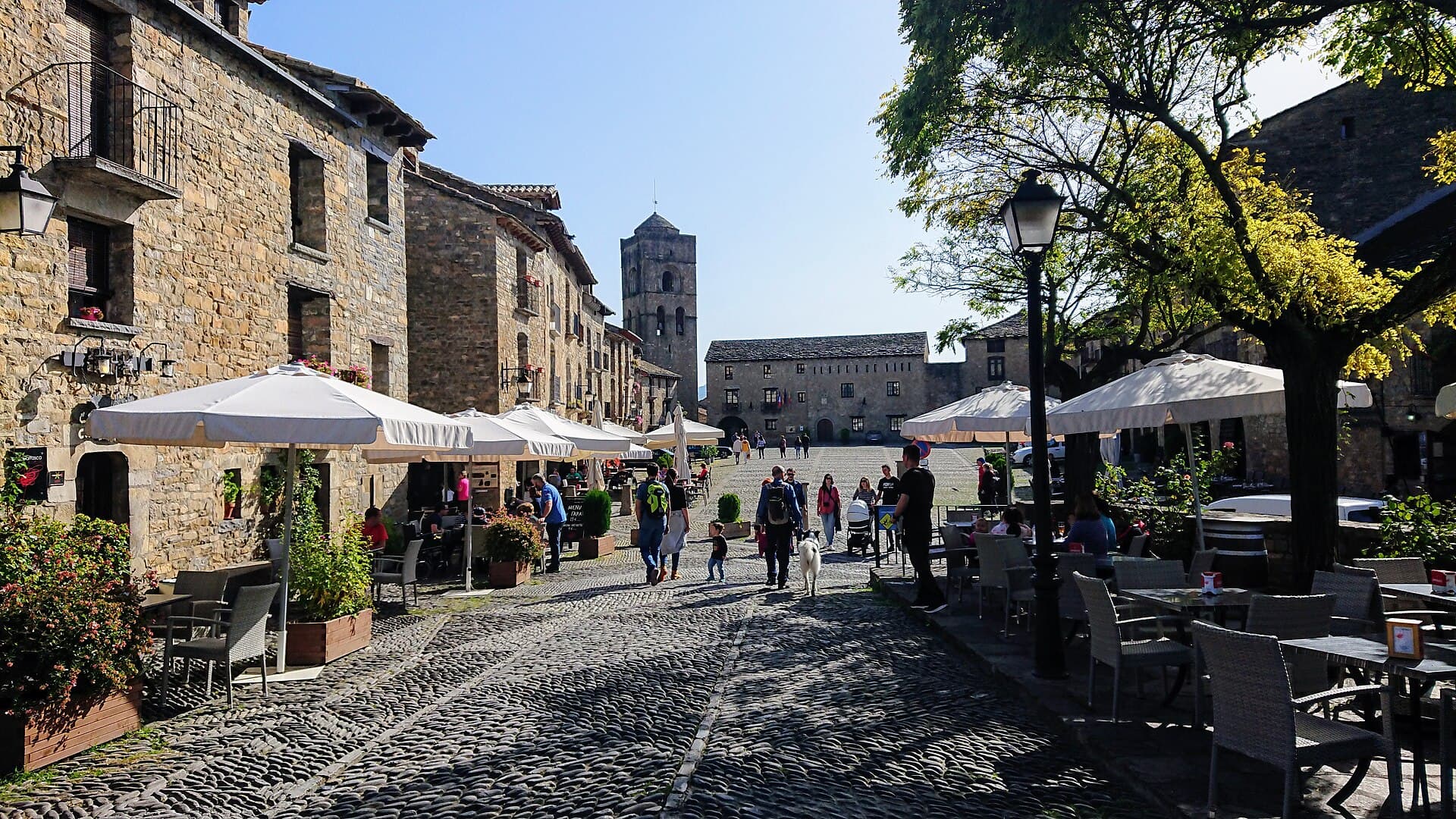
Cette grande place médiévale, un centre d'activité pendant des siècles, recèle un curieux secret architectural.
Découvrez tous les secrets de Aínsa
Chaque adresse, chaque révélation en entier — dans ton oreille, là où elle s'est passée.
Tu choisis tes lieux. Tu marches. La voix te révèle ce que les autres ignorent.

Votre visite audioguidée de Aínsa vous attend — choisissez vos lieux, votre langue, et lancez-vous dès votre arrivée.
AcheterLume intègre un guide en réalité augmentée. Levez votre téléphone : sa caméra montre la rue devant vous, avec une flèche lumineuse posée sur l'image réelle qui pointe toujours vers votre prochain arrêt — aucune carte à déchiffrer, aucun mauvais virage. Comme tout dans Lume, ça fonctionne entièrement hors-ligne.
Aínsa, un village médiéval de la province de Huesca, en Aragon, offre un voyage dans le temps au milieu des paysages spectaculaires des Pyrénées espagnoles. Situé entre les rivières Cinca et Ara, ce site historique et artistique est une collection harmonieuse de bâtiments en pierre, de rues usées et de murs anciens. Sa situation stratégique en a fait un carrefour important tout au long de l'histoire, et aujourd'hui, il sert de porte d'entrée à certains des parcs naturels les plus spectaculaires d'Espagne, notamment le Parc National d'Ordesa et du Mont Perdu.
La ville est divisée en une zone moderne et commerciale et un quartier médiéval captivant. La vieille ville, déclarée Site Historique et Artistique en 1965, est l'endroit où le passé durable d'Aínsa prend véritablement vie. Promenez-vous dans ses ruelles étroites et découvrez un lieu où chaque pierre semble raconter une histoire de royaumes anciens et de batailles légendaires.
Les origines d'Aínsa sont profondément liées à la Reconquête. La tradition veut qu'en 724 après J.-C., une bataille décisive ait eu lieu à proximité, marquant le début de la reconquête chrétienne du Haut Aragon. La légende raconte qu'une croix lumineuse est apparue sur un chêne vert, inspirant García Ximénez, considéré comme le premier roi de Sobrarbe et d'Aragon, et ses forces à la victoire contre la domination musulmane. Cet événement, connu sous le nom de 'Croix de Sobrarbe', est si central à l'identité aragonaise qu'il figure sur les armoiries de la région.
Au XIe siècle, le château d'Aínsa est devenu un élément crucial de la ligne défensive chrétienne. Sa position stratégique sur un promontoire, surplombant le confluent des rivières Cinca et Ara, en a fait un important centre commercial et une forteresse. La ville a reçu des privilèges royaux, notamment une charte de ville et une charte de repeuplement d'Alphonse Ier le Batailleur en 1124, qui lui accordaient des avantages similaires à Jaca et l'exemptaient de certaines taxes.
La ville s'est étendue entre le XIVe et le XVe siècle, intégrant le château à la place et ajoutant une seconde enceinte défensive. Bien qu'Aínsa ait connu une période difficile aux XVIIe et XVIIIe siècles, sa structure médiévale est restée largement intacte. Aujourd'hui, la vieille ville bien conservée témoigne de son histoire durable, offrant un lien tangible avec l'ère médiévale.
Commencez votre exploration sur la Plaza Mayor, le cœur du quartier médiéval d'Aínsa. Cette place à arcades, datant des XIIe et XIIIe siècles, est entourée de bâtiments bien conservés et offre un cadre pittoresque pour une promenade.
Dominant l'extrémité ouest du centre historique se trouve le Château d'Aínsa. Si sa partie la plus ancienne, le donjon, date du XIe siècle, une grande partie de sa forme actuelle a été construite au XVIIe siècle. Il abrite aujourd'hui le Centre d'Interprétation de l'Écomusée et accueille des événements comme le Festival de Musique du Château d'Aínsa.
L'Église de Santa María, construite entre la fin du XIe et le début du XIIe siècle et consacrée en 1181, est un exemple notable d'architecture romane dans les Pyrénées. Sa tour servait autrefois à la fois à des fonctions religieuses et militaires.
Juste à l'extérieur du château, vous trouverez la Cruz Cubierta (Croix Couverte), un petit temple circulaire construit en 1655. Il commémore l'apparition légendaire d'une croix lumineuse qui, selon la tradition, a poussé les forces chrétiennes à la victoire en 724 après J.-C.
Pour une immersion plus profonde dans le patrimoine local, visitez le Musée des Arts et Métiers Traditionnels dans la Casa Latorre, un bâtiment du XVIe siècle. Il présente des collections ethnographiques et des ateliers d'artisanat traditionnel.
Ne manquez pas le Mirador de la Cinca pour des vues imprenables sur la vallée de la rivière Cinca, les Pyrénées aragonaises et la vieille ville médiévale d'Aínsa.
Pour un temps plus agréable, envisagez de visiter Aínsa entre juin et septembre. Pendant ces mois, les températures diurnes sont confortables, avoisinant les 26°C en juillet et août. Juillet est également le mois le plus ensoleillé, avec environ 11,5 heures d'ensoleillement par jour. Les saisons intermédiaires du printemps (avril-mai) et de l'automne (septembre-octobre) offrent également de bonnes températures et moins de foule, ce qui les rend idéales pour l'exploration. Les hivers sont froids, avec des maximales diurnes autour de 7-8°C et des nuits glaciales.
Aínsa est mieux accessible en voiture, offrant une flexibilité pour explorer les Pyrénées environnantes. Les grands aéroports comme Saragosse (ZAZ) et Toulouse (TLS) sont des options, à partir desquelles vous pouvez louer une voiture. Bien que des services de bus relient Aínsa à des villes plus grandes, ils peuvent être peu fréquents.
Le stationnement dans la vieille ville est restreint ; des zones de stationnement désignées sont disponibles juste à l'extérieur des murs médiévaux. Pour les camping-cars, une aire de stationnement municipale près du château offre environ 40 places marquées avec vidange gratuite des eaux grises et noires, et de l'eau potable payante.
La vieille ville est mieux explorée à pied, des chaussures de marche confortables sont donc recommandées pour ses rues usées. De nombreuses attractions, y compris le château et le musée, sont accessibles à pied.
Aínsa en coréen, en chinois ou en hébreu — et dans 29 autres langues, chaque étape narrée par une voix native. La plus large gamme de langues de tous les audioguides autoguidés.
Disponible en :