Plaza Porticada
One of Aragon's most beautiful squares holds an architectural secret, a subtle echo of a grander design far to the east.
Full story unlocks in the tour
 manelzaera / CC BY-SA 2.0, via Wikimedia Commons
Self-guided audio walking tour of Cantavieja — GPS route, offline playback, story-driven narration in 32 languages.
“Where ancient stones recount sagas of Templars and Carlist strongholds.”
Not the postcards. The stories even locals don't know — whispered in your ear, right where they happened.
One of Aragon's most beautiful squares holds an architectural secret, a subtle echo of a grander design far to the east.
The castle's weathered remnants suggest a past so fiercely contested that its ruin became a strategic necessity.
Within the Gothic walls of the Church of San Miguel rests an alabaster tomb, belonging to a figure whose title suggests a surprising link to a powerful medieval order.
Discover every secret of Cantavieja
Every address, every reveal in full — in your ear, right where it happened.
You pick your stops. You walk. The voice reveals what the others miss.

Your self-guided audio tour of Cantavieja is ready — pick your landmarks, choose your language, and start the moment you arrive.
BuyLume has a built-in augmented-reality guide. Hold your phone up and its camera shows the street ahead of you, with a glowing arrow laid over the real view that always points to your next stop — no map to puzzle over, no wrong turns. Like everything in Lume, it works fully offline.
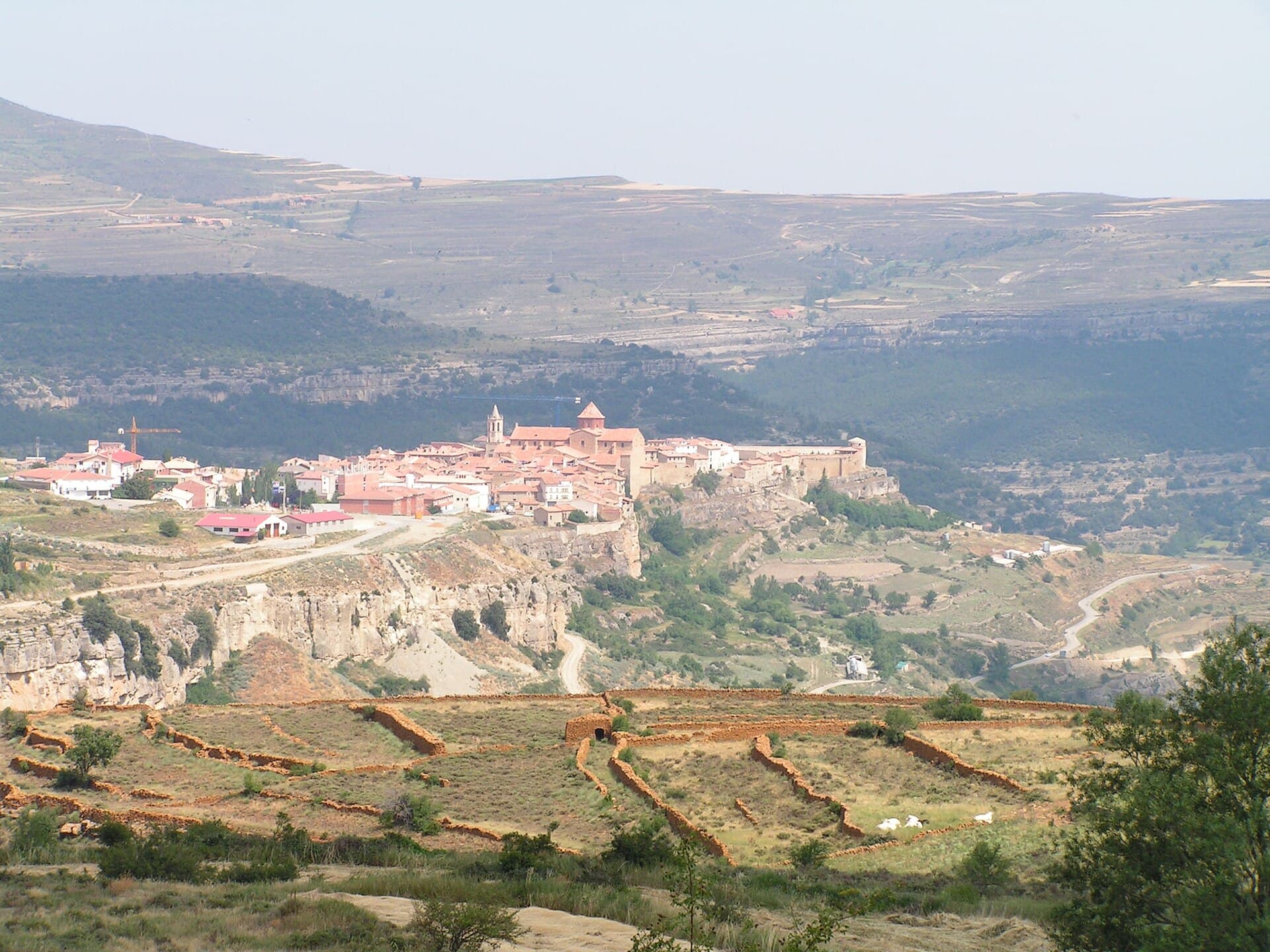
Cantavieja, the historic capital of the Maestrazgo region in Teruel, Aragon, rises dramatically from a limestone rock at an altitude of 1,300 meters. This elevation lends it the appearance of a 'ship's prow' or an 'eagle's aerie' furrowing the ravines below. Designated a Historic-Artistic Site in 1981 and later recognized as one of the 'Most Beautiful Villages of Spain', its medieval layout and architectural heritage speak to a storied and turbulent past. The town's strategic location has drawn numerous historical groups, leaving an indelible mark on its buildings, narratives, and customs.
Walking through Cantavieja's narrow, winding streets is a journey through time, revealing layers of history from Iberian settlements to the Carlist Wars of the 19th century. The town's urban core is a testament to its enduring character, with well-preserved structures and viewpoints offering expansive panoramas of the surrounding rugged mountains and ravines. Cantavieja offers a compelling blend of history, nature, and culture, inviting visitors to uncover its particularities and appreciate its timeless allure.
Cantavieja's history is deeply intertwined with its strategic location, a commanding position that made it a coveted stronghold throughout the centuries. The area was conquered in 1169 by Alfonso II, and by 1197, it was settled by the Knights Templar, who established it as the head of the 'baylía' of Cantavieja, encompassing seven municipalities. The Templars played a crucial role in organizing the towns and villages, granting population charters to attract settlers to this frontier land bordering the Moorish kingdom of Valencia. Their presence shaped the urban structure of Cantavieja, and their legacy can still be discerned in the ancient walls.
Following the dissolution of the Order of the Temple in 1308, after a prolonged resistance, its assets in Maestrazgo, including Cantavieja, passed into the hands of the Order of St. John of Jerusalem (the Hospitalers). This order maintained jurisdiction over the area for over 500 years, continuing to influence the town's development. The 18th century marked a prosperous period for Cantavieja, fueled by livestock and the wool trade, leading to the construction of significant buildings such as the Loreto Chapel, the Church of the Assumption, the hospital, and several manor houses that stand today.
The 19th century brought a new chapter of conflict with the Carlist Wars (1833-1876), in which Maestrazgo played a pivotal role. Cantavieja became a fundamental enclave and a command center for the Carlist general Ramón Cabrera, famously known as 'El Tigre del Maestrazgo'. Cabrera established his residence and headquarters in the town, transforming it into the capital of the General Command of Maestrazgo, complete with food stores, a prisoner depot, and even a newspaper. The intensity of these conflicts led to the deterioration of many fortifications, most notably the castle, of which only several towers of its walled enclosure remain. Today, the Carlist Wars Museum in Cantavieja offers a deep dive into this tumultuous period, preserving the memory of the battles and the influential figures who shaped the region's destiny.
Cantavieja's historic center, a designated Property of Cultural Interest, invites exploration with its medieval character. The arcaded Plaza de Cristo Rey (also known as Plaza Porticada) is a central feature, framed by the Gothic Council House and the imposing Baroque Church of the Assumption. The Church of the Assumption, enlarged between 1730 and 1745, features a Gothic doorway and portico from an earlier medieval temple. Seek out the Church of San Miguel, a 15th-century Gothic structure with a single nave and a remarkable alabaster tomb.
While the old castle of Cantavieja is mostly in ruins due to the Carlist Wars, its remnants and the ancient walls offer a glimpse into its past strategic importance. The Carlist Wars Museum provides a comprehensive understanding of this significant period in Spanish history. Beyond the main square, wander through the narrow streets to discover manor houses like Casa Bayle and Casa Novales, and the old Baroque hospital of San Roque. For those seeking natural beauty, the surrounding paths lead to viewpoints like Cantavieja's Balcony, the fountain 'La Faldrija', and the banks of the River Cantavieja, where griffon vultures and mountain goats can be observed.
The most pleasant time to visit Cantavieja for warm-weather activities extends from late June to late August. During these months, the average daily temperature remains comfortable, with July being the warmest month, averaging 76°F (24°C). Skies are clearest in July, offering excellent conditions for enjoying the town's viewpoints and outdoor trails. While the wetter season lasts from September to June, precipitation is generally highest in October and lowest in July. For those who prefer cooler temperatures and fewer crowds, the shoulder seasons of late spring and early autumn can also be appealing.
Cantavieja is located in the province of Teruel, Aragon, Spain, at an elevation of 1,290 meters (4,230 feet). The town has a population of approximately 700-729 inhabitants. While there is no direct train service to Cantavieja, it is accessible by bus from Teruel, with a journey time of approximately 1 hour and 45 minutes. Driving from Valencia takes about 2 hours and 13 minutes, covering a distance of 174.7 km. The nearest airports are in Castellón, Zaragoza, and Valencia. Within the town, public transportation is primarily by bus, with a central stop at Plaza de España Nº 10. The Cantavieja Tourist Office, located on Calle Mayor 14, can provide further information and assistance.
Cantavieja in Korean, in Chinese or in Hebrew — and 29 more languages, every stop narrated by a native voice. The widest language range of any self-guided audio tour.
Available in: