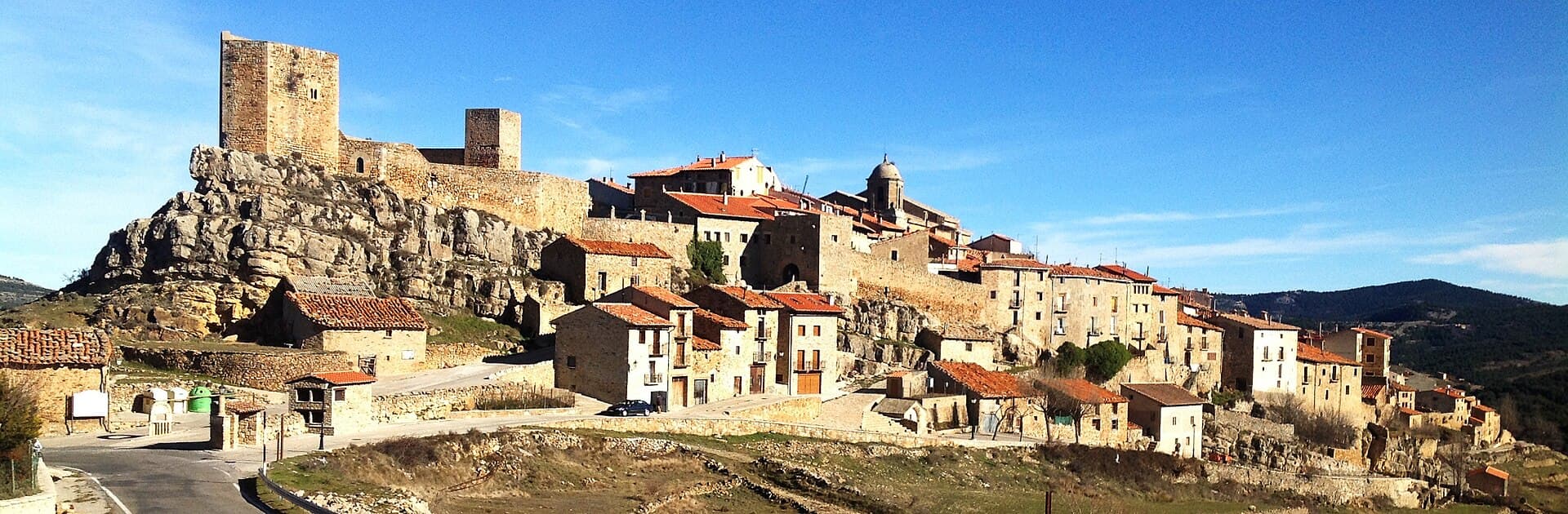
Puertomingalvo Castle
This formidable fortress, a defining feature of Puertomingalvo, has undergone many transformations through the centuries. For a long period, however, it served a purpose far removed from defense.
Full story unlocks in the tour
 Pabloandr85 / CC BY-SA 3.0, via Wikimedia Commons
Self-guided audio walking tour of Puertomingalvo — GPS route, offline playback, story-driven narration in 32 languages.
“Where ancient stones recount the sagas of Moorish knights and Aragonese kings.”
Not the postcards. The stories even locals don't know — whispered in your ear, right where they happened.
This formidable fortress, a defining feature of Puertomingalvo, has undergone many transformations through the centuries. For a long period, however, it served a purpose far removed from defense.
The 14th-century Town Hall building stands as a fine example of Aragonese Gothic-civilian architecture. Observe its lower level, and you will discover a surprising modern use for its historic spaces.
The name of this village carries echoes of a legendary figure from Spanish history, an ally of El Cid Campeador.
Discover every secret of Puertomingalvo
Every address, every reveal in full — in your ear, right where it happened.
You pick your stops. You walk. The voice reveals what the others miss.


Your self-guided audio tour of Puertomingalvo is ready — pick your landmarks, choose your language, and start the moment you arrive.
BuyLume has a built-in augmented-reality guide. Hold your phone up and its camera shows the street ahead of you, with a glowing arrow laid over the real view that always points to your next stop — no map to puzzle over, no wrong turns. Like everything in Lume, it works fully offline.
Puertomingalvo, a village in the province of Teruel, Aragon, Spain, stands at an elevation of 1,449 meters (approximately 4,754 feet) above sea level. It is situated in the heart of the Maestrazgo Cultural Park, within the Gúdar-Javalambre region. Recognized as a Monumental Complex and declared of Tourist Interest, Puertomingalvo has been part of "The Most Beautiful Villages of Spain" network since 2013, and in 2024, it was named 'The Most Beautiful Village of Aragon' by the Spain Tourism application.
The village's urban core is built upon a rocky promontory, overlooked by its castle. Its streets, a network of narrow passages, showcase examples of popular architecture, including the 14th to 15th-century Town Hall and the 15th-century Old Hospital of Santa María de Gracia. Puertomingalvo offers a tranquil atmosphere, surrounded by mountains and forests, making it a destination for those seeking to disconnect and explore natural beauty.
The history of Puertomingalvo stretches back millennia, with evidence of dinosaur footprints from 100 million years ago found nearby. Iberian settlements, such as the fortified complex of Los Castillejos dating to the 6th century BC, also mark the region's ancient past. Roman necropolises further indicate early human presence.
The village's name itself, 'Puertomingalvo,' reflects its strategic mountainous location ('Puerto' meaning pass) and a connection to a Muslim knight, Ben Galbón, an ally of El Cid Campeador. The castle, a central element of Puertomingalvo, is believed to have Muslim origins, possibly constructed between the 10th and 11th centuries. It is first mentioned in documents from 1202, under its Arabic name, Avingalbón.
In 1202, Peter II of Aragon donated the castle to the Bishop of Zaragoza. However, it later experienced a long period of abandonment. By the 16th century, the castle belonged to the Archbishop of Zaragoza, Don Fadrique de Portugal, who decided against its restoration due to its poor condition. For centuries, the castle's parade ground even served as the village cemetery.
Puertomingalvo saw its period of greatest splendor between the 17th and 18th centuries. However, it suffered significant damage during the Carlist Wars and the Spanish Civil War of 1936-1939. In 1982, the entire urban area was declared an Asset of Cultural Interest. Rehabilitation efforts on the castle began in the 1980s, transforming it into an ethnological museum. In 2013, the village joined the prestigious association of "The Most Beautiful Villages of Spain," further solidifying its status as a significant historical and cultural destination.
Begin your exploration at the Puertomingalvo Castle, a well-preserved fortification that offers expansive views of the Maestrazgo area. Originally known as Avingalbón in 1202, the castle now houses a permanent exhibition of ethnological pieces and its refurbished parade ground is used for various shows. Guided tours of the castle can be arranged through the Tourist Office.
Next, visit the Town Hall House, a 14th to 15th-century building in the Aragonese Gothic style, notable for its stone masonry facade, semicircular arch entrances, and twin openings on the upper floor. The lower level of the Town Hall contains the Maestrazgo Castles Interpretation Center.
The Parish Church of La Asunción and San Blas, an 18th-century Baroque construction, features three naves, a high choir, and a bell tower that once served as a fortress. Its interior walls are adorned with pictorial decorations, and the top of the tower provides another viewpoint over the Sierra de Gúdar.
Stroll through the narrow, stone-paved streets to admire examples of popular architecture, including the Casa Lloveros and Casa Alta, both in the Levantine Gothic style, and the 15th-century Old Hospital of Santa María de Gracia. Explore the remnants of the walled enclosure, particularly the Portalón and Portalillo (also known as the High Portal or San Antón Portal), which are significant examples of the village's medieval defenses.
Beyond the village, consider a hike to the Arquero Waterfall, also known as "Chorrador el Arquero." This natural wonder, named after its 13th-century owner, offers views in a serene setting. The PR-TE25 trail leads to the waterfall from Puertomingalvo.
The best time to visit Puertomingalvo for warm-weather activities is from late June to late August. During these months, summers are comfortable, dry, and mostly clear, with average daily high temperatures above 69°F (20°C). July is typically the hottest month, with an average high of 75°F (24°C) and a low of 55°F (13°C). The clearer part of the year generally extends from mid-June to early September. While July and August are popular, be aware that coastal areas in Spain can be crowded and more expensive during these peak summer months.
Puertomingalvo is located in the province of Teruel, Aragon, Spain, approximately 104 km from Teruel via the A-23 and A-1701 roads, a drive of about 1 hour and 29 minutes. From Zaragoza, the journey is around 3 hours and 1 minute (269 km) via the A-23. Madrid is about 4 hours and 56 minutes away (404 km) via the A-2.
The village has a range of accommodation options, including hotels, campsites, and rural tourism homes. The local currency is the Euro, and the language spoken is Spanish. Puertomingalvo is part of the Schengen Area, so visa requirements depend on your nationality. The time zone is Central European Time (UTC+1), with daylight saving time (UTC+2) in summer.
For dining, Puertomingalvo offers a gastronomy focused on local products, including cured meats, meats, and wild mushrooms. The restaurant 'Existe', mentioned in the Michelin Guide and with a Repsol 'Solete', offers avant-garde cuisine with a focus on local ingredients, including game and wild mushrooms. It is located at the Mas de Cebrián hotel, along the A-1701 road.
Puertomingalvo in Korean, in Chinese or in Hebrew — and 29 more languages, every stop narrated by a native voice. The widest language range of any self-guided audio tour.
Available in: