Li Bassinia Fountain, Grand-Place
This elaborate fountain in Huy's main square possesses a notable distinction beyond its visual appeal.
Full story unlocks in the tour
 Jean-Pol GRANDMONT / CC BY-SA 3.0, via Wikimedia Commons
Self-guided audio walking tour of Huy — GPS route, offline playback, story-driven narration in 32 languages.
“Where ancient stones recount eras of crusaders, industry, and ingenuity along the Meuse.”
Not the postcards. The stories even locals don't know — whispered in your ear, right where they happened.
This elaborate fountain in Huy's main square possesses a notable distinction beyond its visual appeal.
The formidable fort surveying Huy carries a somber and moving history extending far beyond its military purpose.
The final resting place of a pivotal, yet contentious, figure in European history is found in an unexpected location.
Discover every secret of Huy
Every address, every reveal in full — in your ear, right where it happened.
You pick your stops. You walk. The voice reveals what the others miss.


Your self-guided audio tour of Huy is ready — pick your landmarks, choose your language, and start the moment you arrive.
BuyLume has a built-in augmented-reality guide. Hold your phone up and its camera shows the street ahead of you, with a glowing arrow laid over the real view that always points to your next stop — no map to puzzle over, no wrong turns. Like everything in Lume, it works fully offline.
Huy, a city in the Walloon province of Liège, Belgium, invites exploration through time along the Meuse River. Situated at the convergence of the Meuse, Mehaigne, and Hoyoux rivers, Huy is home to approximately 20,000 residents. Its story reaches back to Roman times, and it held a significant role in Belgian and European history throughout the Middle Ages. The city's contours are shaped by its dramatic riverside setting, with a historic core displaying Mosan-style architecture and bluestone structures.
Often described as a captivating destination, Huy balances its industrial past—as part of the sillon industriel—with a tranquil environment. Visitors can uncover a profound cultural heritage, from medieval passages to impressive religious structures, and enjoy peaceful walks along the river. The combination of historical depth, natural splendor, and a lively local atmosphere makes Huy a compelling stop for those seeking an authentic Belgian experience.
The origins of Huy trace back to the 2nd century when the Romans established a castrum, a fortified town, on the right bank of the Meuse River. The town's name first appeared in 6th and 7th-century documents as Hoius vicus, deriving from the smaller Hoyoux River. In the early Middle Ages, Huy thrived as a prosperous center, with an economy driven by metallurgy, tanning, sculpting, woodworking, and even wine-making.
In 941, Holy Roman Emperor Otto I created the County of Huy. However, by 985, the county came under the control of Bishop Notger of Liège, who, by absorbing the territory, became the first Prince-Bishop of Liège, granting him both secular and religious authority. This marked the beginning of Huy's more than eight-century-long association with the Prince-Bishopric of Liège. A pivotal moment arrived in 1066 when Bishop Theodwin of Bavaria granted Huy what is considered the first charter of liberties in Western Europe, north of the Alps. This charter, granted in exchange for financing the reconstruction of the Notre-Dame Church, recognized Huy as a city and gave its inhabitants significant rights, including the right of asylum and inviolability of their homes.
The 13th and 14th centuries saw an economic boom, particularly in the cloth industry. Huy's castle, known as "Li Tchestia" in the local Walloon dialect, became a powerful fortress and a symbol of the town by the 15th century. However, its strategic location on the Meuse also made it a frequent target. The city experienced a gradual decline in the 17th and 18th centuries, suffering numerous attacks during Louis XIV's wars. So severe was the destruction that in 1715, the frustrated inhabitants themselves dismantled their own castle to prevent further conflict.
In 1818, under Dutch rule, a new fort was constructed on the site of the old castle. This Fort de Huy would later serve as a German detention camp during World War II, holding thousands of prisoners. The 19th century brought a period of renewed prosperity with new industries like paper making. While the 20th century saw a decline in heavy industry, Huy is now experiencing a resurgence, partly due to tourism and its tin products.
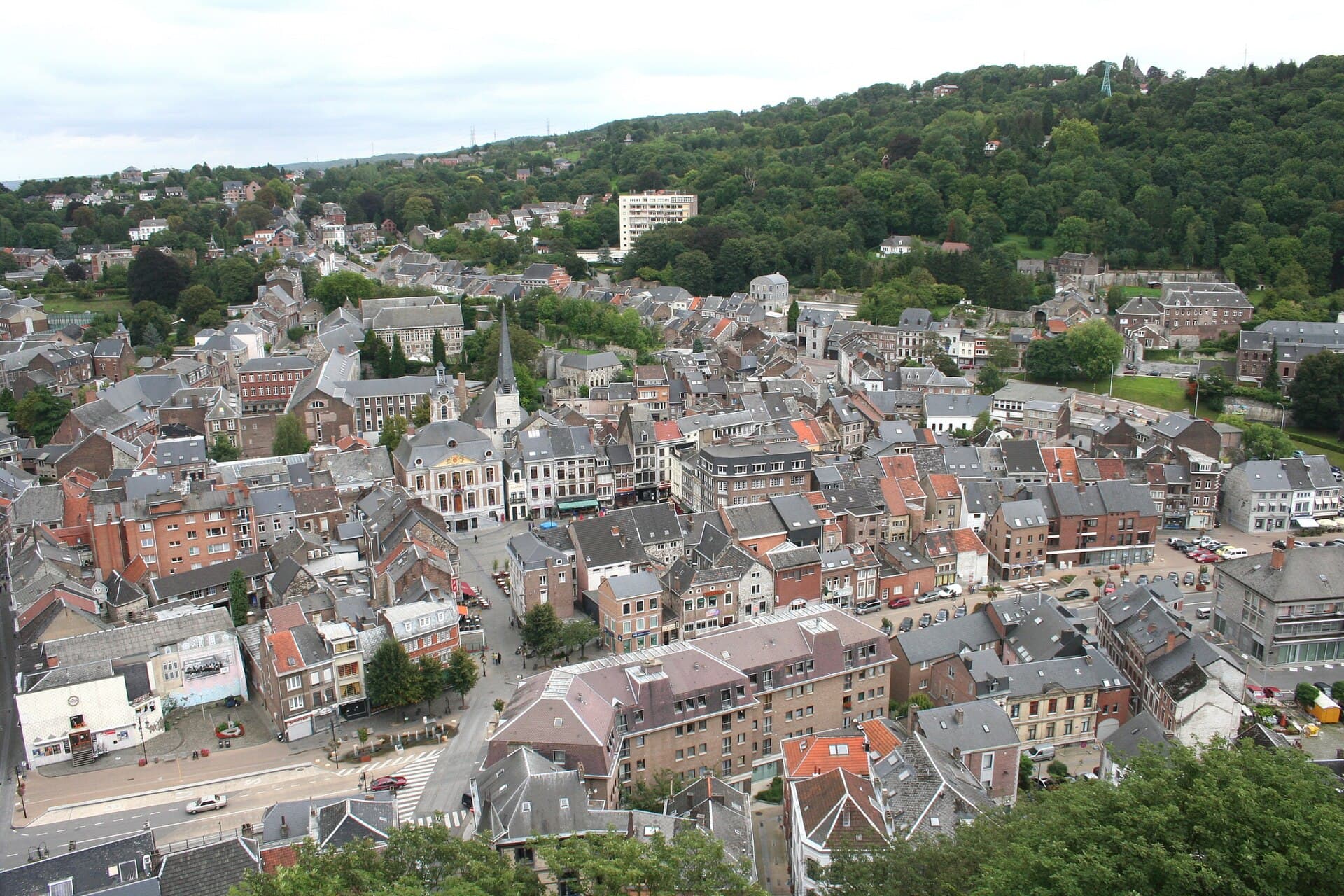
Begin your exploration in Huy's historic center, characterized by its Mosan style architecture and bluestone buildings. The Grand-Place is a natural starting point, featuring the 18th-century neoclassical Hôtel de Ville (Town Hall) and the Li Bassinia fountain, one of the city's "Four Wonders." Just a short walk away, the Collégiale Notre-Dame et Saint-Domitien (Collegiate Church of Our Lady and Saint Domitian) is a magnificent example of Mosan Gothic architecture, built between 1311 and 1536. It houses the largest Gothic-style rose window in Wallonia, measuring 6 meters in diameter outside and 9 meters inside, and a treasury with art from Huy's golden age.
Surveying the city is the Fort de Huy, accessible by road or cable car. Constructed by the Dutch in the early 19th century on the site of the medieval Li Tchestia castle, it now serves as a memorial to World War II, housing a museum that details the experiences of the over 7,000 prisoners held there. For a different perspective, consider a cruise on the Meuse River, which offers picturesque views of the valley. The Musée Communal (Municipal Museum), located in a 17th-century rebuilt Franciscan convent, offers a comprehensive look at Huy's history, from prehistory to the present, including local crafts and a notable 13th-century wooden sculpture known as "Le beau Dieu de Huy." For families, Mont Mosan amusement park provides rides, animal shows, and mini-golf.
The ideal time to visit Huy for pleasant weather and outdoor pursuits is during the warm season, typically from late June to early September. In these months, average daily high temperatures exceed 67°F (19°C), with July being the warmest month at an average high of 72°F (22°C). Spring (March to May) and autumn (September to October) also present mild weather, fewer crowds, and lower prices, making them excellent shoulder seasons for a visit. While winters are colder, they provide a quieter experience and opportunities to enjoy indoor cultural attractions.
Huy is readily accessible by train on the Namur-Liège line, with journeys taking approximately 18-31 minutes from Namur and 20 minutes from Liège. If driving, take the E42 motorway and exit at number 7 for Huy, or choose the more scenic N90 route along the Meuse. The city center is largely walkable, especially the historic district on the right bank of the Meuse. To reach the Fort de Huy, a cable car offers a distinctive and scenic ascent from the riverbank.
While Huy is a safe city, it is always prudent to be aware of your belongings in busy areas like the Grand-Place. Many smaller shops and local bakeries may prefer cash or local debit cards, so having some Euros on hand is advisable. For internet connectivity, Belgium has excellent mobile coverage, and eSIMs are a convenient option for international travelers. Comfortable walking shoes are recommended, particularly if you intend to explore the fort, as the terrain can be steep and uneven.
Huy in Korean, in Chinese or in Hebrew — and 29 more languages, every stop narrated by a native voice. The widest language range of any self-guided audio tour.
Available in: