Collegiate Church of Saint Gertrude
Look up at the south tower of the Collegiate Church, and you'll spot a gilded figure marking the hours. This is no ordinary clockwork man.
Full story unlocks in the tour
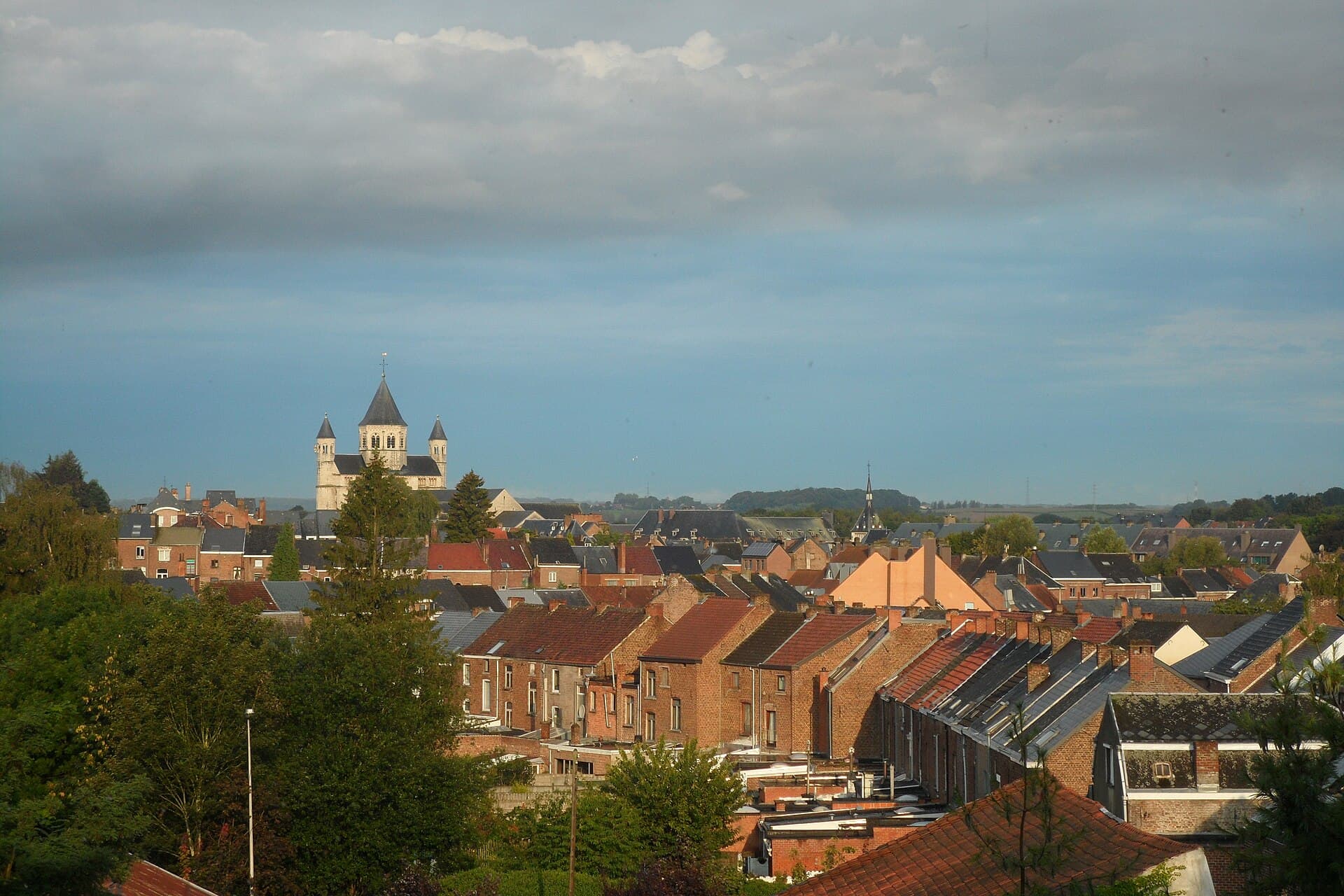 Ligne11 / CC BY-SA 3.0, via Wikimedia Commons
Self-guided audio walking tour of Nivelles — GPS route, offline playback, story-driven narration in 32 languages.
“Where ancient echoes meet enduring folklore.”
Not the postcards. The stories even locals don't know — whispered in your ear, right where they happened.
Look up at the south tower of the Collegiate Church, and you'll spot a gilded figure marking the hours. This is no ordinary clockwork man.
Nivelles observes its own version of a celebrated Belgian carnival, complete with iconic costumed figures. Among the revelers, you might encounter a giant family with a remarkably long and dramatic story.
Inside the Collegiate Church of Saint Gertrude, a particular pier in Saint Gertrude's Chapel features a narrow aperture. It is said that only those with a specific blessing can pass through.
Discover every secret of Nivelles
Every address, every reveal in full — in your ear, right where it happened.
You pick your stops. You walk. The voice reveals what the others miss.


Your self-guided audio tour of Nivelles is ready — pick your landmarks, choose your language, and start the moment you arrive.
BuyLume has a built-in augmented-reality guide. Hold your phone up and its camera shows the street ahead of you, with a glowing arrow laid over the real view that always points to your next stop — no map to puzzle over, no wrong turns. Like everything in Lume, it works fully offline.
Nivelles, a city in Walloon Brabant, Belgium, offers a blend of medieval heritage and contemporary life. Its origins trace back to 650 CE with the founding of an abbey, which became a significant religious and cultural center. The city is French-speaking and serves as an industrial hub and railway junction, while preserving a notable architectural legacy.
At the heart of Nivelles stands the Collegiate Church of Saint Gertrude, a Romanesque masterpiece that commands the skyline and recounts the city's beginnings. Beyond its historical landmarks, Nivelles is recognized for its local gastronomy, such as the 'tarte al djote,' and its lively folklore, including its carnival and processional giants.
The history of Nivelles begins around 4,000 BC with Danubian settlers who cultivated the land. The Romans arrived in the first century AD, constructing villas that were later destroyed during Germanic invasions in the 3rd century.
In the 7th century, Nivelles became part of the Frankish kingdom. Pippin of Landen, a powerful leader, established a large estate here. After his death in 640, his wife, Itta, founded an abbey on their land, with their daughter, Gertrude, becoming its first abbess. This Benedictine double monastery, initially housing both monks and nuns, swiftly gained prominence due to its ties to the influential Pippinid family. The abbey was among the most important in Europe until its closure during the French Revolutionary army's invasion in 1798.
By the 13th century, a city had grown around the church, becoming part of the Duchy of Brabant. Artisans and guild members often contended with the abbesses and dukes for more rights, which were eventually granted in the 14th century. However, an uprising by thread manufacturers in 1647 led many entrepreneurs to depart for France, contributing to the city's economic decline. The 17th century brought further hardship with numerous attacks and occupations during various wars.
Nivelles played a role in the Belgian Revolution, being one of the first cities to send soldiers to Brussels in 1830. The subsequent years saw growth in heavy industry, particularly metalworking and railway construction. While some buildings were damaged during World War I, the city suffered extensive destruction on May 14, 1940, during World War II, when almost the entire city center was destroyed, leaving only the walls of the collegiate church standing. The church was rebuilt and completed in 1984.
The Collegiate Church of Saint Gertrude is the paramount attraction in Nivelles. This Romanesque church, consecrated in 1046, features an impressive 102-meter-long central nave and one of Europe's largest 11th-century crypts. Visitors can explore the archaeological basement, which reveals the remains of earlier churches and 7th-century Merovingian tombs. Observe the gilded automaton, Jean de Nivelles, on the south tower, marking the hours.
The Municipal Museum of Archaeology, Art and History of Nivelles is housed in an 18th-century mansion and displays the city's collection of paintings, sculptures, and furniture. For a green escape, Dodaine Park offers a pleasant space, historically significant as it was created in the early 19th century.
Consider a stroll through the Saint-James Quarter, a historic area once frequented by pilgrims on their way to Santiago de Compostela. You can still discern scallop shells, the symbol of St. James, on various building facades. The Simone Tower, a remnant of the former ramparts, is also worth seeing.
The most comfortable months to visit Nivelles, considering both temperature and rainfall, are June, July, and August. However, for optimal sightseeing and outdoor activities with pleasant weather, spring (April to June) and autumn (September to October) are recommended. These shoulder seasons offer mild temperatures, fewer crowds, and opportunities to experience local markets and festivals in late spring, or harvest events and quieter streets in autumn. Summers are comfortable and partly cloudy, with the warmest period lasting from June to early September.
Nivelles is generally a safe town, but it's advisable to be aware of your surroundings, especially in busier areas like the Grand Place, where pickpockets might be present. Keeping belongings secure in a crossbody bag is a good practice. While wandering in the early evening is pleasant, the atmosphere shifts as night falls.
For guided tours of the town, including the historic center, Dodaine Park, the museum, and Simone Tower, the Nivelles Tourist Office can arrange group visits in French, Dutch, English, and German upon request. Individual visitors can also obtain booklets for self-guided walks. The Tourist Office is located near the Grand Place at 48, Rue de Saintes.
Nivelles is approximately 40km south of Brussels and 40km north of Charleroi. It is accessible by car via the E19 or E420, and by train, it's about a 30-minute journey from Brussels or Charleroi.
Nivelles in Korean, in Chinese or in Hebrew — and 29 more languages, every stop narrated by a native voice. The widest language range of any self-guided audio tour.
Available in: