Bhagton ki Choti Haveli
This haveli, with its distinct yellow, blue, and green palette, holds a subtle nod to British colonial influence.
Full story unlocks in the tour
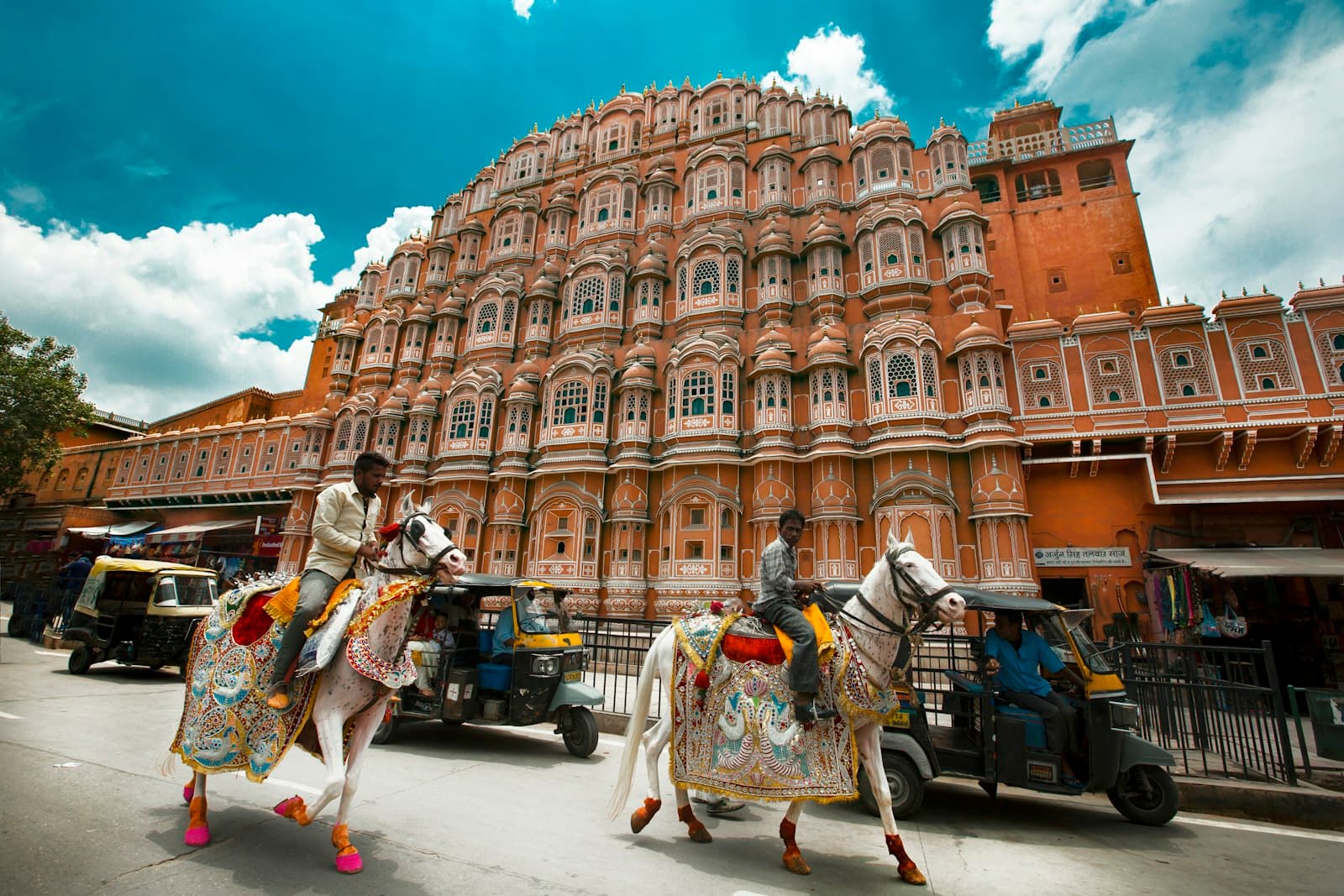 Photo: Aditya Siva / Unsplash
Self-guided audio walking tour of Nawalgarh — GPS route, offline playback, story-driven narration in 32 languages.
“Where every wall whispers a forgotten tale, and frescoes bloom in the desert air.”
Not the postcards. The stories even locals don't know — whispered in your ear, right where they happened.
This haveli, with its distinct yellow, blue, and green palette, holds a subtle nod to British colonial influence.
Among the 750 frescoes adorning the Podar Haveli, you will find an unexpected blend of ancient mythology and modern marvels.
Look closely at the entrance of this exquisitely refined haveli, and you might spot an unusual artistic choice for a traditional Indian mansion.
Discover every secret of Nawalgarh
Every address, every reveal in full — in your ear, right where it happened.
You pick your stops. You walk. The voice reveals what the others miss.
Your self-guided audio tour of Nawalgarh is ready — pick your landmarks, choose your language, and start the moment you arrive.
BuyLume has a built-in augmented-reality guide. Hold your phone up and its camera shows the street ahead of you, with a glowing arrow laid over the real view that always points to your next stop — no map to puzzle over, no wrong turns. Like everything in Lume, it works fully offline.
Nawalgarh, often called the "Golden City of Shekhawati," is a captivating town in Rajasthan's Jhunjhunu district, a living testament to a bygone era of wealth and artistic patronage. This small yet culturally rich destination is renowned for its exquisitely painted havelis—traditional mansions adorned with frescoes that narrate tales of Hindu mythology, daily life, and even early technological marvels.
Stepping into Nawalgarh is like entering an open-air art gallery, where every street and courtyard reveals intricate murals. While some travelers might bypass it for more popular Shekhawati towns, Nawalgarh offers a denser and better-preserved collection of these painted wonders, making it an ideal starting point for exploring the region's unique heritage.
## The Rise of a Trading Hub Nawalgarh's story begins in 1737 CE, when Thakur Nawal Singh Ji Bahadur, the younger son of Thakur Shardul Singh of Jhunjhunu, established a fortified town on the site of an earlier village called Rohili. As part of the Panchpana, or five estates of Jhunjhunu, Nawalgarh was strategically planned with high walls and four main gates—Bawadi, Mandi, Agoona, and Nansa—to protect its inhabitants and burgeoning trade. A central fort, Bala Kila, anchored the town, with a second outpost, Fatehgarh, located outside the walls.
Thakur Nawal Singh actively encouraged Marwari merchants from Jaipur and other regions to settle in his new town. This proved to be a pivotal decision, as Shekhawati lay along ancient caravan routes connecting inland India to western ports. With lighter taxes compared to neighboring states, Nawalgarh quickly attracted affluent business families like the Podars, Goenkas, and Mansingkas, becoming one of India's wealthiest trading centers.
## The Golden Age of Frescoes The prosperity brought by these merchants fueled an extraordinary artistic boom. The wealthy families, eager to display their status and devotion, commissioned elaborate frescoes to adorn their havelis. These murals, a defining characteristic of Shekhawati architecture, depicted a diverse range of subjects, from Hindu deities and mythological scenes to everyday life, royal processions, and even contemporary elements like steam trains and early automobiles. This artistic competition transformed Nawalgarh into an open-air art gallery, a canvas showcasing centuries of art, trade, and culture.
## A Fading Legacy By the late 19th and early 20th centuries, British trade policies and the development of new port cities like Mumbai and Kolkata shifted trade routes, diminishing the importance of Shekhawati's caravan paths. Consequently, many Marwari merchant families migrated to these larger urban centers for greater opportunities. While some havelis were maintained by caretakers, others were simply locked and left, leading to varying states of preservation today. Despite this, Nawalgarh remains a captivating destination, offering a unique glimpse into a rich historical and artistic legacy.
Nawalgarh is a treasure trove of art and architecture, best explored on foot due to its narrow lanes. Start your journey at the Dr. Ramnath A. Podar Haveli Museum, a meticulously restored mansion from 1902. It contains over 750 frescoes, showcasing everything from mythological scenes to early steam engines, alongside 19 thematic galleries on Rajasthani culture.
Just a short walk away is the Morarka Haveli, constructed around 1900. While more rustic, its charm lies in its original frescoes depicting Rajasthani royalty, Hindu gods, and notably, two portraits of Lord Jesus Christ. Do not miss the distinctive yellow, blue, and green hues of the 19th-century Bhagton ki Choti Haveli, which also features unique frescoes with a British influence.
Explore the Aath Haveli Complex, a cluster of mansions on the western side of Nawalgarh Fort, recognized for its diverse fresco styles. The Sheesh Mahal, or 'Palace of Mirrors', is another architectural marvel with a ceiling mural depicting maps of Nawalgarh and Jaipur. For a glimpse into the town's defensive past, visit the Nawalgarh Fort, established in 1737. Beyond the prominent havelis, a leisurely stroll through the town's lanes will reveal countless other smaller havelis, each with its own fading beauty and stories etched into their walls.
The optimal time to visit Nawalgarh is during the cooler months, from October to March. During this period, the weather is pleasant and mild, with average daytime temperatures around 26 degrees Celsius, making it ideal for walking through the town's lanes and exploring the havelis. The colors of the frescoes are particularly striking in the winter light. Summers, from April to June, are extremely hot, with temperatures often exceeding 40 degrees Celsius, and are best avoided. The monsoon season, from July to September, brings light rainfall, which can sometimes green the surrounding landscape.
Nawalgarh is well-connected and can be reached by various means. The nearest airport is Jaipur International Airport (JAI), approximately 140 km away. From Jaipur, you can travel to Nawalgarh by train or road, with the journey taking around 2.5 hours by car or bus. Nawalgarh has its own railway station, but Jhunjhunu (around 30 km away) is a major railway hub.
Within Nawalgarh, the best way to explore is on foot, as the town is compact and its lanes are narrow. Auto-rickshaws and cycle rickshaws are also available, though prices are negotiable. When visiting, carry sufficient cash as ATMs may be limited, and credit cards might not be accepted by smaller vendors. Dress modestly, especially when visiting religious sites, and be respectful of local customs. Hiring a local guide is highly recommended to gain deeper insights into the history and artistry of the havelis.
Nawalgarh in Korean, in Chinese or in Hebrew — and 29 more languages, every stop narrated by a native voice. The widest language range of any self-guided audio tour.
Available in: