Ruine Hinterhaus
The crumbling walls of Hinterhaus Castle hold a spectral secret, tied to a forbidden love and a broken vow.
Full story unlocks in the tour
 Isiwal / CC BY-SA 4.0, via Wikimedia Commons
Self-guided audio walking tour of Spitz — GPS route, offline playback, story-driven narration in 32 languages.
“Where the Danube widens and wine flows freely.”
Not the postcards. The stories even locals don't know — whispered in your ear, right where they happened.
The crumbling walls of Hinterhaus Castle hold a spectral secret, tied to a forbidden love and a broken vow.
This vineyard isn't just known for its exceptional wine; its name hints at a harvest almost too abundant to believe.
Look closely at Spitz's official emblem, and you might notice a surprising detail that reveals its historical allegiance.
Discover every secret of Spitz
Every address, every reveal in full — in your ear, right where it happened.
You pick your stops. You walk. The voice reveals what the others miss.


Your self-guided audio tour of Spitz is ready — pick your landmarks, choose your language, and start the moment you arrive.
BuyLume has a built-in augmented-reality guide. Hold your phone up and its camera shows the street ahead of you, with a glowing arrow laid over the real view that always points to your next stop — no map to puzzle over, no wrong turns. Like everything in Lume, it works fully offline.
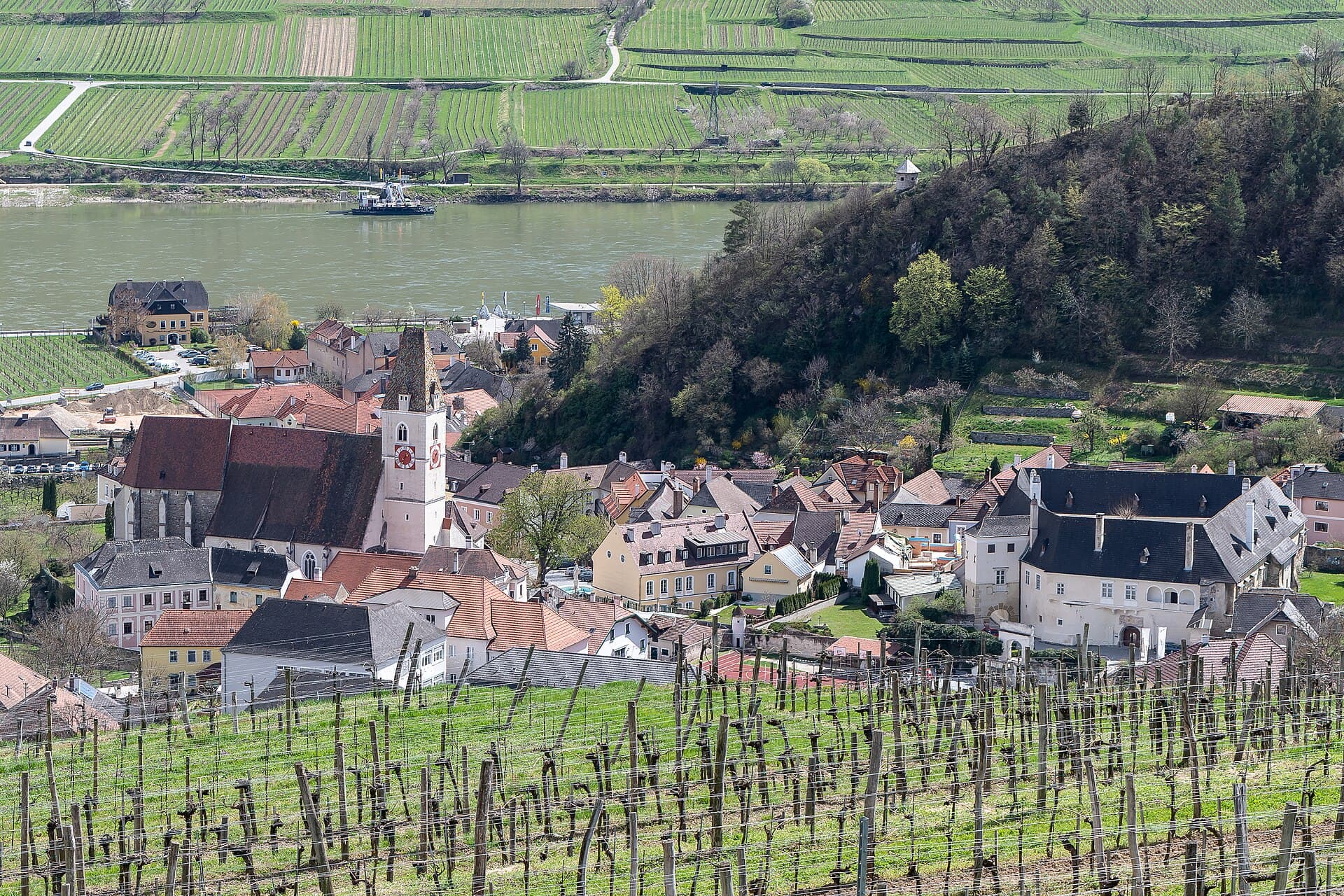
Spitz an der Donau, a market town in Austria's UNESCO World Heritage Wachau Valley, offers a compelling blend of natural splendor, ancient chronology, and viticultural tradition. The town, situated on the left bank of the Danube River, is characterized by its terraced vineyards, medieval remnants, and a tranquil riverfront. Spitz provides a serene escape, inviting visitors to immerse themselves in the region's celebrated white wines, particularly Grüner Veltliner and Riesling, and to wander its appealing village paths.
Unlike some of its more frequented Wachau neighbors, Spitz retains a quieter, more genuine atmosphere, allowing for a slower pace of discovery. The expansive riverbank area here, where the Wachau valley broadens, has drawn settlers for millennia, with archaeological evidence extending back 40,000 years, including the oldest human skeleton found on Austrian soil. This profound historical presence, combined with its scenic setting, makes Spitz an ideal destination for those seeking both repose and exploration.
The earliest human presence in the Spitz area dates back approximately 40,000 years, with archaeological findings suggesting continuous settlement since Celtic times. The town itself was first formally mentioned in 830 CE. For nearly 700 years, from 812 to 1504 CE, Spitz was a Bavarian enclave, governed by the Niederaltaich Abbey in Germany. This distinctive historical allegiance is even reflected in the town's coat of arms, which displays a white-blue Bavarian pattern.
Throughout the centuries, Spitz has been shaped by its strategic location on the Danube and its fertile wine-growing lands. The 12th-century Ruine Hinterhaus, a prominent castle ruin overlooking the town, stands as a testament to the region's medieval past. The castle was expanded and modified by the Knights of Spitz in the 13th and 14th centuries. The Late Gothic parish church of St. Maurice, dating from the 15th century, is another significant historical landmark, known for its 1380 Apostles and an altarpiece by Kremser Schmidt.
By the mid-16th century, Spitz became a center of the Reformation, with a Protestant church built in 1550. The town also played a crucial role in river trade; the Old Shipmaster's House, an inn since 1680, hints at the importance of rafting, transporting timber and firewood from the Waldviertel to Vienna until 1953. Today, Spitz is recognized as part of the UNESCO World Heritage Wachau Valley, a designation received in 2000, celebrating its unique cultural landscape and historical significance.
Begin your exploration in Kirchenplatz, the village square, a pleasant starting point for many of Spitz's attractions and hiking trails. The late Gothic St. Maurice Parish Church, with its distinctive bent chancel, is a notable architectural feature. Nearby, the Schifffahrtsmuseum (Maritime Museum), housed in the baroque Erlahof, details the history of Danube river traffic, including how horses once pulled ships along the river.
A short uphill walk leads to the impressive Ruine Hinterhaus, a 12th-century castle ruin offering expansive views of the Danube and surrounding vineyards. For even more sweeping vistas, hike the Tausendeimerberg, or 'Hill of a Thousand Buckets,' a legendary vineyard that provides wide views of Spitz and the Wachau Valley. Do not miss the Red Gate, another ruin from the Thirty Years' War, which offers fine viewpoints. Afterwards, unwind with a stroll along the Donaulände, the pedestrian path along the Danube, where locals often swim in warmer months.
The best times to visit Spitz are during mid-spring (April to June) or early autumn (September to October). During these periods, the weather is mild and agreeable, perfect for outdoor activities like hiking and cycling. Autumn is particularly appealing, as the vineyards glow golden for the grape harvest, and local wine festivals offer a chance to experience the region's traditions. These seasons also tend to have fewer crowds, allowing for a more relaxed visit.
Spitz is approximately 100 km (62 miles) from Vienna. You can reach Spitz by train from Vienna Westbahnhof to Melk, then connect via the Wachaubahn train, bus, cruise, or bike. By car, take the A1 from Vienna towards Salzburg, exiting at Melk, or follow the Danube upstream via A22, S5, S33, and then road 37a to Krems, then road 3. River cruise vessels typically dock directly at the Spitz pontoons along the Donaulände, a six-minute walk to the town square. The town is highly walkable, but comfortable shoes are recommended for vineyard trails and castle ruins. While many local wine taverns may not accept credit cards, ATMs are available in town, such as the Raiffeisenbank at Hauptstrasse 12.
Spitz in Korean, in Chinese or in Hebrew — and 29 more languages, every stop narrated by a native voice. The widest language range of any self-guided audio tour.
Available in: