Egon Schiele's Birthplace
The celebrated expressionist painter Egon Schiele spent his early years in Tulln, though not in a grand manor.
Full story unlocks in the tour
 GuentherZ / CC BY 3.0, via Wikimedia Commons
Self-guided audio walking tour of Tulln — GPS route, offline playback, story-driven narration in 32 languages.
“Where ancient Roman foundations meet modern art and flourishing gardens along the Danube.”
Not the postcards. The stories even locals don't know — whispered in your ear, right where they happened.
The celebrated expressionist painter Egon Schiele spent his early years in Tulln, though not in a grand manor.
Tulln carries a surprising connection to one of Europe's most famous medieval epic poems.
A colorful, unusual ship designed by a renowned Austrian artist found its permanent home in Tulln.
Discover every secret of Tulln
Every address, every reveal in full — in your ear, right where it happened.
You pick your stops. You walk. The voice reveals what the others miss.

Your self-guided audio tour of Tulln is ready — pick your landmarks, choose your language, and start the moment you arrive.
BuyLume has a built-in augmented-reality guide. Hold your phone up and its camera shows the street ahead of you, with a glowing arrow laid over the real view that always points to your next stop — no map to puzzle over, no wrong turns. Like everything in Lume, it works fully offline.
Tulln an der Donau, often called the 'City of Flowers,' is an Austrian town that gracefully blends a Roman past with a lively present of art and horticulture. Situated on the southern bank of the Danube River in Lower Austria, Tulln offers a relaxed atmosphere with its extensive green spaces and beautifully maintained riverside promenade.
This historic district capital serves as a hub for the region, providing both a high quality of life for its residents and a diverse range of leisure activities for visitors. From exploring ancient Roman fortifications to admiring the works of its most famous son, expressionist painter Egon Schiele, Tulln invites a deeper look.
The town's commitment to green living is evident in its many parks and the renowned GARTEN TULLN, Europe's first ecological garden show. Whether drawn to historical narratives, artistic expressions, or simply the tranquility of riverside gardens, Tulln offers a unique and enriching experience.
Tulln's story stretches back two millennia, rooted in its strategic location along the Danube. In the 1st century AD, it was established as the Roman cavalry fort 'Comagenis,' a crucial part of the Danube Limes, the northern border of the Roman Empire. This fort protected the region and controlled a militarily significant ford. Archaeological finds from this period, including the Roman Tower and remnants of the eastern camp double gate, can be explored in the Roman Museum.
By the end of the 8th century, Tulln was already recognized as an urban settlement. Its importance grew in the 11th century when the Babenberg dynasty made it a residence, leading to its flourishing as a trading center. Tulln even earned a mention in the epic 'Song of the Nibelungs,' written around 1200, depicting a legendary meeting between King Etzel and Kriemhild within its bounds. The town was granted city rights in 1270, solidifying its status as one of Austria's oldest cities.
The subsequent centuries brought challenges, including Turkish invasions, floods, and the Thirty Years' War, which led to a decline in its significance. However, the construction of the Franz Josef Railway and a Danube bridge in the 1870s spurred a new era of growth. The 19th century saw population growth and the demolition of city walls, allowing for urban expansion. Tulln became a regional center for trade and commerce.
The 20th century marked the beginning of industrialization with the establishment of a sugar factory in 1936. World War II brought destruction, including a bombing raid in December 1944 and the demolition of the Danube bridge in April 1945. The city was occupied by the Red Army until 1955. In 1986, Tulln vied for the function of the Lower Austrian state capital, subsequently gaining numerous state capital functions in agriculture, trade fairs, and civil protection, further cementing its regional importance. Today, Tulln is celebrated for its historical depth, its artistic connections, particularly to Egon Schiele, and its identity as a flourishing 'City of Flowers' along the Danube.
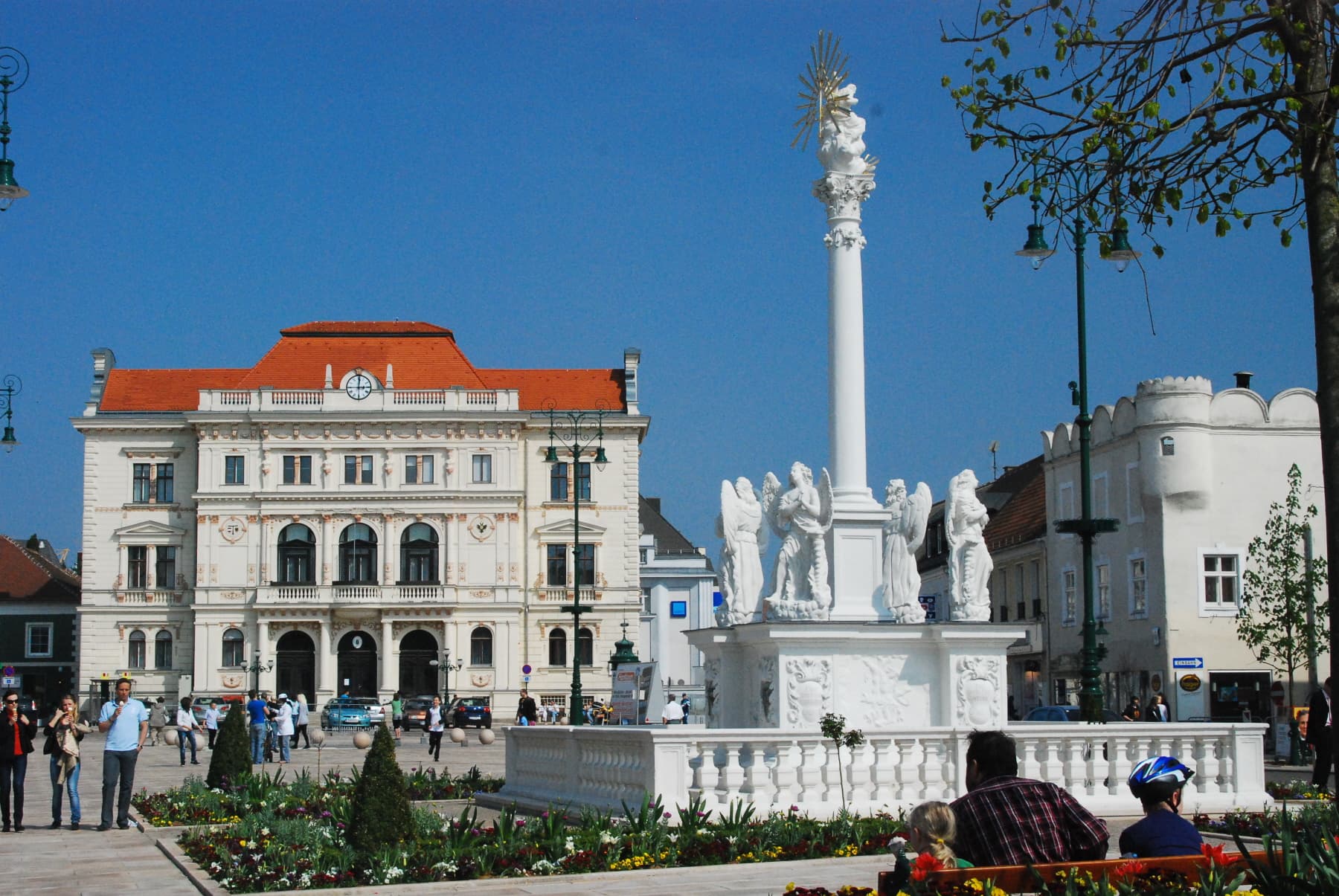
Begin your exploration in Tulln's historic Hauptplatz, a beautifully renovated main square featuring a Baroque Trinity Column and surrounded by buildings showcasing Gothic, Renaissance, and Baroque architectural styles. Nearby, the Pfarrkirche (Parish Church) of St. Stephan, originating from a 12th-century Romanesque basilica, presents a 13th-century west portal and a 1786 altarpiece. Adjoining the church is the remarkable Romanesque Charnel House, an eleven-sided funereal chapel from the mid-13th century, celebrated for its rich decoration and frescoes.
Stroll along the Donaulände, Tulln's picturesque Danube promenade, which offers scenic views and is home to several monuments, including the Nibelungen Monument and the Marcus Aurelius Monument. Here, you'll also find the Donaubühne, an open-air stage hosting concerts and events. Do not overlook the unique Hundertwasser Ship 'Regentag,' a colorful vessel designed by Friedensreich Hundertwasser, permanently moored in the guest harbor.
Delve into Tulln's Roman past at the Römermuseum (Roman Museum) in Marcus Aurelius Park, which provides insights into the Roman fort of Comagenis. Nearby, the Roman Tower, a 3rd-century horseshoe-shaped flank tower, stands as a tangible relic of the Roman frontier. For art enthusiasts, the Egon Schiele Museum at Donaulände 28 is dedicated to the town's famous expressionist painter, showcasing over 90 of his works and memorabilia. You can also visit Schiele's birthplace above the railway station, now a discovery world, and follow the Egon Schiele Trail through town.
Finally, immerse yourself in nature at GARTEN TULLN, Europe's first ecological garden show, featuring over 65 themed show gardens, a treetop trail, and an adventure playground. The adjacent natural water park and the idyllic Aubad recreational park offer further opportunities for relaxation and outdoor activities.
The ideal time to visit Tulln for warm-weather activities and general outdoor tourism is from mid-June to early September, with a peak in the second week of August. During these months, temperatures are comfortable, and the days are generally clear and rainless, perfect for exploring the gardens, riverside, and outdoor attractions. July is typically the warmest month, with an average high of 78°F (25°C), while January is the coldest, with an average low of 27°F (-3°C). May, June, and September are also appealing alternatives, offering pleasant weather and potentially fewer crowds than the peak summer months.
Tulln is easily accessible by train from Vienna and St. Pölten, with two train stations: 'Bahnhof Tulln' and 'Tulln Stadt.' The S40 regional train runs frequently, and faster Regional Express (REX) trains are also available. If arriving by air, Vienna-Schwechat Airport (VIE) is the closest international airport, with train connections to Tulln.
Once in Tulln, the town is easy to navigate on foot or by bike, especially along the Donaulände. The Tourist Information Office on Minoritenplatz offers free city maps, information on activities, dining, events, and e-bike rentals. You'll find a range of accommodation options, from hotels to guesthouses, with many located within walking distance of the city center and major attractions. For dining, Tulln offers numerous restaurants with idyllic pavement cafés, particularly around the main square.
Tulln in Korean, in Chinese or in Hebrew — and 29 more languages, every stop narrated by a native voice. The widest language range of any self-guided audio tour.
Available in: