Schloss Stuppach
A grand Austrian castle holds a secret about one of the most famous musical compositions in history.
Full story unlocks in the tour
 C.Stadler/Bwag / CC BY-SA 4.0, via Wikimedia Commons
Self-guided audio walking tour of Gloggnitz — GPS route, offline playback, story-driven narration in 32 languages.
“Where alpine engineering met imperial ambition.”
Not the postcards. The stories even locals don't know — whispered in your ear, right where they happened.
A grand Austrian castle holds a secret about one of the most famous musical compositions in history.
Before it became a popular wedding venue and exhibition space, this imposing structure served a different, more spiritual purpose for centuries.
This UNESCO World Heritage site isn't just a feat of engineering; its construction involved an unexpected workforce.
Discover every secret of Gloggnitz
Every address, every reveal in full — in your ear, right where it happened.
You pick your stops. You walk. The voice reveals what the others miss.
Your self-guided audio tour of Gloggnitz is ready — pick your landmarks, choose your language, and start the moment you arrive.
BuyLume has a built-in augmented-reality guide. Hold your phone up and its camera shows the street ahead of you, with a glowing arrow laid over the real view that always points to your next stop — no map to puzzle over, no wrong turns. Like everything in Lume, it works fully offline.
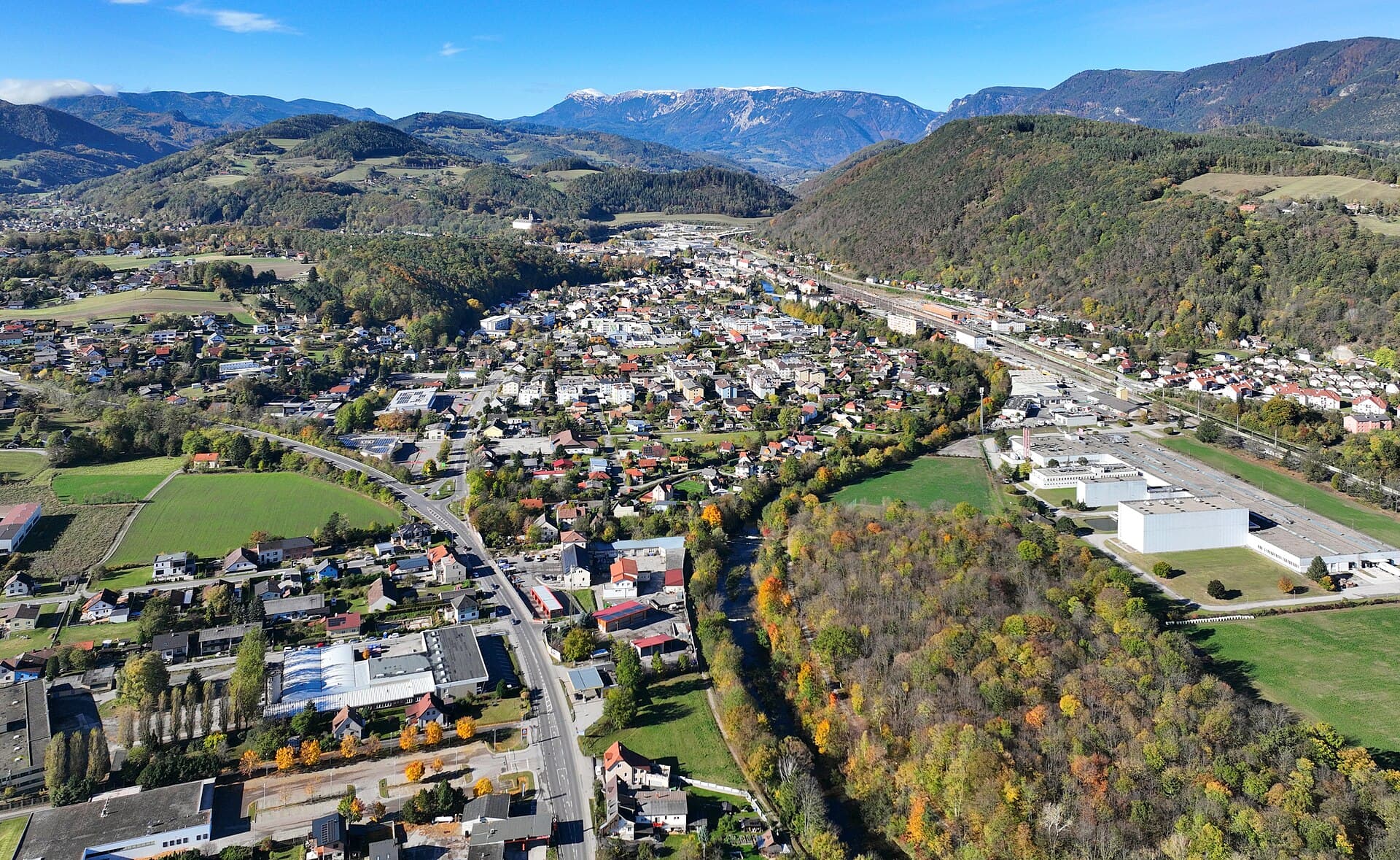
Gloggnitz, a captivating town in Lower Austria, rests in the southwestern reaches of the Vienna Basin, at the foothills of the Rax and Schneeberg mountains. Often known as the 'Town in the Mountains,' it serves as a portal to the Semmering-Rax region, celebrated for its dramatic alpine landscapes and enduring narrative.
This scenic location is not merely a sanctuary for those who seek the outdoors, offering extensive routes for hiking and cycling, but also a significant historical crossroads. Gloggnitz played a pivotal part in the construction of the Semmering Railway, a UNESCO World Heritage site, which transformed the region and forged a connection between Vienna and Trieste.
Beyond its natural splendor and engineering marvels, Gloggnitz possesses a cultural foundation shaped by centuries of monastic influence and the lives of prominent Austrian figures. From medieval castles to contemporary museums, the town presents a compelling fusion of its past and present, inviting visitors to uncover its distinct character and tranquil surroundings.
The origins of Gloggnitz trace back to the Slavic word "Klokati," meaning "bubble" or "murmur," referring to a local river; the town first appeared in records in 1094. Monks from the Bavarian monastery of Formbach established a hermitage near the River Schwarza, leading to the creation of a provostry for Gloggnitz. For over nine centuries, until the 19th century, monastic lords profoundly shaped the town's economic and social fabric. Early inhabitants were active farmers, artisans, and even winemakers, though shifts in climate eventually rendered viticulture unprofitable.
Its strategic position on an arterial route between Lower Austria and Italy fostered development, and Gloggnitz earned the right to host its own market. Over the centuries, it welcomed notable visitors, including Emperor Leopold I in 1660 and Napoleon Bonaparte in 1809.
The 19th century ushered in a transformative era with the arrival of the railway. The construction of the Südbahn, the main rail route between Vienna and Trieste, and particularly the Semmering Railway, profoundly affected Gloggnitz. The inaugural train arrived in Gloggnitz on May 5, 1842, and the complete Semmering passage was established in 1854. This engineering achievement, the first standard-gauge mountain railway in Europe, was conceived by Carl Ritter von Ghega and constructed by some 20,000 workers, including women, over six demanding years. The railway not only eased trade but also opened the alpine scenery to Viennese tourists, sparking a significant population and building surge in Gloggnitz.
Gloggnitz was officially granted town status on May 5, 1926. The town has also been home to two distinguished Federal Presidents of Austria, Dr. Michael Hainisch and Dr. Karl Renner, with Renner residing there for 42 years. In 1992, Gloggnitz hosted the "Lower Austrian Landesausstellung," a significant exhibition that funded the restoration of the former monastery. Today, Gloggnitz continues as an important traffic junction and a popular destination for both national and international visitors, preserving its historical monuments and embracing its role as a portal to the Semmering-Rax region.
Begin your exploration at Gloggnitz Castle, a former Benedictine fortified monastery situated on a hill above the town. First mentioned in 1092, it now hosts weddings, a restaurant, and a confectionery, with its inner courtyard and park, featuring two 150-year-old sequoia trees, freely accessible year-round.
A visit to Gloggnitz is incomplete without experiencing the Semmering Railway, a UNESCO World Heritage site. You can hike along sections of the railway trail, enjoying impressive viaducts and historic buildings, or visit the Gloggnitz railway station, a listed building and a popular starting point for hikers.
Delve into local history at the Dr. Karl Renner Museum, located in the former residence of Austria's first Federal President, offering insights into his life. For a different historical perspective, the Bread and Mill Museum allows you to explore the history of baking within a real mill.
Architectural enthusiasts will appreciate the Christ the King Church, designed by the renowned Austrian architect Prof. Clemens Holzmeister, and the ancient St. Othmar's Chapel, one of Gloggnitz's oldest buildings. For a touch of natural refreshment, the Naturbad Gloggnitz offers a natural swimming pool with clear water maintained by regeneration ponds and aquatic plants.
Consider Stuppach Palace, a significant baroque manor where Mozart's Requiem may have been premiered.
The most favorable time to visit Gloggnitz for general outdoor activities spans from late June to late August, with early August providing optimal conditions. During these months, the weather is comfortably warm, with average daily high temperatures above 18°C (65°F). For warmer weather activities, mid-July to mid-August is ideal, with average highs around 22°C (72°F). While July sees the most precipitation, clear skies are also more frequent. Winter offers a distinct allure, with Gloggnitz Castle hosting Advent markets and opportunities for winter walks, though some trails may be snowy or slick.
Gloggnitz is well-connected, positioned on the main Südbahn rail route and the S6 motorway, ensuring easy access from Vienna, which lies approximately 73-75 km distant by road. The Gloggnitz railway station serves as a crucial transport hub.
Within the town and surrounding area, the RUFbus Semmering-Rax offers convenient public transport to cultural attractions, excursion destinations, hiking trailheads, and accommodations. For those driving, parking is available, including at Gloggnitz Castle.
Accommodation options range from holiday rentals to hotels, catering to diverse preferences. Local amenities include restaurants, cafes, and shops, particularly useful for holiday shopping during the winter months.
Gloggnitz in Korean, in Chinese or in Hebrew — and 29 more languages, every stop narrated by a native voice. The widest language range of any self-guided audio tour.
Available in: