Villa Wartholz
This grand villa once served as the summer residence for an Austrian Emperor, and it was here that his first son was born.
Full story unlocks in the tour
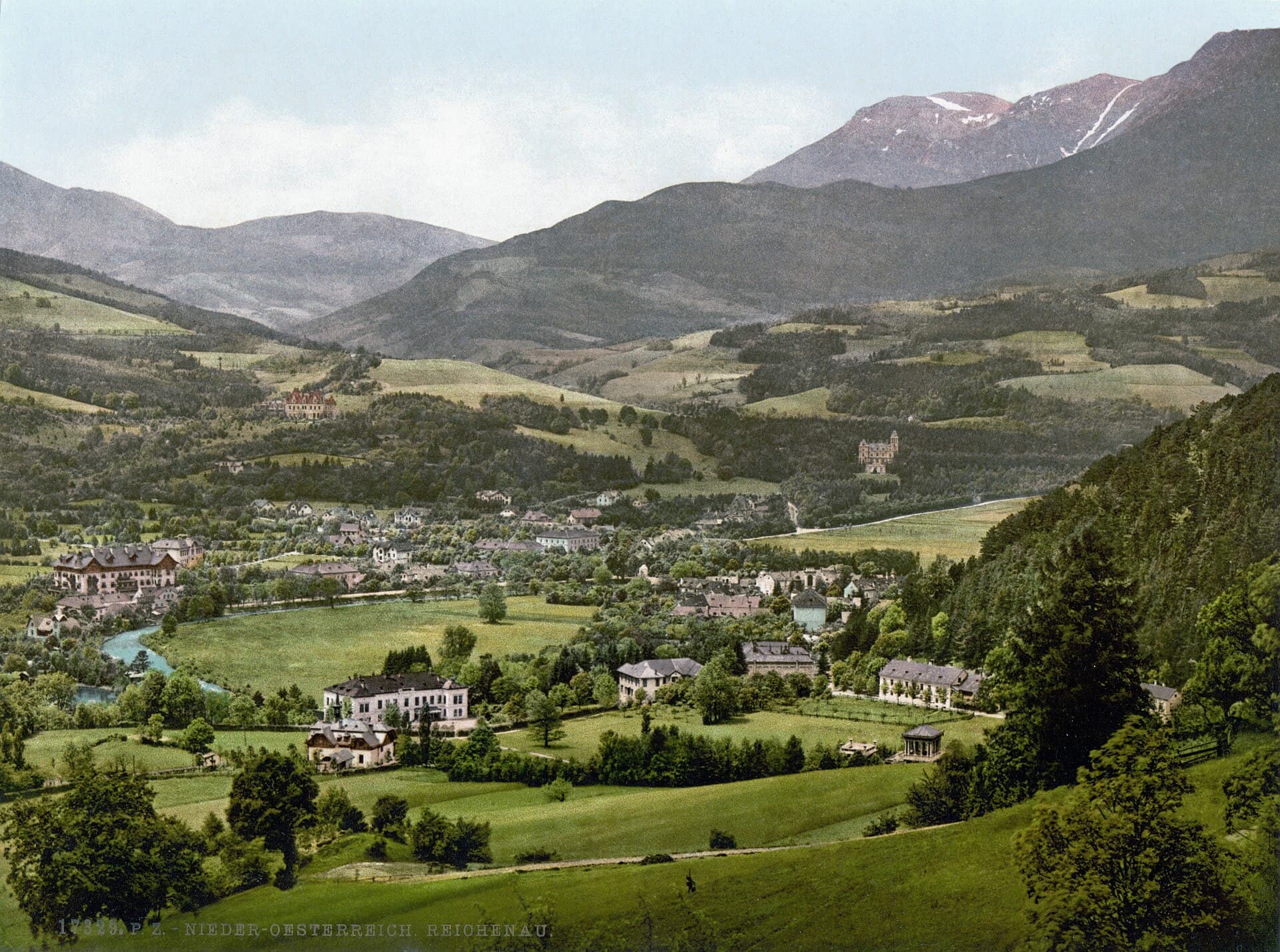 Unknown authorUnknown author / Public domain, via Wikimedia Commons
Self-guided audio walking tour of Reichenau an der Rax — GPS route, offline playback, story-driven narration in 32 languages.
“Where imperial elegance meets alpine wilderness.”
Not the postcards. The stories even locals don't know — whispered in your ear, right where they happened.
This grand villa once served as the summer residence for an Austrian Emperor, and it was here that his first son was born.
A prominent Rothschild constructed a magnificent palace here, only to donate it shortly thereafter.
This narrow-gauge railway is not merely scenic; it provided a vital link to Vienna's drinking water supply.
Discover every secret of Reichenau an der Rax
Every address, every reveal in full — in your ear, right where it happened.
You pick your stops. You walk. The voice reveals what the others miss.
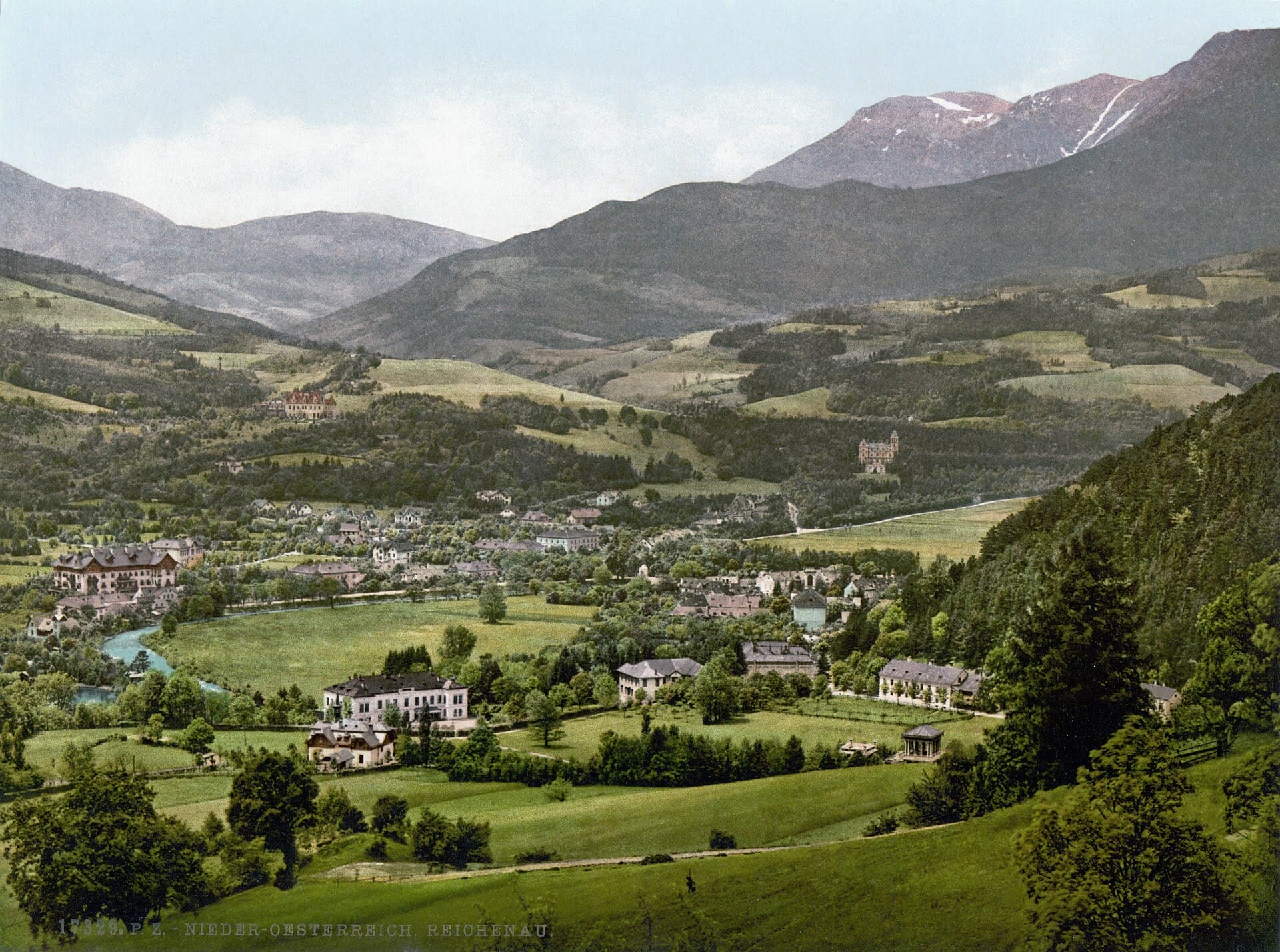
Your self-guided audio tour of Reichenau an der Rax is ready — pick your landmarks, choose your language, and start the moment you arrive.
BuyLume has a built-in augmented-reality guide. Hold your phone up and its camera shows the street ahead of you, with a glowing arrow laid over the real view that always points to your next stop — no map to puzzle over, no wrong turns. Like everything in Lume, it works fully offline.
Reichenau an der Rax, a market town in Lower Austria, rests at the foot of the magnificent Rax mountain range, traversed by the Schwarza river. Recognized as a climatic health resort, its scenic surroundings and crisp mountain air have long attracted visitors seeking repose and inspiration. The town's elevation, ranging from 484 to 680 meters above sea level, contributes to its invigorating atmosphere.
Once a region centered on ore mining and forestry, Reichenau an der Rax evolved into a fashionable summer retreat for Viennese nobility and intellectuals in the 19th century. This transformation was significantly aided by the opening of the Semmering railway line in 1854, connecting it to Vienna. Today, Reichenau an der Rax continues to intertwine outdoor exploration with cultural heritage, presenting an experience where alpine landscapes meet imperial history.
## From Medieval Stronghold to Imperial Retreat Reichenau an der Rax possesses a history that reaches back to the 13th century, with Reichenau Castle first appearing in documented records in 1256. The castle's early history saw it acquired by Duke Otto IV the Merry in 1333, who then granted it to the Neuberg Abbey. For over four and a half centuries, Cistercian monks resided there, often using the castle as a preferred dwelling due to the region's agreeable climate.
The 19th century marked a pivotal transformation for Reichenau. What was once an area primarily engaged in ore mining and forestry began to draw the Viennese elite. The completion of the Semmering railway line in 1854, with a station in nearby Payerbach, dramatically improved accessibility from Vienna, cementing Reichenau's status as a premier summer resort.
This period saw a flurry of construction by prominent figures. In 1872, Archduke Charles Louis of Austria commissioned the elegant Villa Wartholz, which would later serve as a summer residence for Emperor Charles and Empress Zita, and where their first son, Otto von Habsburg, was born. Nathaniel Anselm von Rothschild followed suit in 1889 with the construction of Hinterleiten Palace, though he eventually donated it to a veterans' foundation.
Reichenau's appeal extended beyond royalty and aristocracy; it became a sanctuary for intellectuals and artists. Literary figures like Arthur Schnitzler and Heimito von Doderer, and even Sigmund Freud, discovered inspiration in its serene surroundings. The Thalhof, a historic hotel, became a notable gathering place for these minds.
The early 20th century brought further developments, including the direct connection to Payerbach via the Höllentalbahn narrow-gauge railway and the opening of the Raxseilbahn in 1926, Austria's first aerial tramway for tourists. In 1988, the town established the Reichenau Festival, one of Austria's most important theater festivals, continuing its legacy as a cultural destination.
Begin your exploration at Reichenau Castle, a historic stronghold dating back to 1256. Today, it functions as a lively cultural and event center, hosting exhibitions, concerts, and readings. Be sure to experience the permanent exhibition, "Reichenau's Cultural Heritage—From a Traditional Mining Town to an International Spa and Festival Destination," which provides a thorough examination of the region's past.
An essential experience is a ride on the Rax Cable Car (Raxseilbahn), Austria's oldest aerial tramway for tourists, which transports you to the Rax plateau. Once at the summit, explore the Raxalpe, a high plateau ideal for hiking and appreciating expansive alpine views. You can embark on 'hut hopping' journeys, traversing marked trails and visiting mountain huts like the Raxalpen-Berggasthof or Otto-Schutzhaus.
For a scenic walk, follow sections of the 1st Vienna Water Pipeline Trail through the Höllental valley, where you can admire rugged rock faces and the engineering marvel that provides Vienna with mountain water. Consider a ride on the Höllentalbahn museum railroad, a four-axle passenger railcar offering picturesque views of the Rax. Also, seek out Villa Wartholz, a former imperial summer residence, and its charming café and garden boutique.
The most favorable time to visit Reichenau an der Rax for agreeable weather and outdoor pursuits like hiking is from May through September. During these summer months, days are long, paths are accessible, and public transport connections are reliable, with mountain huts and restaurants typically operating. For those seeking fewer crowds and a quieter experience, the shoulder seasons of April-May and October-November present a landscape in transition with clear paths and changing light. Winter (December-March) offers opportunities for snowshoeing and a more tranquil, reduced experience, though many paths may be impassable and public transport less frequent.
Reichenau an der Rax is readily accessible by train from Vienna. Direct train connections depart every half hour from Vienna Hauptbahnhof to Payerbach-Reichenau, taking approximately one hour and 40 minutes. From Payerbach, a short five-minute bus ride will bring you to Reichenau. Once in Reichenau, supermarkets are available in the town center for provisions. For those planning hikes on the Rax, mountain huts along the routes offer food and shelter. Weather-appropriate clothing is advisable, particularly for mountain excursions. Network coverage is generally reliable on main paths, but it is always prudent to plan return journeys and remain flexible, especially during quieter seasons. In case of emergency, mountain rescue can be reached by dialing 140.
Reichenau an der Rax in Korean, in Chinese or in Hebrew — and 29 more languages, every stop narrated by a native voice. The widest language range of any self-guided audio tour.
Available in: