The name 'Sombrerete'
How did Sombrerete acquire its distinctive name?
Full story unlocks in the tour
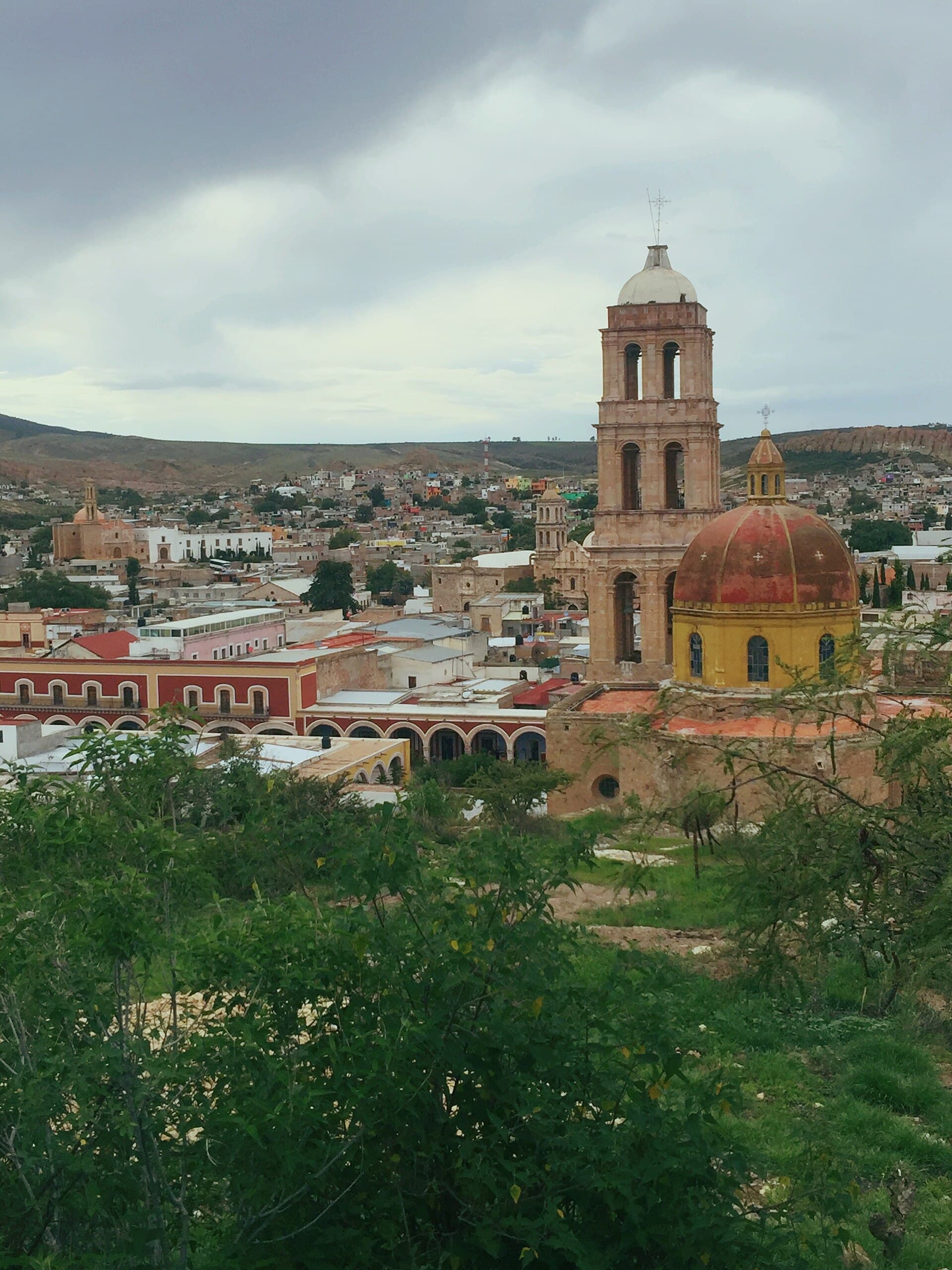 Tomás Esparza / CC BY-SA 4.0, via Wikimedia Commons
Self-guided audio walking tour of Sombrerete — GPS route, offline playback, story-driven narration in 32 languages.
“Where colonial grandeur meets dramatic desert landscapes.”
Not the postcards. The stories even locals don't know — whispered in your ear, right where they happened.
How did Sombrerete acquire its distinctive name?
Local lore suggests the initial silver discovery here was not through excavation, but by chance.
This 16th-century chapel holds a secret beneath its floorboards.
Discover every secret of Sombrerete
Every address, every reveal in full — in your ear, right where it happened.
You pick your stops. You walk. The voice reveals what the others miss.


Your self-guided audio tour of Sombrerete is ready — pick your landmarks, choose your language, and start the moment you arrive.
BuyLume has a built-in augmented-reality guide. Hold your phone up and its camera shows the street ahead of you, with a glowing arrow laid over the real view that always points to your next stop — no map to puzzle over, no wrong turns. Like everything in Lume, it works fully offline.
Sombrerete, a captivating Pueblo Mágico in the state of Zacatecas, Mexico, offers a journey back in time. Established in 1555 as a Spanish mining center, its abundant silver deposits swiftly elevated it to one of New Spain's most important towns. Today, its meticulously preserved historic center, alongside La Noria de San Pantaleón and the dramatic Sierra de Órganos National Park, is recognized as a UNESCO World Heritage Site, forming part of the Camino Real de Tierra Adentro, the historic 'Royal Inland Road' or 'Silver Trail'.
At an elevation of approximately 2,500 meters (8,200 feet), Sombrerete experiences a cool and comfortable climate for much of the year. The town's colonial layout, with its broad avenues, narrow passages, and numerous plazas, invites unhurried exploration. Beyond its architectural marvels, Sombrerete is a town deeply rooted in tradition, its social calendar significantly shaped by religious festivities, offering visitors an authentic glimpse into Mexican culture.
The story of Sombrerete begins in 1555, when Spanish conquistador Juan de Tolosa, accompanied by adventurers and Franciscan friars, established it as a mining center. The name itself, meaning 'little hat,' is said to have originated from a Franciscan friar, Jerónimo de Mendoza, who observed a nearby hill resembling a Spanish three-cornered hat. The discovery of abundant silver, gold, lead, tin, and mercury deposits rapidly transformed the settlement into a bustling and prosperous town.
By 1570, Sombrerete had grown sufficiently to be officially declared a town by the Audiencia de Guadalajara, initially named Villa de Llerena. The San Mateo monastery, established in 1567, became the principal religious center for the region, reflecting the significant influence of the Franciscan Order. The town's economic importance surged in the 17th century with the establishment of a Royal House to collect taxes from an expansive territory, even competing with the wealth of Zacatecas during its zenith. This prosperity fueled an architectural flourishing, resulting in the construction of numerous solidly built stone buildings, including impressive Baroque churches that still stand today.
While the mining boom eventually subsided, Sombrerete maintained political significance throughout the 19th century. During the Mexican War of Independence, many local miners discreetly supported the insurgents. In 1824, it was declared a city and a regional capital by the state of Zacatecas. It even served as the provisional capital of Zacatecas during the French Intervention and Reform War, with President Benito Juárez passing through in 1866. The town's architectural heritage was, in a sense, 'accidentally preserved' as the decline in mining wealth meant there were insufficient funds to demolish or modernize the colonial structures. In 2010, its historical center, along with La Noria de San Pantaleón and Sierra de Órganos National Park, was designated a UNESCO World Heritage Site as part of the Camino Real de Tierra Adentro. In 2012, Sombrerete received further recognition as a Pueblo Mágico, or 'Magical Town,' by the Mexican Secretariat of Tourism, acknowledging its distinctive cultural and historical importance.
Begin your exploration in Sombrerete's historic center, a UNESCO World Heritage site, where colonial-era buildings and plazas evoke a timeless atmosphere. Visit the 16th-century San Mateo monastery complex, which includes a church dedicated to Saint Francis of Assisi, notable for its gold-plated wooden altar. Explore the 18th-century Baroque churches of San Juan Bautista and Santo Domingo, both displaying intricate facades and valuable religious art. Do not overlook the Capilla de la Santa Veracruz, a 16th-century chapel with a distinctive, empty interior and over a hundred unidentified graves beneath its floor.
The Museum Villa de Llerena, housed in an 18th-century building, offers insights into the region's history with artifacts and photographs, including items related to Pancho Villa. Just beyond town, the Sierra de Órganos National Park awaits with its dramatic volcanic rock formations resembling immense organ pipes. This striking landscape, a favored destination for hiking and photography, has also served as a setting for numerous Western films. For a deeper dive into pre-Hispanic history, the Alta Vista Chalchihuites archaeological site, about an hour away, was once an important ceremonial center.
Sombrerete experiences a cool climate for most of the year due to its high altitude. The most favorable time to visit for comfortable weather and outdoor activities is during the dry season, from December to April. Spring (April-June) offers mild temperatures, ideal for exploring the town and its surroundings. Summers (July-August) are warmer and mark the rainy season, with increased precipitation, but also bring lively local events and festivals. Fall (September-November) provides pleasant weather with fewer tourists. Winters are cooler, offering a quieter experience for historical exploration.
Sombrerete is located approximately 168 km from the city of Zacatecas. You can reach Sombrerete by bus from Zacatecas (about 3 hours 45 minutes) or Durango (approximately 75 minutes). The downtown area is easily walkable, but a taxi may be necessary for excursions further afield, such as to Sierra de Órganos National Park. Spanish is the primary language spoken, though some English may be understood in tourist-oriented areas. The local currency is the Mexican Peso (MXN $). Average daily costs for travelers can range from $50-$100. Accommodations include hotels and guesthouses, with some options for camping or cabin rentals near Sierra de Órganos.
Sombrerete in Korean, in Chinese or in Hebrew — and 29 more languages, every stop narrated by a native voice. The widest language range of any self-guided audio tour.
Available in: